Propafenone Hydrochloride
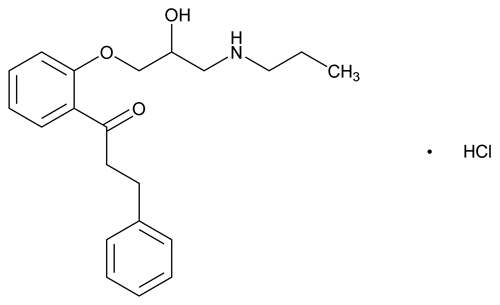
C21H27NO3·HCl 377.90
1-Propanone, 1-[2-[2-hydroxy-3-(propylamino)propoxy]phenyl]-3-phenyl-, hydrochloride;
2¢-[2-Hydroxy-3-(propylamino)propoxy]-3-phenylpropiophenone hydrochloride [34183-22-7].
(proe pa' fen one hye'' droe klor' ide).
+'&img=../../images/v35300/cas-34183-22-7.gif&casNumber=34183-22-7&usp=35&nf=30&chemicalStructureImage=true&ID='+parent.myID,600,500);)
C21H27NO3·HCl 377.90
1-Propanone, 1-[2-[2-hydroxy-3-(propylamino)propoxy]phenyl]-3-phenyl-, hydrochloride;
2¢-[2-Hydroxy-3-(propylamino)propoxy]-3-phenylpropiophenone hydrochloride
[34183-22-7].DEFINITION
Propafenone Hydrochloride contains NLT 98.0% and NMT 102.0% of C21H27NO3·HCl, calculated on the dried basis.
IDENTIFICATION
• B.
Dissolve 0.5 g of Propafenone Hydrochloride in 50 mL of water with heating. Adjust with 0.1 N sodium hydroxide to a pH of 9.5–10.0: a precipitate is formed. Cool the mixture, and filter. Add 1 mL of 6 N nitric acid and 2–3 drops of 0.1 N silver nitrate to the filtrate: a precipitate is formed, which dissolves upon the addition of a few drops of ammonium hydroxide.
ASSAY
• Procedure
Sample solution:
Transfer 250 mg of Propafenone Hydrochloride to a 125-mL flask. Dissolve in 30 mL of methanol, and add 15 mL of mercuric acetate TS.
Analysis:
Titrate with 0.1 N perchloric acid VS, determining the endpoint potentiometrically. Perform a blank determination, and make any necessary correction (see Titrimetry  541
541 ). Each mL of 0.1 N perchloric acid is equivalent to 37.79 mg of C21H27NO3·HCl.
541). Each mL of 0.1 N perchloric acid is equivalent to 37.79 mg of C21H27NO3·HCl.
Acceptance criteria:
98.0%–102.0% on the dried basis
IMPURITIES
Organic Impurities
• Procedure
Solvent A:
3.42 g/L of dipotassium hydrogen phosphate trihydrate. Adjust with phosphoric acid to a pH of 2.5.
Solvent B:
Acetonitrile
Mobile phase:
See the gradient table below.
| Time
(min) |
Solvent A
(%) |
Solvent B
(%) |
|---|---|---|
| 0 | 65 | 35 |
| 8 | 65 | 35 |
| 20 | 30 | 70 |
| 30 | 30 | 70 |
| 31 | 65 | 35 |
| 36 | 65 | 35 |
Diluent:
Solvent A and Solvent B (13:7)
System suitability solution:
0.1 mg/mL of USP Propafenone Hydrochloride RS and USP Propafenone Related Compound B RS in Diluent
Standard solution:
0.001 mg/mL of USP Propafenone Hydrochloride RS in Diluent
Sample solution:
1 mg/mL of Propafenone Hydrochloride in Diluent
Chromatographic system
Mode:
LC
Detector:
UV 220 nm
Column:
4.6-mm × 15-cm; 5-µm packing L7
Flow rate:
1 mL/min
Injection size:
20 µL
Run time:
NLT six times the retention time of propafenone
Suitability requirements
Resolution:
NLT 3 between propafenone and propafenone related compound B
Relative standard deviation:
NMT 5.0%
Analysis
Samples:
Standard solution and Sample solution
Calculate the percentage of each impurity in the portion of Propafenone Hydrochloride taken:
Result = (rU/rS) × 100
| rU | = | = peak response for each impurity from the Sample solution |
| rS | = | = peak response of propafenone from the Standard solution |
Acceptance criteria
Individual impurities:
See Impurity Table 1.
Total impurities:
NMT 0.3%. [Note—Disregard any peak below 0.03%. ]
Impurity Table 1
| Name | Relative Retention Time |
Acceptance Criteria, NMT (%) |
|---|---|---|
| Propafenone related compound Ba | 0.8 | 0.1 |
| Impurity Db | 2.3 | 0.1 |
| Impurity Gc | 3.6 | 0.1 |
| Impurity Cd | 4.1 | 0.1 |
| Impurity Fe | 5.3 | 0.1 |
| Individual unspecified impurities | — | 0.1 |
|
a
(2E)-1-[2-[(2RS)-2-Hydroxy-3-(propylamino)propoxy]phenyl]-3-phenylprop-2-en-1-one.
b
1-[2-[(2RS)-2,3-Dihydroxypropoxy]phenyl]-3-phenylpropan-1-one.
c
1,1¢[Propyliminobis(2-hydroxypropane-3,1-diyl)oxy-2,1-phenylene]bis(3-phenylpropan-1-one.
d
1-[2-[[(2RS)-Oxiranyl]methoxy]phenyl]-3-phenylpropan-1-one.
e
1,1¢-[2-Hydroxypropane-1,3-diylbis(oxy-2,1-phenylene)]bis(3-phenylpropan-1-one).
|
||
SPECIFIC TESTS
• Clarity of Solution:
Dissolve 1.0 g in 30 mL of hot water, and observe without delay: the solution initially is clear.
• Melting Range or Temperature 741:
171 –175
–175
741:
171–175
• pH 791:
5.0–6.2, in a solution (1 in 200)
791:
5.0–6.2, in a solution (1 in 200)
• Loss on Drying 731:
Dry a sample at 105 to constant weight: it loses NMT 0.5% of its weight.
731:
Dry a sample at 105 to constant weight: it loses NMT 0.5% of its weight.
ADDITIONAL REQUIREMENTS
• Packaging and Storage:
Preserve in tight, light-resistant containers, and store at a temperature between 15 and 30.
and 30.
• USP Reference Standards 11
11
USP Propafenone Hydrochloride RS 
') + '&img=../../images/v35300/cas-34183-22-7.gif',600,500);)
USP Propafenone Related Compound B RS
(RS,E)-1-[2-[2-Hydroxy-3-(propylamino)propoxy]phenyl]-3-phenylprop-2-en-1-one.
C21H25NO3 339.43
(RS,E)-1-[2-[2-Hydroxy-3-(propylamino)propoxy]phenyl]-3-phenylprop-2-en-1-one.
C21H25NO3 339.43
Auxiliary Information—
Please check for your question in the FAQs before contacting USP.
| Topic/Question | Contact | Expert Committee |
|---|---|---|
| Monograph | Sujatha Ramakrishna, Ph.D.
Senior Scientific Liaison 1-301-816-8349 |
(SM22010) Monographs - Small Molecules 2 |
| Reference Standards | RS Technical Services 1-301-816-8129 rstech@usp.org |
USP35–NF30 Page 4443
Pharmacopeial Forum: Volume No. 36(1) Page 129