Glycopyrrolate
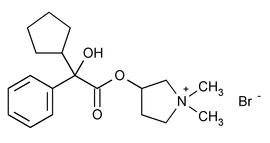
C19H28BrNO3 398.33
Pyrrolidinium, 3-[ (SR)-USP35(cyclopentylhydroxyphenylacetyl)oxy]-1,1-dimethyl-, [RS-]USP35 bromide;
(RS)-[3-(SR)-Hydroxy-1,1-dimethylpyrrolidinium bromide]  -cyclopentylmandelateUSP35
 [596-51-0].
The retention time of the major peak of the Sample solution corresponds to that of the Standard solution, as obtained in the Assay.USP35
Buffer:
Prepare a solution of 1.0 g of anhydrous sodium sulfate and 200 mg of sodium 1-hexanesulfonate monohydrate in 650 mL of water. To this solution add 3.0 mL of 1 N sulfuric acid, and mix.
• Ordinary Impurities
[596-51-0].
The retention time of the major peak of the Sample solution corresponds to that of the Standard solution, as obtained in the Assay.USP35
Buffer:
Prepare a solution of 1.0 g of anhydrous sodium sulfate and 200 mg of sodium 1-hexanesulfonate monohydrate in 650 mL of water. To this solution add 3.0 mL of 1 N sulfuric acid, and mix.
• Ordinary Impurities  466
466 • Organic Impurities
USP35
• Limit of Erythro Isomer
USP35
• Melting Range or Temperature, Class I 741:
193
• Organic Impurities
USP35
• Limit of Erythro Isomer
USP35
• Melting Range or Temperature, Class I 741:
193 –198, but the range between beginning and end of melting does not exceed 2.USP35
Store at room temperature.USP35
11
USP Glycopyrrolate Related Compound A RS
–198, but the range between beginning and end of melting does not exceed 2.USP35
Store at room temperature.USP35
11
USP Glycopyrrolate Related Compound A RS
5-Nitrobenzene-1,3-dicarboxylic acid.
C8H5NO6 211.13
USP35
(glye'' koe pir' oh late).
Change to read:
+'&img=../../images/v35300/g-386.gif&casNumber=596-51-0&usp=35&nf=30&chemicalStructureImage=true&ID='+parent.myID,600,500);)
C19H28BrNO3 398.33
Pyrrolidinium, 3-[
(SR)-USP35(cyclopentylhydroxyphenylacetyl)oxy]-1,1-dimethyl-, [RS-]USP35 bromide;
(RS)-[3-(SR)-Hydroxy-1,1-dimethylpyrrolidinium bromide] -cyclopentylmandelateUSP35
[596-51-0].DEFINITION
Change to read:
Glycopyrrolate USP35 contains NLT 98.0% and NMT 102.0%USP35 of C19H28BrNO3, calculated on the dried basis.USP35
USP35 contains NLT 98.0% and NMT 102.0%USP35 of C19H28BrNO3, calculated on the dried basis.USP35IDENTIFICATION
Change to read:
• B.
The retention time of the major peak of the Sample solution corresponds to that of the Standard solution, as obtained in the Assay.USP35
• C. Identification Tests—General, Bromide 191
191
Sample solution:
25 mg/mL
Acceptance criteria:
Meets the requirements
ASSAY
Change to read:
• Procedure
Buffer:
Prepare a solution of 1.0 g of anhydrous sodium sulfate and 200 mg of sodium 1-hexanesulfonate monohydrate in 650 mL of water. To this solution add 3.0 mL of 1 N sulfuric acid, and mix.
Mobile phase:
Acetonitrile, methanol, and Buffer (20:15:65)
Standard solution:
0.1 mg/mL of USP Glycopyrrolate RS in Mobile phase
Sample solution:
0.1 mg/mL of Glycopyrrolate in Mobile phase
Chromatographic system
Mode:
LC
Detector:
UV 222 nm
Column:
4.6-mm × 15-cm; 5-µm packing L1
Column temperature:
40
Flow rate:
1.2 mL/min
Injection size:
50 µL
System suitability
Sample:
Standard solution
Suitability requirements
Tailing factor:
NMT 2.0
Relative standard deviation:
NMT 1.0%
Analysis
Samples:
Standard solution and Sample solution
Calculate the percentage of glycopyrrolate (C19H28BrNO3) in the portion of Glycopyrrolate taken:
Result = (rU/rS) × (CS/CU) × 100
| rU | = | = peak response of Glycopyrrolate from the Sample solution |
| rS | = | = peak response of glycopyrrolate from the Standard solution |
| CS | = | = concentration of USP Glycopyrrolate RS in the Standard solution (mg/mL) |
| CU | = | = concentration of Glycopyrrolate in the Sample solution (mg/mL) |
Acceptance criteria:
98.0%–102.0% on the dried basisUSP35
USP35
IMPURITIES
• Residue on Ignition 281:
NMT 0.3%
281:
NMT 0.3%
Delete the following:
• Ordinary Impurities 466
Standard solutions:
0.05, 0.25, 0.5, and 1.0 mg/mL in alcohol
Sample solution:
50 mg/mL in alcohol
Eluant:
A mixture of ethyl acetate, water, and anhydrous formic acid (74:16:10)
Adsorbent:
Chromatographic silica gel
Application volume:
5 µL
Visualization:
Dry the plate at 105 for 15 min, followed by Visualization Technique 3; then air-dry the developed plate at room temperature for 2 h.
for 15 min, followed by Visualization Technique 3; then air-dry the developed plate at room temperature for 2 h.
Acceptance criteria:
The intensity of any secondary spot of the Sample solution corresponds to NMT 0.5%, and the sum of the intensities of all secondary spots of the Sample solution corresponds to NMT 2.0%.USP35
USP35
Add the following:
• Organic Impurities
Buffer:
Prepare a solution of 1.0 g of anhydrous sodium sulfate and 200 mg of sodium 1-hexanesulfonate monohydrate in 650 mL of water. To this solution add 3.0 mL of 1 N sulfuric acid, and mix.
Diluent:
Prepare a solution of 1.0 g of anhydrous sodium sulfate, 6.8 g of monobasic potassium phosphate, and 200 mg of sodium 1-hexanesulfonate monohydrate in 650 mL of water. To this solution add 3.0 mL of 1 N sulfuric acid, 150 mL of methanol, and 200 mL of acetonitrile, and mix. Adjust with phosphoric acid to a pH of 2.8.
Solution A:
Acetonitrile, methanol, and Buffer (20:15:65)
Solution B:
Acetonitrile, methanol, and Buffer (50:15:35)
Mobile phase:
See Table 1.
Table 1
| Time (min) |
Solution A (%) |
Solution B (%) |
|---|---|---|
| 0 | 100 | 0 |
| 10 | 100 | 0 |
| 25 | 10 | 90 |
| 35 | 10 | 90 |
| 37 | 100 | 0 |
| 45 | 100 | 0 |
Standard solution:
1.5 µg/mL each of USP Glycopyrrolate RS, USP Glycopyrrolate Related Compound A RS, USP Glycopyrrolate Related Compound B RS, and USP Glycopyrrolate Related Compound C RS in Diluent. Sonicate, if necessary, to facilitate dissolution.
Sample solution:
1.0 mg/mL of Glycopyrrolate in Diluent
Chromatographic system
Mode:
LC
Detector:
UV 222 nm
Column:
4.6-mm × 15-cm; 5-µm packing L1
Column temperature:
40
Flow rate:
1 mL/min
Injection size:
50 µL
System suitability
Sample:
Standard solution
Suitability requirements
Resolution:
NLT 2.0 between glycopyrrolate and glycopyrrolate related compound B
Tailing factor:
NMT 2.0 for the glycopyrrolate peak
Relative standard deviation:
NMT 6.0% for each peak
Analysis
Samples:
Standard solution and Sample solution
Calculate the percentage of glycopyrrolate related compounds A, B, and C in the portion of Glycopyrrolate taken:
Result = (rU/rS) × (CS/CU) × 100
| rU | = | = peak response of each related compound from the Sample solution |
| rS | = | = peak response of the corresponding related compound from the Standard solution |
| CS | = | = concentration of the corresponding related compound in the Standard solution (mg/mL) |
| CU | = | = concentration of Glycopyrrolate in the Sample solution (mg/mL) |
Calculate the percentage of any other individual impurity in the portion of Glycopyrrolate taken:
Result = (rU/rS) × (CS/CU) × 100
| rU | = | = peak response of each impurity from the Sample solution |
| rS | = | = peak response of glycopyrrolate from the Standard solution |
| CS | = | = concentration of USP Glycopyrrolate RS in the Standard solution (mg/mL) |
| CU | = | = concentration of Glycopyrrolate in the Sample solution (mg/mL) |
Acceptance criteria:
See Table 2.
Table 2
| Name | Relative Retention Time |
Acceptance Criteria, NMT (%) |
|---|---|---|
| 5-Nitroisophthalic acida | 0.45 | 0.15 |
| Glycopyrrolate | 1.00 | — |
| Glycopyrrolate baseb | 1.14 | 0.15 |
| Cyclopentylmandelic acidc | 2.68 | 0.15 |
| Any other individual impurity | — | 0.10 |
| Total impurities | — | 0.50 |
|
a
Glycopyrrolate related compound A.
b
Glycopyrrolate related compound B.
c
Glycopyrrolate related compound C.
|
||
USP35
Add the following:
• Limit of Erythro Isomer
Buffer:
2.8 g/L of monobasic sodium phosphate in water. Adjust with a sodium hydroxide solution (1 in 10) to a pH of 6.50 ± 0.05.
Mobile phase:
Methanol, acetonitrile, and Buffer (50:10:40)
System suitability solution:
40 µg/mL each of USP Glycopyrrolate Erythro Isomer RS and USP Glycopyrrolate RS in Mobile phase
Standard solution:
10 µg/mL of USP Glycopyrrolate RS in Mobile phase
Sample solution:
500 µg/mL of Glycopyrrolate in Mobile phase
Chromatographic system
Mode:
LC
Detector:
UV 222 nm
Column:
4.0-mm × 25-cm; 5-µm packing L45
Column temperature:
30
Flow rate:
1 mL/min
Injection size:
10 µL
System suitability
Samples:
System suitability solution and Standard solution
Suitability requirements
Resolution:
NLT 1.2 between the erythro isomer and glycopyrrolate, System suitability solution
Tailing factor:
NMT 2.0, Standard solution
Relative standard deviation:
NMT 6.0%, Standard solution
Analysis
Samples:
Standard solution and Sample solution
Calculate the percentage of erythro isomer in the portion of Glycopyrrolate taken:
Result = (rU/rS) × (CS/CU) × 100
| rU | = | = peak response of the erythro isomer from the Sample solution |
| rS | = | = peak response of glycopyrrolate from the Standard solution |
| CS | = | = concentration of USP Glycopyrrolate RS in the Standard solution (mg/mL) |
| CU | = | = concentration of Glycopyrrolate in the Sample solution (mg/mL) |
Acceptance criteria:
See Table 3.
Table 3
| Name | Relative Retention Time |
Acceptance Criteria, NMT (%) |
|
|---|---|---|---|
| Erythro isomer (R,R/S,S-glycopyrrolate)a | 0.89 | 0.4 | |
| Glycopyrrolate | 1.00 | — | |
|
a
USP Glycopyrrolate Erythro Isomer RS.
|
|||
USP35SPECIFIC TESTS
Delete the following:
• Melting Range or Temperature, Class I 741:
193–198, but the range between beginning and end of melting does not exceed 2.USP35
• Loss on Drying 731:
Dry at 105 for 3 h: it loses NMT 0.5% of its weight.
731:
Dry at 105 for 3 h: it loses NMT 0.5% of its weight.
ADDITIONAL REQUIREMENTS
Change to read:
• Packaging and Storage:
Preserve in tight containers. Store at room temperature.USP35
Change to read:
• USP Reference Standards 11
USP Glycopyrrolate RS 
') + '&img=../../images/v35300/cas-596-51-0.gif',600,500);) USP Glycopyrrolate Related Compound A RS
USP Glycopyrrolate Related Compound A RS
5-Nitrobenzene-1,3-dicarboxylic acid.
C8H5NO6 211.13
USP Glycopyrrolate Related Compound B RS
1-Methylpyrrolidin-3-yl-2-cyclopentyl-2-hydroxy-2-phenylacetate.
C18H25NO3 303.40
1-Methylpyrrolidin-3-yl-2-cyclopentyl-2-hydroxy-2-phenylacetate.
C18H25NO3 303.40
USP Glycopyrrolate Related Compound C RS
2-Cyclopentyl-2-hydroxy-2-phenylacetic acid.
C13H16O3 220.26
2-Cyclopentyl-2-hydroxy-2-phenylacetic acid.
C13H16O3 220.26
USP Glycopyrrolate Erythro Isomer RS
(RS)-3-[(RS)-2-cyclopentyl-2-hydroxy-2-phenylacetoxy]-1,1-dimethylpyrrolidinium bromide.
C19H28BrNO3 398.33
(RS)-3-[(RS)-2-cyclopentyl-2-hydroxy-2-phenylacetoxy]-1,1-dimethylpyrrolidinium bromide.
C19H28BrNO3 398.33
USP35
Auxiliary Information—
Please check for your question in the FAQs before contacting USP.
| Topic/Question | Contact | Expert Committee |
|---|---|---|
| Monograph | Elena Gonikberg, Ph.D.
Principal Scientific Liaison 1-301-816-8251 |
(SM32010) Monographs - Small Molecules 3 |
| Reference Standards | RS Technical Services 1-301-816-8129 rstech@usp.org |
USP35–NF30 Page 3356
Pharmacopeial Forum: Volume No. 37(1)