Vinblastine Sulfate
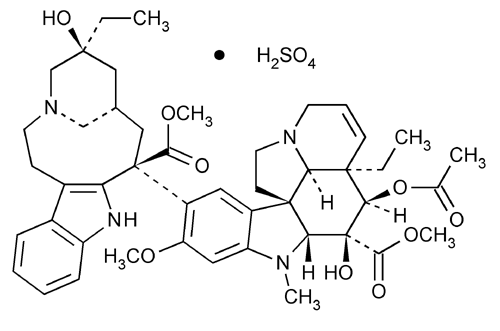
 909.07
Vincaleukoblastine, sulfate (1:1) (salt).
Vincaleukoblastine sulfate (1:1) (salt)
[143-67-9].» Vinblastine Sulfate contains not less than 96.0 percent and not more than 102.0 percent of C46H58N4O9·H2SO4, corrections being applied for loss in weight.
Caution—Handle Vinblastine Sulfate with great care, because it is a potent cytotoxic agent.
Packaging and storage—
Preserve in tight, light-resistant containers, in a freezer.
Labeling—
Where it is intended for use in preparing injectable dosage forms, the label states that it is sterile or must be subjected to further processing during the preparation of injectable dosage forms.
USP Reference standards  11
11 —
—
USP Endotoxin RS.
USP Vinblastine Sulfate RS.
USP Vincristine Sulfate RS. [note—No Loss on drying determination is needed for
USP Vincristine Sulfate RS.]
11—
USP Endotoxin RS.
USP Vinblastine Sulfate RS.
USP Vincristine Sulfate RS. [note—No Loss on drying determination is needed for
USP Vincristine Sulfate RS.]
Identification—
A:
Infrared Absorption 197K—The test specimen and Reference Standard are previously dried in vacuum at 60 for 16 hours.
197K—The test specimen and Reference Standard are previously dried in vacuum at 60 for 16 hours.
B:
A solution (1 in 10) responds to the test for Sulfate 191.
191.
pH 791:
between 3.5 and 5.0, in a solution prepared by dissolving 3 mg in 2 mL of water.
791:
between 3.5 and 5.0, in a solution prepared by dissolving 3 mg in 2 mL of water.
Loss on drying
(see Thermal Analysis 891)—[note—In this procedure, perform weighings rapidly with minimum exposure of the substances to air.] Determine the percentage of volatile substances by thermogravimetric analysis on an appropriately calibrated instrument, using about 10 mg of Vinblastine Sulfate, accurately weighed. Heat the specimen at the rate of 5 per minute between ambient temperature and 200 in an atmosphere of nitrogen at a flow rate of 40 mL per minute. From the thermogram, determine the accumulated loss in weight between ambient temperature and a point on the plateau before decomposition is indicated (at about 160): it loses not more than 15.0% of its weight.
891)—[note—In this procedure, perform weighings rapidly with minimum exposure of the substances to air.] Determine the percentage of volatile substances by thermogravimetric analysis on an appropriately calibrated instrument, using about 10 mg of Vinblastine Sulfate, accurately weighed. Heat the specimen at the rate of 5 per minute between ambient temperature and 200 in an atmosphere of nitrogen at a flow rate of 40 mL per minute. From the thermogram, determine the accumulated loss in weight between ambient temperature and a point on the plateau before decomposition is indicated (at about 160): it loses not more than 15.0% of its weight.
Related compounds—
Mobile phase
, System suitability preparation, and Chromatographic system—Prepare as directed in the Assay.
Low load test preparation—
Pipet 1 mL of High load test preparation into a 25-mL volumetric flask, dilute with water to volume, and mix.
Procedure—
Separately inject 200 µL of the Low load test preparation and of the High load test preparation into the chromatograph, and record the chromatograms. Measure the peak responses, ri, of any related substances appearing after the solvent peak in the chromatogram of the High load test preparation. Calculate the total percentage of responses due to related substances taken by the formula:
100rt / (rt + 25rv)
in which rt is the sum of the ri responses; and rv is the vinblastine peak response in the chromatogram of the Low load test preparation. Not more than 3.0% is found. Calculate the percentage response of each related substance taken by the formula:
100ri / (rt + 25rv).
Not more than 1.0% of response due to any individual related substance is found.
Other requirements—
Where the label states that Vinblastine Sulfate is sterile, it meets the requirements for Sterility and Bacterial endotoxins under Vinblastine Sulfate for Injection. Where the label states that Vinblastine Sulfate must be subjected to further processing during the preparation of injectable dosage forms, it meets the requirements for Bacterial endotoxins under Vinblastine Sulfate for Injection.
Assay—
Mobile phase—
Mix 14 mL of diethylamine with 986 mL of water, and adjust with phosphoric acid to a pH of 7.5 (Solution A). Mix 200 mL of acetonitrile with 800 mL of methanol (Solution B). Mix 380 mL of Solution A with 620 mL of Solution B, pass through a 0.5-µm filter, and degas under vacuum. The ratio of Solutions A and B may be varied to meet system suitability requirements and to provide a suitable elution time for vinblastine sulfate.
Standard preparation—
Dissolve an accurately weighed quantity of USP Vinblastine Sulfate RS in water to obtain a solution having a known concentration of about 0.4 mg per mL.
Assay preparation—
Transfer about 4 mg of Vinblastine Sulfate, accurately weighed, to a 10-mL volumetric flask, dissolve in and dilute with water to volume, and mix.
System suitability preparation—
Dissolve an amount of USP Vincristine Sulfate RS in a portion of Standard preparation to obtain a solution having concentrations of about 0.4 mg of each Reference Standard per mL.
Chromatographic system
(see Chromatography 621)—The liquid chromatograph is equipped with a 262-nm detector, a pre-column packed with porous silica gel installed between the pump and the injector, and a 4.6-mm × 15-cm analytical column that contains packing L1. The Mobile phase is maintained at a pressure and flow rate (about 2 mL per minute) capable of producing the required resolution and a suitable elution time. Chromatograph replicate injections of the Standard preparation, and record the peak responses as directed for Procedure: the relative standard deviation is not more than 2.0%. Similarly chromatograph 20 µL of the System suitability preparation, and record the peak responses: the resolution, R, between the vincristine and vinblastine is not less than 4.0. [note—For a particular column, the resolution may be increased by increasing the proportion of Solution A in the Mobile phase.]
621)—The liquid chromatograph is equipped with a 262-nm detector, a pre-column packed with porous silica gel installed between the pump and the injector, and a 4.6-mm × 15-cm analytical column that contains packing L1. The Mobile phase is maintained at a pressure and flow rate (about 2 mL per minute) capable of producing the required resolution and a suitable elution time. Chromatograph replicate injections of the Standard preparation, and record the peak responses as directed for Procedure: the relative standard deviation is not more than 2.0%. Similarly chromatograph 20 µL of the System suitability preparation, and record the peak responses: the resolution, R, between the vincristine and vinblastine is not less than 4.0. [note—For a particular column, the resolution may be increased by increasing the proportion of Solution A in the Mobile phase.]
Procedure—
Separately inject equal volumes (about 20 µL) of the Standard preparation and the Assay preparation into the chromatograph, record the chromatograms, and measure the responses for the major peaks. Calculate the quantity, in mg, of C46H58N4O9·H2SO4 in the portion of Vinblastine Sulfate taken by the formula:
10C(rU / rS)
in which C is the concentration, in mg per mL, of USP Vinblastine Sulfate RS (corrected for loss in weight) in the Standard preparation; and rU and rS are the peak responses obtained from the Assay preparation and the Standard preparation, respectively.
Auxiliary Information—
Please check for your question in the FAQs before contacting USP.
Chromatographic Column—
| Topic/Question | Contact | Expert Committee |
| Monograph | Feiwen Mao, M.S.
Scientist 1-301-816-8320 |
(MDOOD05) Monograph Development-Ophthalmics Oncologics and Dermatologicals |
| Reference Standards | Lili Wang, Technical Services Scientist 1-301-816-8129 RSTech@usp.org |
USP32–NF27 Page 3859
Pharmacopeial Forum: Volume No. 32(5) Page 1470
Chromatographic columns text is not derived from, and not part of, USP 32 or NF 27.