Cefamandole Nafate
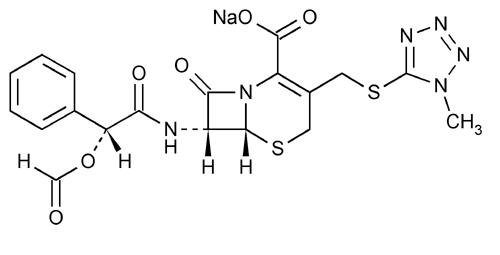
 512.50
5-Thia-1-azabicyclo[4.2.0]oct-2-ene-2-carboxylic acid, 7-[[(formyloxy)phenylacetyl]amino]-3-[[(1-methyl-1H-tetrazol-5-yl)thio]methyl]-8-oxo-, monosodium salt, [6R-[6
 ,7
,7 (R*)]]-.
Sodium (6R,7R)-7-(R)-mandelamido-3-[[(1-methyl-1H-tetrazol- 5-yl)thio]methyl]-8-oxo-5-thia-1-azabicyclo[4.2.0]oct-2-ene-2-carboxylate formate (ester)
[42540-40-9].» Cefamandole Nafate has a potency equivalent to not less than 810 µg and not more than 1000 µg of cefamandole (C18H18N6O5S2) per mg, calculated on the anhydrous basis.
Packaging and storage—
Preserve in tight containers.
Labeling—
Where it is intended for use in preparing injectable dosage forms, the label states that it is sterile or must be subjected to further processing during the preparation of injectable dosage forms.
Identification—
Prepare a mixture of ethyl acetate, acetone, glacial acetic acid, and water (5:2:1:1) (Developing solvent). Prepare a solution of the specimen in Developing solvent containing 10 mg per mL. Prepare a Standard solution of USP Cefamandole Nafate RS in Developing solvent containing 10 mg per mL. Use these solutions promptly after preparation. Apply separately 10 µL of each solution to a suitable thin-layer chromatographic plate (see Chromatography  621
621 ) coated with a 0.25-mm layer of chromatographic silica gel mixture. Place the plate in a suitable chromatographic chamber, previously equilibrated with Developing solvent for not less than 30 minutes, and develop the chromatogram until the solvent front has moved about three-fourths of the length of the plate. Remove the plate from the developing chamber, mark the solvent front, and allow to air-dry. Locate the spots on the plate by examination under short-wavelength UV light: the RF value of the principal spot obtained from the test solution corresponds to that obtained from the Standard solution.
621) coated with a 0.25-mm layer of chromatographic silica gel mixture. Place the plate in a suitable chromatographic chamber, previously equilibrated with Developing solvent for not less than 30 minutes, and develop the chromatogram until the solvent front has moved about three-fourths of the length of the plate. Remove the plate from the developing chamber, mark the solvent front, and allow to air-dry. Locate the spots on the plate by examination under short-wavelength UV light: the RF value of the principal spot obtained from the test solution corresponds to that obtained from the Standard solution.
pH 791:
between 3.5 and 7.0, in a solution containing 100 mg per mL.
791:
between 3.5 and 7.0, in a solution containing 100 mg per mL.
Water, Method I 921:
not more than 2.0%.
921:
not more than 2.0%.
Other requirements—
Where the label states that Cefamandole Nafate is sterile, it meets the requirements for Sterility Tests 71 and for Bacterial endotoxins under Cefamandole Nafate for Injection. Where the label states that Cefamandole Nafate must be subjected to further processing during the preparation of injectable dosage forms, it meets the requirements for Bacterial endotoxins under Cefamandole Nafate for Injection.
71 and for Bacterial endotoxins under Cefamandole Nafate for Injection. Where the label states that Cefamandole Nafate must be subjected to further processing during the preparation of injectable dosage forms, it meets the requirements for Bacterial endotoxins under Cefamandole Nafate for Injection.
Assay—
pH 2.3 Buffer—
Dissolve 3.6 g of anhydrous dibasic sodium phosphate, 39.4 g of citric acid monohydrate, and 70.8 g of potassium chloride in water to make 1000 mL.
Standard preparation—
Transfer about 12 mg of USP Cefamandole Nafate RS, accurately weighed, to a 50-mL volumetric flask containing 4 mL of water. Immediately before use, add 30.0 mL of pH 2.3 Buffer, dilute with water to volume, and mix.
Assay preparation—
Using Cefamandole Nafate, prepare as directed under Standard preparation.
Procedure—
Transfer a portion of the Assay preparation to a suitable polarographic cell. Deaerate by bubbling scrubbed nitrogen through the solution for 5 minutes, and redirect the nitrogen flow to the surface outlet. Insert the dropping mercury electrode of a suitable polarograph (see Polarography 801) capable of measuring a current of 0.5 microampere or appropriate current to maintain on-scale response, using an average capillary, and a drop rate of 1 per second. Record the polarogram in the differential pulse mode from  0.3 volt to 1.05 volts, using a saturated calomel reference electrode and platinum wire counter electrode. Determine the peak height obtained, in microamperes, where the peak height is defined as the perpendicular distance from the extrapolated baseline to the highest point of the peak as compared to the full-scale current range. Similarly, determine the peak current of the Standard preparation. Calculate the quantity, in µg, of C18H18N6O5S2 in each mg of the Cefamandole Nafate taken by the formula:
801) capable of measuring a current of 0.5 microampere or appropriate current to maintain on-scale response, using an average capillary, and a drop rate of 1 per second. Record the polarogram in the differential pulse mode from 0.3 volt to 1.05 volts, using a saturated calomel reference electrode and platinum wire counter electrode. Determine the peak height obtained, in microamperes, where the peak height is defined as the perpendicular distance from the extrapolated baseline to the highest point of the peak as compared to the full-scale current range. Similarly, determine the peak current of the Standard preparation. Calculate the quantity, in µg, of C18H18N6O5S2 in each mg of the Cefamandole Nafate taken by the formula:
P(WS / WU)(iU / iS)
in which P is the potency, in µg of cefamandole per mg, of USP Cefamandole Nafate RS; WS and WU are the quantities, in mg, of USP Cefamandole Nafate RS and Cefamandole Nafate taken to prepare the Standard preparation and the Assay preparation, respectively; and iU and iS are the peak currents, in microamperes, from the Assay preparation and the Standard preparation, respectively.
Auxiliary Information—
Please check for your question in the FAQs before contacting USP.
| Topic/Question | Contact | Expert Committee |
| Monograph | Ahalya Wise, M.S.
Scientist 1-301-816-8161 |
(MDANT05) Monograph Development-Antibiotics |
| Reference Standards | Lili Wang, Technical Services Scientist 1-301-816-8129 RSTech@usp.org |
USP32–NF27 Page 1821