Carisoprodol
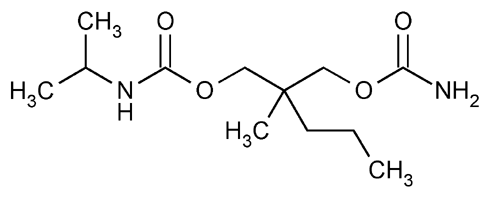
 260.33
(±)-2-Methyl-2-propyl-1,3-propanediol carbamate isopropylcarbamate
[78-44-4].» Carisoprodol contains not less than 98.0 percent and not more than 102.0 percent of C12H24N2O4, calculated on the dried basis.
Packaging and storage—
Preserve in tight containers.
Identification—
B:
The RF value of the principal spot due to carisoprodol in the chromatogram of the test solution obtained in the test for Limit of meprobamate corresponds to that obtained in a similarly prepared chromatogram of a Standard solution of USP Carisoprodol RS in chloroform containing 100 mg per mL.
Loss on drying  731
731 —
Dry it in vacuum at 60
—
Dry it in vacuum at 60 for 3 hours: it loses not more than 0.5% of its weight.
731—
Dry it in vacuum at 60 for 3 hours: it loses not more than 0.5% of its weight.
Heavy metals, Method II 231:
0.001%.
231:
0.001%.
Limit of meprobamate—
Dissolve 100 mg of Carisoprodol in 1.0 mL of chloroform. Dissolve USP Meprobamate RS in chloroform to obtain a Standard solution containing about 1 mg per mL. Apply a 10-µL portion of the test solution and a separate 5-µL portion of the Standard solution to a suitable thin-layer chromatographic plate (see Chromatography 621), coated with a 0.25-mm layer of chromatographic silica gel. Allow the spots to dry in a current of air, and develop the chromatogram in a solvent system consisting of a mixture of chloroform and acetone (4:1) until the solvent front has moved about three-fourths of the length of the plate. Remove the plate from the developing chamber, mark the solvent front, allow the solvent to evaporate, and spray the plate alternately with antimony trichloride TS and a 3 in 100 solution of furfural in chloroform until one or more black spots appear, heat the plate at 110 for 15 minutes, and examine the plate: any spot in the chromatogram of the test solution having an RF value corresponding to that of meprobamate in the chromatogram of the Standard solution is not darker in color than the meprobamate spot in the chromatogram of the Standard solution (0.5%).
621), coated with a 0.25-mm layer of chromatographic silica gel. Allow the spots to dry in a current of air, and develop the chromatogram in a solvent system consisting of a mixture of chloroform and acetone (4:1) until the solvent front has moved about three-fourths of the length of the plate. Remove the plate from the developing chamber, mark the solvent front, allow the solvent to evaporate, and spray the plate alternately with antimony trichloride TS and a 3 in 100 solution of furfural in chloroform until one or more black spots appear, heat the plate at 110 for 15 minutes, and examine the plate: any spot in the chromatogram of the test solution having an RF value corresponding to that of meprobamate in the chromatogram of the Standard solution is not darker in color than the meprobamate spot in the chromatogram of the Standard solution (0.5%).
Assay—
Sodium methoxide titrant—
Prepare and standardize as directed for 0.1 N sodium methoxide (in toluene) (see Volumetric Solutions under Reagents, Indicators, and Solutions), except to use 200 mL of methanol to dissolve the sodium metal, to add 750 mL of toluene, and to dilute with methanol to 1000 mL.
Procedure—
Transfer about 400 mg of Carisoprodol, accurately weighed, to a suitable boiling flask, add 10 mL of pyridine, and mix. Add 1 drop of phenolphthalein TS, and titrate with Sodium methoxide titrant to a permanent pink endpoint. Add 25.0 mL of Sodium methoxide titrant, connect the flask to a water-cooled condenser, and reflux on a hot plate for 30 minutes. Allow to cool, add 40 mL of alcohol and 7 drops of phenolphthalein TS, and titrate the excess alkali with 0.1 N hydrochloric acid VS until the pink color disappears. Perform a blank determination (see Residual Titrations under Titrimetry 541). Each mL of Sodium methoxide titrant is equivalent to 26.03 mg of C12H24N2O4.
541). Each mL of Sodium methoxide titrant is equivalent to 26.03 mg of C12H24N2O4.
Auxiliary Information—
Please check for your question in the FAQs before contacting USP.
Chromatographic Column—
| Topic/Question | Contact | Expert Committee |
| Monograph | Ravi Ravichandran, Ph.D.
Senior Scientist 1-301-816-8345 |
(MDPP05) Monograph Development-Psychiatrics and Psychoactives |
| Reference Standards | Lili Wang, Technical Services Scientist 1-301-816-8129 RSTech@usp.org |
USP32–NF27 Page 1803
Chromatographic columns text is not derived from, and not part of, USP 32 or NF 27.