Methacrylic Acid and Methyl Methacrylate Copolymer
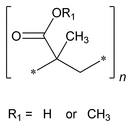
(Ratio of H to CH3 is either 1:1 or 1:2)
Poly(methacrylic acid, methyl methacrylate);
Methacrylic acid–methyl methacrylate copolymer [25086-15-1].
(Title for this new monograph—to become official December 1, 2015)
(Prior to December 1, 2015, the current practice of labeling the article of commerce with the name Methacrylic Acid Copolymer, Type A or Type B, whichever is appropriate, may be continued. Use of the name Methacrylic Acid and Methyl Methacrylate Copolymer will be permitted as of December 1, 2010, but the use of this name will not be mandatory until December 1, 2015. The 60-month extension will provide the time needed by manufacturers and users to make necessary changes.)
+'&img=../../images/v35300/cas-25086-15-1.gif&casNumber=25086-15-1&usp=35&nf=30&chemicalStructureImage=true&ID='+parent.myID,600,500);)
(Ratio of H to CH3 is either 1:1 or 1:2)
Poly(methacrylic acid, methyl methacrylate);
Methacrylic acid–methyl methacrylate copolymer
[25086-15-1].DEFINITION
Methacrylic Acid and Methyl Methacrylate Copolymer consists of methacrylic acid and methyl methacrylate monomers arranged in a random distribution. Methacrylic acid units in Methacrylic Acid and Methyl Methacrylate Copolymer are NLT 27.6% and NMT 50.6%, calculated on the dried basis. It may contain suitable surface-active agents.
IDENTIFICATION
• A. Infrared Absorption  197K
197K
197K
Use USP Methacrylic Acid and Methyl Methacrylate Copolymer (1:1) RS for Methacrylic Acid and Methyl Methacrylate Copolymer, with a range of 46.0%–50.6% for methacrylic acid units.
Use USP Methacrylic Acid and Methyl Methacrylate Copolymer (1:2) RS for Methacrylic Acid and Methyl Methacrylate Copolymer, with a range of 27.6%–30.7% for methacrylic acid units.
• B.
It meets the requirements of the Assay.
ASSAY
• Procedure
Sample:
1 g, previously dried
Analysis:
Dissolve the Sample in 100 mL of neutralized acetone, and titrate with 0.1 N sodium hydroxide VS, determining the endpoint potentiometrically (see Titrimetry 541). Each mL of 0.1 N sodium hydroxide is equivalent to 8.609 mg of methacrylic acid (C4H6O2) units.
541). Each mL of 0.1 N sodium hydroxide is equivalent to 8.609 mg of methacrylic acid (C4H6O2) units.
Acceptance criteria
27.6%–30.7% for Methacrylic Acid and Methyl Methacrylate Copolymer (1:2) on the dried basis
46.0%–50.6% for Methacrylic Acid and Methyl Methacrylate Copolymer (1:1) on the dried basis
IMPURITIES
Organic Impurities
• Procedure: Limit of Methacrylic Acid and Methyl Methacrylate
Phosphate buffer:
Prepare an aqueous solution containing 17.8 g/L of anhydrous dibasic sodium phosphate and 17.0 g/L of monobasic potassium phosphate. Adjust with phosphoric acid to a pH of 2.0. This buffer has a concentration of 0.125 M.
Mobile phase:
Add phosphoric acid dropwise to water to obtain a solution having a pH of 2.0. Prepare a mixture of this acidified water and methanol (80:20), and degas.
Standard solution:
Dissolve 0.05 g of methacrylic acid and 0.05 g of methyl methacrylate in 5 mL of butanol, and add methanol to exactly 100 mL. Transfer 1.0 mL of this solution to a 100-mL volumetric flask. Dilute with methanol to volume. Mix 3.0 mL of this solution with 10.0 mL of Phosphate buffer. This solution contains 1.15 µg/mL each of methacrylic acid and methyl methacrylate.
Sample solution:
Transfer 1 g of Methacrylic Acid and Methyl Methacrylate Copolymer to a 50-mL volumetric flask, dilute with methanol to volume, and mix. Add 3 mL of this solution dropwise, while continuously stirring, to a beaker that contains 10.0 mL of Phosphate buffer. Remove the precipitated polymer to obtain a clear supernatant by centrifugation (e.g., NLT 5000 × g for NLT 5 min). Use the clear supernatant.
Chromatographic system
Mode:
LC
Detector:
UV 202 nm
Column:
4.0-mm × 12.5-cm analytical column; 7-µm packing L1
Flow rate:
2 mL/min
Injection size:
20 µL
System suitability
Sample:
Standard solution
[Note—The relative retention times for methacrylic acid and methyl methacrylate are 1.0 and 2.8, respectively. ]
Suitability requirements
Resolution:
NLT 2.0 between methacrylic acid and methyl methacrylate
Relative standard deviation:
NMT 5.0%
Analysis
Samples:
Standard solution and Sample solution
Calculate the percentage of each monomer (methacrylic acid or methyl methacrylate) in the portion of Methacrylic Acid and Methyl Methacrylate Copolymer taken:
Result = (rU/rS) × (C/W) × VF × D × F × 100
| rU | = | = monomer (methacrylic acid or methyl methacrylate) peak response from the Sample solution |
| rS | = | = monomer (methacrylic acid or methyl methacrylate) peak response from the Standard solution |
| C | = | = concentration of the monomer (methacrylic acid or methyl methacrylate) in the Standard solution (µg/mL) |
| W | = | = weight of Methacrylic Acid and Methyl Methacrylate Copolymer taken to prepare the Sample solution (g) |
| VF | = | = final volume of the Sample solution, 13 mL |
| D | = | = dilution factor for preparation of the Sample solution, 16.7 |
| F | = | = conversion factor, 10 6 g/µg 6 g/µg |
Acceptance criteria:
NMT 0.05% for the total amount of monomers
SPECIFIC TESTS
• Viscosity 911
911
Analysis:
Place 254.6 g of isopropyl alcohol and 7.9 g of water in a test flask. Add a quantity of Methacrylic Acid and Methyl Methacrylate Copolymer, equivalent to 37.5 g of solids on the dried basis, while stirring by means of a magnetic stirrer. Close the flask, and continue stirring until the polymer has dissolved completely. Adjust the temperature to 20 ± 0.1 . Equip a rotational viscometer with an accessory.1 The shear rate under the test condition is NLT 1 s1 and NMT 100 s1. Follow the instrument manufacturer's directions to measure the apparent viscosity.
. Equip a rotational viscometer with an accessory.1 The shear rate under the test condition is NLT 1 s1 and NMT 100 s1. Follow the instrument manufacturer's directions to measure the apparent viscosity.
Acceptance criteria
60–120 mPa·s for Methacrylic Acid and Methyl Methacrylate Copolymer having a range of 46.0%–50.6% for methacrylic acid units
50–200 mPa·s for Methacrylic Acid and Methyl Methacrylate Copolymer having a range of 27.6%–30.7% for methacrylic acid units
• Loss on Drying 731:
Dry a sample at 110 for 6 h: it loses NMT 5.0% of its weight.
731:
Dry a sample at 110 for 6 h: it loses NMT 5.0% of its weight.
ADDITIONAL REQUIREMENTS
• Packaging and Storage:
Preserve in tight containers, and store at controlled room temperature.
• Labeling:
Label it to indicate the range of methacrylic acid units. The labeling also indicates the name and quantity of any added surface-active agent.
• USP Reference Standards 11
11
USP Methacrylic Acid and Methyl Methacrylate Copolymer (1:1) RS (USP Methacrylic Acid Copolymer, Type A RS)
USP Methacrylic Acid and Methyl Methacrylate Copolymer (1:2) RS (USP Methacrylic Acid Copolymer, Type B RS)
1
A suitable accessory is available from Brookfield Engineering as the LV1 spindle, a cylindrical spindle 1.9 cm in diameter and 6.5 cm high attached to a shaft 0.3 cm in diameter. The spindle rotates at 30 rpm at an immersion depth of 8.15 cm.
Auxiliary Information—
Please check for your question in the FAQs before contacting USP.
| Topic/Question | Contact | Expert Committee |
|---|---|---|
| Monograph | Robert H. Lafaver, M.S.
Scientific Liaison 1-301-816-8335 |
(EXC2010) Monographs - Excipients |
| Reference Standards | RS Technical Services 1-301-816-8129 rstech@usp.org |
USP35–NF30 Page 1864
Pharmacopeial Forum: Volume No. 35(4) Page 909