Ammonio Methacrylate Copolymer

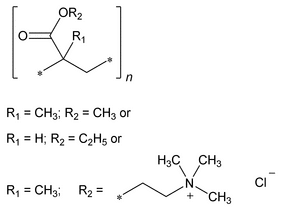
Ratio of ethyl acrylate groups to methyl methacrylate groups to trimethylammonioethyl methacrylate groups is about 1: 2: 0.2 as being Type A or 1: 2: 0.1 as being Type B.
Poly(ethyl acrylate, methyl methacrylate, trimethylammonioethyl methacrylate chloride) (1: 2: 0.2);
Ethyl acrylate–methyl methacrylate–trimethylammonioethyl methacrylate chloride copolymer (1: 2: 0.2);
Poly(ethyl acrylate, methyl methacrylate, trimethylammonioethyl methacrylate chloride) (1: 2: 0.1);
Ethyl acrylate–methyl methacrylate–trimethylammonioethyl methacrylate chloride copolymer (1: 2: 0.1) [33434-24-1].NF30
Meets the requirements of the AssayNF30
 911
911
1
A commercial device is available from Brookfield as an ultra-low (UL) viscosity adapter. The adapter comprises a 0.4-cm diameter shaft, an accurately machined chamber (or tube) with an internal diameter of 2.8 cm and a depth of 13.5 cm, and a cylindrical spindle 2.5 cm in diameter and 9.1 cm in height.NF30
2
For the Brookfield UL adapter, the cylindrical spindle rotates at 30 rpm, which corresponds to a rate of shear of approximately 37 s 1.NF30
(a moe' nee oh meth ak' ri late koe pol' i mer).
Add the following:
+'&img=../../images/v35300/cas-33434-24-1.gif&casNumber=33434-24-1&usp=35&nf=30&chemicalStructureImage=true&ID='+parent.myID,600,500);)
Ratio of ethyl acrylate groups to methyl methacrylate groups to trimethylammonioethyl methacrylate groups is about 1: 2: 0.2 as being Type A or 1: 2: 0.1 as being Type B.
Poly(ethyl acrylate, methyl methacrylate, trimethylammonioethyl methacrylate chloride) (1: 2: 0.2);
Ethyl acrylate–methyl methacrylate–trimethylammonioethyl methacrylate chloride copolymer (1: 2: 0.2);
Poly(ethyl acrylate, methyl methacrylate, trimethylammonioethyl methacrylate chloride) (1: 2: 0.1);
Ethyl acrylate–methyl methacrylate–trimethylammonioethyl methacrylate chloride copolymer (1: 2: 0.1)
[33434-24-1].NF30DEFINITION
Change to read:
Ammonio Methacrylate Copolymer is a polymerized copolymer of ethyl acrylate, methyl methacrylate, and a low content of methacrylic acid ester with quaternary ammonium groups (trimethylammonioethyl methacrylate chloride).NF30 The Assay requirements differ for the two types as set forth in the accompanying table.
polymerized copolymer of ethyl acrylate, methyl methacrylate, and a low content of methacrylic acid ester with quaternary ammonium groups (trimethylammonioethyl methacrylate chloride).NF30 The Assay requirements differ for the two types as set forth in the accompanying table.| Ammonio Methacrylate Units, Dried Basis (%) |
||
|---|---|---|
| Type | Min. | Max. |
| A | 8.85 | 11.96 |
| B | 4.48 | 6.77 |
IDENTIFICATION
Change to read:
• B.
Meets the requirements of the AssayNF30
ASSAY
Change to read:
• Procedure
Sample:
1 g of Ammonio Methacrylate Copolymer Type A, or 2 g of Type B, previously dried
Titrimetric system
(See Titrimetry 541.)
541.)
Mode:
Direct titration
Titrant:
0.1 N perchloric acid VS
Endpoint detection:
Potentiometric
Analysis
Sample:
Sample
Dissolve the Sample in 75 mL of glacial acetic acid at about 50 within 30 min. After the solution cools down to room temperature, add 25 mL of 0.6% cupric acetate in glacial acetic acid.NF30 Titrate this solution and a blank, and make any necessary corrections. Each mL of 0.1 N perchloric acid is equivalent to 20.772 mg of ammonio methacrylate (C9H18ClNO2) units.
Dissolve the Sample in 75 mL of glacial acetic acid at about 50 within 30 min. After the solution cools down to room temperature, add 25 mL of 0.6% cupric acetate in glacial acetic acid.NF30 Titrate this solution and a blank, and make any necessary corrections. Each mL of 0.1 N perchloric acid is equivalent to 20.772 mg of ammonio methacrylate (C9H18ClNO2) units.
Acceptance criteria
Type A:
8.85%–11.96%
Type B:
4.48%–6.77%
IMPURITIES
Change to read:
Organic Impurities
• Procedure: Limit of Monomers
Sodium perchlorate solution:
35 mg/mL of sodium perchlorate (NaClO4·H2O)
Mobile phase:
Dilute phosphoric acid with water to obtain a solution with a pH of 2.0. Mix 4 volumes of this solution with 1 volume of methanol.
Standard stock solution:
1.6 mg/mL of ethyl acrylate and 0.2 mg/mL of methyl methacrylate in methanol
Standard solution:
Dilute 1 mL of the Standard stock solution with methanol to 100 mL. Add 10 mL of this solution to 5 mL of the Sodium perchlorate solution. This solution contains about 10.67 µg/mL of ethyl acrylate and 1.33 µg/mL of methyl methacrylate.NF30
This solution contains about 10.67 µg/mL of ethyl acrylate and 1.33 µg/mL of methyl methacrylate.NF30
Sample solution:
Dissolve 5 g of Ammonio Methacrylate Copolymer in methanol, and dilute with the same solvent to 50 mL. Add 5 mL of the Sodium perchlorate solution dropwise to 10 mL of this solution while continuously stirring. Remove the precipitated polymer by centrifugation. Use the clear supernatant. Calculate the concentration of Ammonio Methacrylate Copolymer, in mg/mL, as CU.NF30
Calculate the concentration of Ammonio Methacrylate Copolymer, in mg/mL, as CU.NF30
Chromatographic system
Mode:
LC
Detector:
UV 202 nm
Column:
4.6-mm × 12-cm; packing L1
Flow rate:
2 mL/min
Injection size:
50 µL
System suitability
[Note—The relative retention times for ethyl acrylate and methyl methacrylate are 1.00 and 1.14, respectively. ]
NF30
Sample:
Standard solution
[Note—The relative retention times for ethyl acrylate and methyl methacrylate are 1.00 and 1.14, respectively. ]
NF30
Suitability requirements
NF30
Resolution:
NLT 1.0 between the pair of analytes
NF30
Relative standard deviation:
NMT 5.0%NF30 for each analyte
5.0%NF30 for each analyte
Analysis
Samples:
Standard solution and Sample solution
Calculate the percentage of ethyl acrylate (or methyl methacrylate) in the portion of Ammonio Methacrylate Copolymer taken:
Result = (rU/rS) × (CS/CU) × F × 100
| rU | = | = peak response of ethyl acrylate (or methyl methacrylate) from the Sample solution |
| rS | = | = peak response of ethyl acrylate (or methyl methacrylate) from the Standard solution |
| CS | = | = concentration of ethyl acrylate (or methyl methacrylate) in the Standard solution (µg/mL) |
| CU | = | = concentration of Ammonio Methacrylate Copolymer in the Sample solution (mg/mL) |
| F | = | = conversion factor, 10-3 mg/µg |
Acceptance criteria
Ethyl acrylate:
NMT 100 ppmNF30
NMT 100 ppmNF30
Methyl methacrylate:
NMT 50 ppm
SPECIFIC TESTS
• Loss on Drying 731:
Dry a sample in a vacuum at 80 for 5 h: it loses NMT 3.0% of its weight.
731:
Dry a sample in a vacuum at 80 for 5 h: it loses NMT 3.0% of its weight.
Change to read:
• Viscosity 911
Sample solution:
Place 52.5 g of isopropyl alcohol and 35.0 g of acetone in a conical flask with a ground-glass joint. Add a quantity of Ammonio Methacrylate Copolymer, equivalent to 12.5 g of solids on the dried basis, while stirring until the polymer has dissolved completely.
Analysis:
Equip a suitable rotational viscometer with an adapter comprising a cylindrical spindle rotating within an accurately machined chamber (or tube).1 Pipet the Sample solution in the specified volume, which is recommended by the instrument manufacturer, into the chamber (or tube), and ensure that the temperature of the test specimen is at 20 ± 0.1. The cylindrical spindle rotates at the value of rpm, which corresponds to a rate of shear of approximately 37 s1.2 Measure the apparent viscosity following the instrument manufacturer’s directions.NF30
Equip a suitable rotational viscometer with an adapter comprising a cylindrical spindle rotating within an accurately machined chamber (or tube).1 Pipet the Sample solution in the specified volume, which is recommended by the instrument manufacturer, into the chamber (or tube), and ensure that the temperature of the test specimen is at 20 ± 0.1. The cylindrical spindle rotates at the value of rpm, which corresponds to a rate of shear of approximately 37 s1.2 Measure the apparent viscosity following the instrument manufacturer’s directions.NF30
Acceptance criteria:
1–15 mPa·sNF30
1–15 mPa·sNF30
ADDITIONAL REQUIREMENTS
• Packaging and Storage:
Preserve in tight containers, and store at a temperature not exceeding 30.
.
• Labeling:
Label it to state whether it is Type A or Type B.
• USP Reference Standards 11
11
USP Ammonio Methacrylate Copolymer, Type A RS
Poly(ethyl acrylate, methyl methacrylate, trimethylammonioethyl methacrylate chloride) (1: 2: 0.2);
Ethyl acrylate–methyl methacrylate–trimethylammonioethyl methacrylate chloride copolymer (1: 2: 0.2).
Poly(ethyl acrylate, methyl methacrylate, trimethylammonioethyl methacrylate chloride) (1: 2: 0.2);
Ethyl acrylate–methyl methacrylate–trimethylammonioethyl methacrylate chloride copolymer (1: 2: 0.2).
USP Ammonio Methacrylate Copolymer, Type B RS
Poly(ethyl acrylate, methyl methacrylate, trimethylammonioethyl methacrylate chloride) (1: 2: 0.1);
Ethyl acrylate–methyl methacrylate–trimethylammonioethyl methacrylate chloride copolymer (1: 2: 0.1).
Poly(ethyl acrylate, methyl methacrylate, trimethylammonioethyl methacrylate chloride) (1: 2: 0.1);
Ethyl acrylate–methyl methacrylate–trimethylammonioethyl methacrylate chloride copolymer (1: 2: 0.1).
1
A commercial device is available from Brookfield as an ultra-low (UL) viscosity adapter. The adapter comprises a 0.4-cm diameter shaft, an accurately machined chamber (or tube) with an internal diameter of 2.8 cm and a depth of 13.5 cm, and a cylindrical spindle 2.5 cm in diameter and 9.1 cm in height.NF30
2
For the Brookfield UL adapter, the cylindrical spindle rotates at 30 rpm, which corresponds to a rate of shear of approximately 37 s1.NF30
Auxiliary Information—
Please check for your question in the FAQs before contacting USP.
| Topic/Question | Contact | Expert Committee |
|---|---|---|
| Monograph | Robert H. Lafaver, M.S.
Scientific Liaison 1-301-816-8335 |
(EXC2010) Monographs - Excipients |
| Reference Standards | RS Technical Services 1-301-816-8129 rstech@usp.org |
USP35–NF30 Page 1696
Pharmacopeial Forum: Volume No. 36(6) Page 1631