Bupropion Hydrochloride
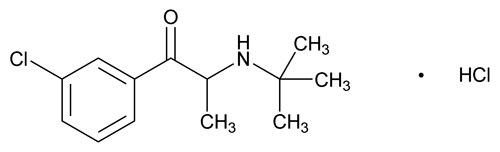
C13H18ClNO·HCl 276.20
1-Propanone, 1-(3-chlorophenyl)-2-[(1,1-dimethylethyl)amino]-, hydrochloride, (±)-;
(±)-2-(tert-Butylamino)-3¢-chloropropiophenone hydrochloride [31677-93-7].
(bue proe' pee on hye'' droe klor' ide).
+'&img=../../images/v35300/cas-31677-93-7.gif&casNumber=31677-93-7&usp=35&nf=30&chemicalStructureImage=true&ID='+parent.myID,600,500);)
C13H18ClNO·HCl 276.20
1-Propanone, 1-(3-chlorophenyl)-2-[(1,1-dimethylethyl)amino]-, hydrochloride, (±)-;
(±)-2-(tert-Butylamino)-3¢-chloropropiophenone hydrochloride
[31677-93-7].DEFINITION
Bupropion Hydrochloride contains NLT 98.0% and NMT 102.0% of C13H18ClNO·HCl, calculated on the anhydrous basis.
IDENTIFICATION
• B.
The retention time of the major peak of the Sample solution corresponds to that of the Standard solution, as obtained in the Assay.
• C. Identification Tests—General, Chloride  191
191 :
Meets the requirements for the silver nitrate precipate test
:
Meets the requirements for the silver nitrate precipate test
191:
Meets the requirements for the silver nitrate precipate test
Sample solution:
1 mg/mL of Bupropion Hydrochloride
ASSAY
• Procedure
Diluent:
Methanol and water (1:1)
Buffer:
3.4 g/L of monobasic potassium phosphate in water. Adjust with 1 N sodium hydroxide to a pH of 7.0.
Mobile phase:
Methanol, tetrahydrofuran, and Buffer (39:11:51)
Standard solution:
1 mg/mL of USP Bupropion Hydrochloride RS and 2 µg/mL each of USP Bupropion Hydrochloride Related Compound A RS and USP Bupropion Hydrochloride Related Compound B RS in Diluent
Sample solution:
1 mg/mL of Bupropion Hydrochloride in Diluent
Chromatographic system
Mode:
LC
Detector:
UV 250 nm
Column:
3.9-mm × 15-cm; 5-µm packing L7
Flow rate:
1.1 mL/min
Injection size:
20 µL
System suitability
Sample:
Standard solution
[Note—The relative retention times for bupropion hydrochloride related compound A, bupropion hydrochloride, and bupropion hydrochloride related compound B are about 0.92, 1.0, and 1.14, respectively. ]
Suitability requirements
Resolution:
NLT 1.3 between bupropion hydrochloride related compound A and bupropion hydrochloride
Relative standard deviation:
NMT 2.0% determined from bupropion hydrochloride; NMT 5.0% determined from bupropion hydrochloride related compound B
Analysis:
Calculate the percentage of C13H18ClNO·HCl in the portion of Bupropion Hydrochloride taken:
Result = (rU/rS) × (CS/CU) × 100
| rU | = | = peak response from the Sample solution |
| rS | = | = peak response from the Standard solution |
| CS | = | = concentration of USP Bupropion Hydrochloride RS in the Standard solution (mg/mL) |
| CU | = | = concentration of Bupropion Hydrochloride in the Sample solution (mg/mL) |
Acceptance criteria:
98.0%–102.0% on the anhydrous basis
IMPURITIES
Organic Impurities
• Procedure 1: Limit of m-Chlorobenzoic Acid
Mobile phase:
Acetonitrile, trifluoroacetic acid, and water (35:0.1:65)
System suitability solution:
1.0 mg/mL of USP Bupropion Hydrochloride RS and 4 µg/mL of m-chlorobenzoic acid in Mobile phase
Sample solution:
2 mg/mL of Bupropion Hydrochloride in Mobile phase
Chromatographic system
Mode:
LC
Detector:
UV 235 nm
Column:
4.6-mm × 25-cm; 5-µm packing L1
Flow rate:
1 mL/min
Injection size:
20 µL
Run time:
2.7 times the retention time of m-chlorobenzoic acid
System suitability
Sample:
System suitability solution
[Note—The relative retention times for bupropion hydrochloride and m-chlorobenzoic acid are 1.0 and 2.0, respectively. ]
Suitability requirements
Resolution:
NLT 10.0 between the bupropion and m-chlorobenzoic acid peaks
Relative standard deviation:
NMT 5.0% for the m-chlorobenzoic acid peak
Analysis
Sample:
Sample solution
Calculate the percentage of m-chlorobenzoic acid in the portion of Bupropion Hydrochloride taken:
Result = (rU/rT) × 100
| rU | = | = peak response of m-chlorobenzoic acid from the Sample solution |
| rT | = | = sum of the responses of all the peaks from the Sample solution |
Acceptance criteria
m-chlorobenzoic acid:
NMT 0.2%
• Procedure 2
Diluent, Buffer, Mobile phase, Standard solution, Sample solution, Chromatographic system, and System suitability:
Proceed as directed in the Assay.
Analysis
Samples:
Standard solution and Sample solution
Calculate the percentage of each impurity in the portion of Bupropion Hydrochloride taken:
Result = (rU/rS) × (CS/CU) × (1/F) × 100
| rU | = | = peak response for each impurity from the Sample solution |
| rS | = | = peak response for bupropion hydrochloride from the Standard solution |
| CS | = | = concentration of USP Bupropion Hydrochloride RS in the Standard solution (mg/mL) |
| CU | = | = concentration of Bupropion Hydrochloride in the Sample solution (mg/mL) |
| F | = | = relative response factor for each impurity relative to bupropion |
Calculate the percentage of bupropion hydrochloride related compound B in the portion of Bupropion Hydrochloride taken:
Result = (rU/rS) × (CS/CU) × 100
| rU | = | = peak response of bupropion hydrochloride related compound B from the Sample solution |
| rS | = | = peak response of bupropion hydrochloride related compound B from the Standard solution |
| CS | = | = concentration of USP Bupropion Hydrochloride Related Compound B RS in the Standard solution (mg/mL) |
| CU | = | = concentration of Bupropion Hydrochloride in the Sample solution (mg/mL) |
Acceptance criteria
Individual impurities:
See Impurity Table 1.
Total impurities:
The limits of impurities are specified in the accompanying table: NMT 0.3% of total unidentified impurities is found; and NMT 1.0% of total impurities is found, the results of Procedure 1 and Procedure 2 being added.
Impurity Table 1
| Name | Relative Retention Time |
Relative Response Factor |
Acceptance Criteria, NMT (%) |
|---|---|---|---|
| 2-(tert-Butylamino)propiophenone hydrochloride | 0.38 | 1.5 | 0.5 |
| 1-(3-Chlorophenyl)-1,2-propanedione | 0.58 | 1.0 | 0.2 |
| 2-(tert-Butylamino)-2¢-chloropropiophenone hydrochloride | 0.71 | 0.45 | 0.1 |
| 3¢-Chloropropiophenone | 0.78 | 1.2 | 0.1 |
| Bupropion hydrochloride related compound A | 0.92 | 1.4 | 0.2 |
| Bupropion | 1.0 | — | — |
| Bupropion hydrochloride related compound B | 1.14 | — | 0.2 |
| 2-Bromo-3¢-chloropropiophenone | 1.63 | 0.88 | 0.1 |
| 2-(tert-Butylamino)-3¢,4¢-chloropropiophenone hydrochloride | 2.30 | 1.1 | 0.2 |
| 2-(tert-Butylamino)-3¢,5¢-chloropropiophenone hydrochloride | 2.74 | 0.69 | 0.2 |
| Any individual impurity | — | 1.0 | 0.1 |
SPECIFIC TESTS
• Water Determination, Method I 921:
NMT 0.5%
921:
NMT 0.5%
ADDITIONAL REQUIREMENTS
• Packaging and Storage:
Preserve in well-closed, light-resistant containers.
• USP Reference Standards 11
11
USP Bupropion Hydrochloride RS 
') + '&img=../../images/v35300/cas-31677-93-7.gif',600,500);)
USP Bupropion Hydrochloride Related Compound A RS
2-(tert-Butylamino)-4¢-chloropropiophenone hydrochloride.
C13H18ClNO·HCl 276.20
') + '&img=../../images/v35300/c11rs1402.gif',600,500);)
2-(tert-Butylamino)-4¢-chloropropiophenone hydrochloride.
C13H18ClNO·HCl 276.20
USP Bupropion Hydrochloride Related Compound B RS
2-(tert-Butylamino)-3¢-bromopropiophenone hydrochloride.
C13H18BrNO·HCl 320.66
') + '&img=../../images/v35300/c11rs1403.gif',600,500);)
2-(tert-Butylamino)-3¢-bromopropiophenone hydrochloride.
C13H18BrNO·HCl 320.66
Auxiliary Information—
Please check for your question in the FAQs before contacting USP.
| Topic/Question | Contact | Expert Committee |
|---|---|---|
| Monograph | Ravi Ravichandran, Ph.D.
Principal Scientific Liaison 1-301-816-8330 |
(SM42010) Monographs - Small Molecules 4 |
| Reference Standards | RS Technical Services 1-301-816-8129 rstech@usp.org |
USP35–NF30 Page 2403
Pharmacopeial Forum: Volume No. 36(2) Page 383