Black Cohosh
» Black Cohosh consists of the dried rhizome and roots of Actaea racemosa L. [Cimicifuga racemosa (L.) Nutt.] (Fam. Ranunculaceae). It is harvested in the summer. It contains not less than 0.4 percent of triterpene glycosides, calculated as 23-epi-26-deoxyactein* (C37H56O10) on the dried basis.
Packaging and storage—
Preserve in a well-closed, light-resistant container. Protect from moisture, and store at room temperature.
Labeling—
The label states the Latin binomial and, following the official name, the parts of the plant contained in the article. Dosage forms prepared with this article should bear the following statement: Discontinue use and consult a healthcare practitioner if you have a liver disorder or develop symptoms of liver trouble, such as abdominal pain, dark urine, or jaundice.
USP Reference standards  11
11 —
—
USP Actein RS .
.
USP 23-epi-26-Deoxyactein RS.
USP Powdered Black Cohosh Extract RS.
11—
USP Actein RS
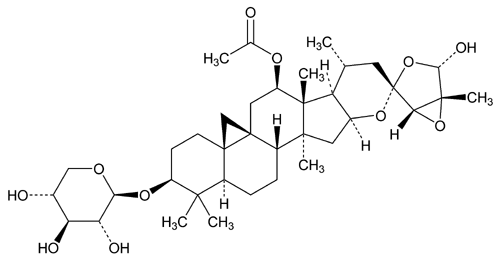 .
.
USP 23-epi-26-Deoxyactein RS.
USP Powdered Black Cohosh Extract RS.
Botanic characteristics—
Macroscopic—
The Black Cohosh rhizome is dark brown, longitudinally grooved, rough, strongly knotty, and somewhat curled and irregular. It is 15 cm long and up to 2.5 cm thick. The upper surface is covered with numerous round scars of the earlier stalks; laterally, it is clearly curled, and the lower surface is covered with thin, longitudinally grooved, dark brown, easily breakable roots. The fracture is horny and fibrous. The transverse surface shows a thin outer bark surrounding a ring of numerous pale, narrow wedges of vascular tissue alternating with dark medullary rays and a large central pith. Black Cohosh roots are dark brown, between 1 and 3 mm in diameter, brittle, nearly cylindrical or obtusely quadrangular, and longitudinally wrinkled. The fracture is short. The transverse surface shows a distinct cambium line separating a wide outer bark from a central region composed of three to six wedges of lignified xylem tissue united by their apices and separated by broad nonlignified medullary rays.
Microscopic—
In a surface view, suberous epidermal cells are tabular with moderately thickened walls. The parenchymatous cortex is filled with starch. Xylem wedges are lignified and composed of numerous small vessels with bordered pits or reticulately thickened walls, thin-walled fibers, and xylem parenchyma. The parenchyma of the pith is unlignified. Medullary rays are filled with starch granules, which are spherical or polygonal and are mostly simple or two to three compounded but can be up to six compounded. Individual starch granules are between 3 and 15 µm in diameter, each with a somewhat central slit-shaped hilum.
Identification—
A:
Thin-Layer Chromatographic Identification Test 201—
201—
Adsorbent:
chromatographic silica gel mixture with an average particle size of 10 to 15 µm (TLC plates).
Test solution—
Transfer about 5 g of powdered Black Cohosh to a screw-capped centrifuge tube, add 10 mL of a mixture of alcohol and water (7:3), and heat on a steam bath for 10 minutes. Centrifuge, and use the clear supernatant.
Standard solution 1—
Dissolve about 100 mg of USP Powdered Black Cohosh Extract RS in 1 mL of methanol.
Standard solution 2—
Dissolve amounts of USP Actein RS, USP 23-epi-26-Deoxyactein RS, and isoferulic acid in methanol to obtain a solution having concentrations of about 1 mg per mL each.
Application volume:
10 µL.
Developing solvent system—
Use the upper phase of a mixture of butyl alcohol, water, and glacial acetic acid (50:40:10).
Spray reagent—
Prepare a mixture of methanol, glacial acetic acid, sulfuric acid, and p-anisaldehyde (85:10:5:0.5). [note—Store in a refrigerator. The reagent is colorless; discard if color appears.]
Procedure—
Develop the chromatograms until the solvent front has moved about 15 cm, and dry the plate with the aid of a current of air. Examine the plate under UV light at a wavelength of 365 nm: the chromatogram of the Test solution exhibits main zones similar in position and color to the main zones in the chromatogram of Standard solution 1. In the upper third of the plate, the chromatogram of the Test solution exhibits a blue fluorescent zone at the level of the zone due to isoferulic acid in the chromatogram of Standard solution 2. Spray the plate with Spray reagent, heat at 100 for 5 minutes, and examine in daylight. The chromatogram of the Test solution exhibits main zones similar in position and color to the main zones in the chromatogram of Standard solution 1. The chromatogram of Standard solution 2 exhibits red-violet zones due to actein and 23-epi-26-deoxyactein. The chromatogram of the Test solution exhibits several greenish-brown spots in the lower third of the plate and several violet zones above; two of these violet zones occur at RF values similar to those due to actein and 23-epi-26-deoxyactein in the chromatogram of Standard solution 2.
for 5 minutes, and examine in daylight. The chromatogram of the Test solution exhibits main zones similar in position and color to the main zones in the chromatogram of Standard solution 1. The chromatogram of Standard solution 2 exhibits red-violet zones due to actein and 23-epi-26-deoxyactein. The chromatogram of the Test solution exhibits several greenish-brown spots in the lower third of the plate and several violet zones above; two of these violet zones occur at RF values similar to those due to actein and 23-epi-26-deoxyactein in the chromatogram of Standard solution 2.
B:
Thin-Layer Chromatographic Identification Test 201—
201—
Adsorbent:
chromatographic silica gel mixture with an average particle size of 5 µm (HPTLC plates).
Test solution—
Transfer about 0.5 g of powdered Black Cohosh to a screw-capped tube, add 5 mL of methanol, sonicate for 10 minutes, and filter into a 10-mL volumetric flask. Wash the residue on the filter paper four times, using 1 mL of methanol for each washing; add the washings to the volumetric flask; and dilute with methanol to volume.
Standard solution 1—
Use about 0.5 mL of the Standard solution 1 that was prepared in Identification test A, and dilute with methanol to 2 mL.
Standard solution 2—
Use about 1.0 mL of the Standard solution 2 that was prepared in Identification test A, and dilute with methanol to 5 mL.
Application volume:
2 µL as an 8-mm band.
Developing solvent system—
Prepare a mixture of toluene, ethyl formate, and formic acid (50:30:20).
Spray reagent—
Proceed as directed for Identification test A.
Procedure—
Develop the chromatograms until the solvent front has moved about two-thirds of the length of the plate, and dry the plate with the aid of a current of air. Spray the plate with Spray reagent, heat at 100 for 5 minutes, and examine in daylight. The chromatogram of the Test solution exhibits main zones similar in position and color to the main zones in the chromatogram of Standard solution 1. The chromatogram of Standard solution 2 exhibits red-violet zones due to actein and 23-epi-26-deoxyactein at RF values of about 0.5 and 0.4, respectively. The chromatogram of the Test solution exhibits zones similar in color and RF values to those due to actein and 23-epi-26-deoxyactein in the chromatogram of Standard solution 2.
for 5 minutes, and examine in daylight. The chromatogram of the Test solution exhibits main zones similar in position and color to the main zones in the chromatogram of Standard solution 1. The chromatogram of Standard solution 2 exhibits red-violet zones due to actein and 23-epi-26-deoxyactein at RF values of about 0.5 and 0.4, respectively. The chromatogram of the Test solution exhibits zones similar in color and RF values to those due to actein and 23-epi-26-deoxyactein in the chromatogram of Standard solution 2.
C:
The chromatogram of the Test solution exhibits peaks for cimiracemoside A, 26-deoxycimicifugoside, (26S)-actein, 23-epi-26-deoxyactein, cimigenol–arabinoside, and cimigenol–xyloside at retention times corresponding to those compounds in the chromatogram of the Standard solution, as obtained in the test for Content of triterpene glycosides. The ratio of the peak areas of cimigenol–arabinoside to cimigenol–xyloside is not less than 0.4 (distinction from Cimicifuga foetida).
Microbial enumeration 2021—
It meets the requirements of the tests for absence of Salmonella species and Escherichia coli. The total aerobic microbial count does not exceed 105 cfu per g, the total combined molds and yeasts count does not exceed 103 cfu per g, and the bile-tolerant Gram-negative bacteria count does not exceed 103 cfu per g.
2021—
It meets the requirements of the tests for absence of Salmonella species and Escherichia coli. The total aerobic microbial count does not exceed 105 cfu per g, the total combined molds and yeasts count does not exceed 103 cfu per g, and the bile-tolerant Gram-negative bacteria count does not exceed 103 cfu per g.
Loss on drying 731—
Dry it at 105 for two hours: it loses not more than 12.0% of its weight.
731—
Dry it at 105 for two hours: it loses not more than 12.0% of its weight.
Foreign organic matter 561:
not more than 2.0% of foreign organic matter, and not more than 5.0% of stem bases.
561:
not more than 2.0% of foreign organic matter, and not more than 5.0% of stem bases.
Total ash 561:
not more than 10.0%.
561:
not more than 10.0%.
Acid-insoluble ash 561:
not more than 4.0%.
561:
not more than 4.0%.
Alcohol-soluble extractives, Method 2 561:
not less than 8.0%, using a mixture of alcohol and water (1:1) instead of alcohol.
561:
not less than 8.0%, using a mixture of alcohol and water (1:1) instead of alcohol.
Pesticide residues 561:
meets the requirements.
561:
meets the requirements.
Heavy metals 231:
not more than 10 µg per g.
231:
not more than 10 µg per g.
Content of triterpene glycosides—
Solution A—
Use filtered and degassed 0.05% trifluoroacetic acid in water.
Solution B—
Use filtered and degassed acetonitrile.
Mobile phase—
Use variable quantities of Solution A, Solution B, and water as directed for Chromatographic system. Make adjustments if necessary (see System Suitability under Chromatography 621).
621).
System suitability solution—
Dissolve amounts of USP Actein RS and USP 23-epi-26-Deoxyactein RS in methanol to obtain a solution having concentrations of about 0.1 mg per mL of each.
Standard solution—
Dissolve an accurately weighed quantity of USP Powdered Black Cohosh Extract RS in methanol with shaking for 1 minute, and dilute with methanol to obtain a solution having a known concentration of about 30 mg per mL. Pass through a membrane filter having a 0.45-µm or finer porosity.
23-epi-26-Deoxyactein standard solutions—
Dissolve an accurately weighed quantity of USP 23-epi-26-Deoxyactein RS in methanol with shaking for 1 minute. Dilute quantitatively, and stepwise if necessary, to obtain solutions having known concentrations of about 500, 100, 50, 25, and 12.5 µg per mL. Pass through a membrane filter having a 0.45-µm or finer porosity.
Test solution—
Accurately weigh approximately 750 mg of ground plant material, and place into a 20-mL polytef-capped centrifuge tube. Pipet 15 mL of methanol, mix, sonicate for 30 minutes, centrifuge, and transfer the supernatant to an evaporation flask. Repeat the extraction twice. Evaporate the combined extracts under vacuum at 45 to 50. Dissolve the residue in methanol, and quantitatively transfer to a 10-mL volumetric flask. Dilute with methanol to volume, and pass through a membrane filter having a 0.45-µm or finer porosity.
to 50. Dissolve the residue in methanol, and quantitatively transfer to a 10-mL volumetric flask. Dilute with methanol to volume, and pass through a membrane filter having a 0.45-µm or finer porosity.
Chromatographic system (see Chromatography 621)—
The liquid chromatograph is equipped with an evaporative light-scattering detector and a 4.6-mm × 25-cm column that contains 5-µm packing L1. The flow rate is about 1.6 mL per minute. The column temperature is maintained at 35. The detector is set up according to the manufacturer's instruction in order to achieve a signal-to-noise ratio of not less than 10 for the 12.5 µg per mL 23-epi-26-Deoxyactein standard solution. The chromatograph is programmed as follows.
Chromatograph the Standard solution, the 100 µg per mL 23-epi-26-Deoxyactein standard solution, and the System suitability solution, and record the peak responses as directed for Procedure: the chromatogram of the Standard solution is similar to the Reference Chromatogram provided with the lot of USP Powdered Black Cohosh Extract RS; the resolution, R, between the (26S)-actein and the 23-epi-26-deoxyactein peaks in the chromatogram of the System suitability solution is not less than 1.0; the tailing factor for the 23-epi-26-deoxyactein peak in the chromatogram of the 100 µg per mL 23-epi-26-Deoxyactein standard solution is not more than 2.0; and the relative standard deviation of the logarithm of the area responses for replicate injections is not more than 2.0%.
621)—
The liquid chromatograph is equipped with an evaporative light-scattering detector and a 4.6-mm × 25-cm column that contains 5-µm packing L1. The flow rate is about 1.6 mL per minute. The column temperature is maintained at 35. The detector is set up according to the manufacturer's instruction in order to achieve a signal-to-noise ratio of not less than 10 for the 12.5 µg per mL 23-epi-26-Deoxyactein standard solution. The chromatograph is programmed as follows.
| Time (minutes) |
Water (%) |
Solution
A (%) |
Solution
B (%) |
Elution |
| 0–8 | 0 | 80 | 20 | isocratic |
| 8–15 | 68 | 0 | 32 | isocratic |
| 15–55 | 68®36 | 0 | 32®64 | linear gradient |
| 55–65 | 36®5 | 0 | 64®95 | linear gradient |
| 65–70 | 5 | 0 | 95 | isocratic |
| 70–85 | 5®0 | 0®80 | 95®20 | linear gradient |
Procedure—
Separately inject equal volumes (about 20 µL) of the System suitability solution, the 23-epi-26-Deoxyactein standard solutions, the Standard solution, and the Test solution into the chromatograph, record the chromatograms, and measure the areas of the analyte peaks. Using the chromatogram of the Standard solution and the Reference Chromatogram provided with the lot of USP Powdered Black Cohosh Extract RS, identify the retention times of the peaks corresponding to the triterpene glycosides. The approximate relative retention times of the triterpene glycosides are provided in the following table.
Plot the logarithms of the peak area responses versus the logarithms of the concentrations, in µg per mL, of the 23-epi-26-Deoxyactein standard solutions, and determine the regression line using a least-squares analysis. The correlation coefficient for the regression line is not less than 0.995. From the graphs so obtained, determine the concentration, C, in µg per mL, of the relevant analyte in the Test solution. Separately calculate the percentages of cimicifugoside H-1, cimiracemoside A, (26R)-actein, 26-deoxycimicifugoside, (26S)-actein, 23-epi-26-deoxyactein, acetyl-shengmanol–xyloside, cimigenol–arabinoside, cimigenol–xyloside (cimicifugoside), 26-deoxyactein, 25-acetyl-cimigenol–arabinoside, (24S)-25-acetyl-cimigenol–xyloside, 25-O-methyl-cimigenol–arabinoside, and 25-O-methyl-cimigenol–xyloside as 23-epi-26-deoxyactein (C37H56O10) in the portion of Black Cohosh taken by the formula:
| Compound | Relative Retention Time |
| Cimicifugoside H-1 | 0.61 |
| Cimiracemoside A | 0.78 |
| (26R)-Actein | 0.94 |
| 26-Deoxycimicifugoside | 0.96 |
| (26S)-Actein | 0.98 |
| 23-epi-26-Deoxyactein | 1.00 |
| Acetyl-shengmanol–xyloside | 1.03 |
| Cimigenol–arabinoside | 1.08 |
| Cimigenol–xyloside (cimicifugoside) | 1.13 |
| 26-Deoxyactein | 1.22 |
| 25-Acetyl-cimigenol–arabinoside | 1.60 |
| (24S)-25-Acetyl-cimigenol–xyloside | 1.64 |
| 25-O-Methyl-cimigenol–arabinoside | 1.90 |
| 25-O-Methyl-cimigenol–xyloside | 1.93 |
(C/W)
in which C is the concentration, in µg per mL, of the relevant analyte in the Test solution, as obtained above; and W is the weight, in mg, of Black Cohosh taken to prepare the Test solution. Calculate the content of triterpene glycosides, in percentage, in the portion of Black Cohosh taken by adding all of the percentages calculated for the individual analytes.
*
23-epi-26-deoxyactein is sometimes referred to as 27-deoxyactein.
Auxiliary Information—
Please check for your question in the FAQs before contacting USP.
Chromatographic Column—
| Topic/Question | Contact | Expert Committee |
| Monograph | Maged H. Sharaf, Ph.D.
Senior Scientist 1-301-816-8318 |
(DSB05) Dietary Supplements - Botanicals |
| Reference Standards | Lili Wang, Technical Services Scientist 1-301-816-8129 RSTech@usp.org |
|
| 2021 |
Radhakrishna S Tirumalai, Ph.D.
Senior Scientist 1-301-816-8339 |
(MSA05) Microbiology and Sterility Assurance |
USP32–NF27 Page 986
Pharmacopeial Forum: Volume No. 33(5) Page 954
Chromatographic columns text is not derived from, and not part of, USP 32 or NF 27.