Triclosan
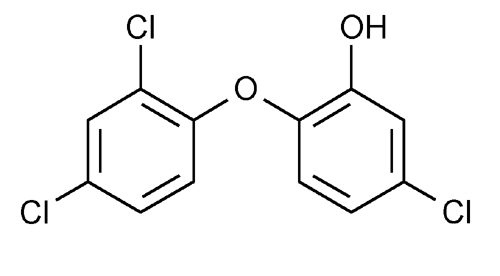
 289.54
Phenol, 5-chloro-2-(2,4-dichlorophenoxy)-.
2,4,4¢-Trichloro-2¢-hydroxydiphenyl ether
[3380-34-5].» Triclosan contains not less than 97.0 percent and not more than 103.0 percent of C12H7Cl3O2, calculated on the anhydrous basis.
Packaging and storage—
Preserve in tight, light-resistant containers.
USP Reference standards  11
11 —
—
USP 2,4-Dichlorophenol RS .
.
USP Parachlorophenol RS .
USP Triclosan RS.
USP Triclosan Related Compounds Mixture A RS .
11—
USP 2,4-Dichlorophenol RS
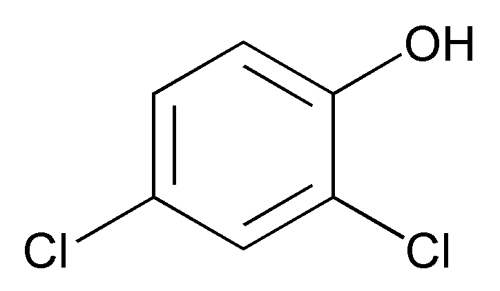 .
.
USP Parachlorophenol RS
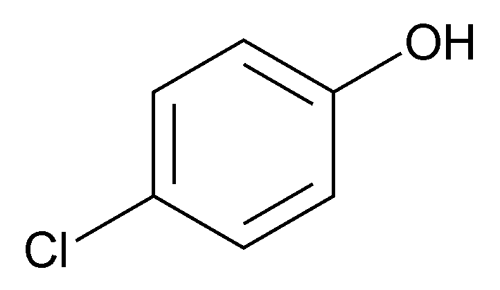 .
.
USP Triclosan RS.
USP Triclosan Related Compounds Mixture A RS
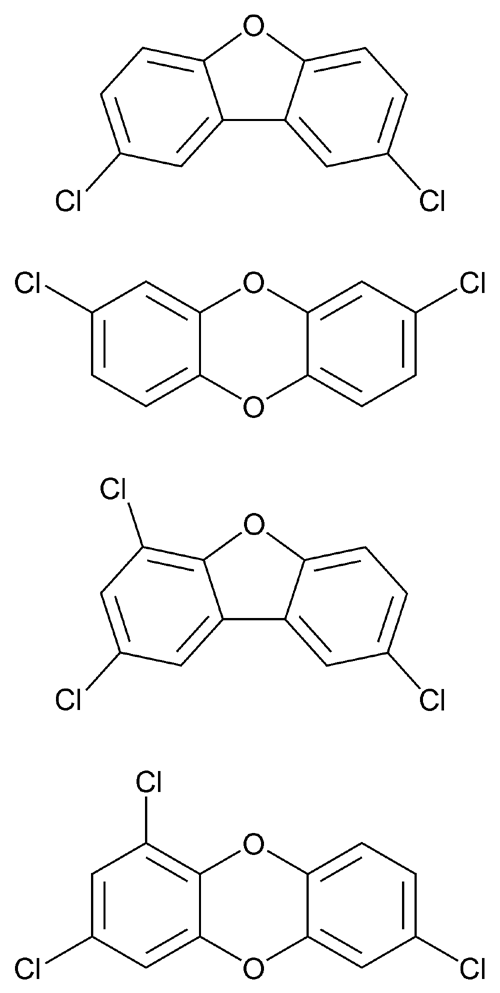 .
.
Identification—
B:
The retention time of the major peak in the chromatogram of the Assay preparation corresponds to that in the chromatogram of the Standard preparation, as obtained in the Assay.
Water, Method I 921:
not more than 0.1%.
921:
not more than 0.1%.
Completeness of solution 641—
A solution of 1.40 g of Triclosan in 10 mL of acetone is clear.
641—
A solution of 1.40 g of Triclosan in 10 mL of acetone is clear.
Heavy metals, Method II 231:
0.002%.
231:
0.002%.
Related compounds—
Chromatographic system—
Proceed as directed in the Assay.
Test solution—
Use the Assay preparation.
Procedure—
Inject a volume (about 0.5 µL) of the Test solution into the chromatograph, increase the column temperature by 20 per minute to 140, then increase column temperature by 4 per minute to 240, maintain this temperature for not less than 5 minutes, record the chromatogram, and measure the peak responses. Calculate the percentage of each impurity in the portion of Triclosan taken by the formula:
per minute to 140, then increase column temperature by 4 per minute to 240, maintain this temperature for not less than 5 minutes, record the chromatogram, and measure the peak responses. Calculate the percentage of each impurity in the portion of Triclosan taken by the formula:
100(ri / rs)
in which ri is the peak response for each impurity; and rs is the sum of the responses of all of the peaks: not more than 0.1% of any individual impurity is found; and not more than 0.5% of total impurities is found.
Limit of monochlorophenols and 2,4-dichlorophenol—
Phosphate buffer—
Transfer about 1.38 g of anhydrous monobasic sodium phosphate and about 1.42 g of dibasic sodium phosphate to a 1-L volumetric flask, dissolve in and dilute with water to volume, and mix.
Mobile phase—
Prepare a filtered and degassed mixture of acetonitrile and Phosphate buffer (1:1). Make adjustments if necessary (see System Suitability under Chromatography 621).
621).
Standard solution—
Quantitatively dissolve accurately weighed quantities of USP Parachlorophenol RS and USP 2,4-Dichlorophenol RS in acetonitrile, dilute with an equal volume of water, and mix. Transfer a portion of this solution to a suitable container, and dilute quantitatively, and stepwise if necessary, with a mixture of acetonitrile and water (1:1) to obtain a solution having known concentrations of about 0.5 µg of parachlorophenol and 0.1 µg of 2,4-dichlorophenol per mL.
Test solution—
Transfer about 250 mg of Triclosan, accurately weighed, to a 25-mL low-actinic volumetric flask, dissolve in 20 mL of acetonitrile, dilute with water to volume, and mix.
Chromatographic system (see Chromatography 621)—
The liquid chromatograph is equipped with a coulometric electrochemical detector with electrode 1 set at 0.45 V and electrode 2 set at 0.75 V, both having a positive (oxidative) polarity and a 4.6-mm × 25-cm column that contains packing L1. The flow rate is about 1 mL per minute. Chromatograph the Standard solution, and record the peak responses as directed for Procedure: the relative standard deviation for replicate injections is not more than 9.0% for 2,4-dichlorophenol.
621)—
The liquid chromatograph is equipped with a coulometric electrochemical detector with electrode 1 set at 0.45 V and electrode 2 set at 0.75 V, both having a positive (oxidative) polarity and a 4.6-mm × 25-cm column that contains packing L1. The flow rate is about 1 mL per minute. Chromatograph the Standard solution, and record the peak responses as directed for Procedure: the relative standard deviation for replicate injections is not more than 9.0% for 2,4-dichlorophenol.
Procedure—
Separately inject equal volumes (about 20 µL) of the Standard solution and the Test solution into the chromatograph, record the chromatograms, and measure the peak responses. The peak responses for parachlorophenol and 2,4-dichlorophenol in the chromatogram of the Test solution are not greater than the corresponding peaks in the chromatogram of the Standard solution.
Limit of 1,3,7-trichlorodibenzo-p-dioxin, 2,8-dichlorodibenzo-p-dioxin, 2,8-dichlorodibenzofuran, and 2,4,8-trichlorodibenzofuran—
Mobile phase—
Prepare a filtered and degassed mixture of acetonitrile, water, and glacial acetic acid (70:30:0.1). Make adjustments if necessary (see System Suitability under Chromatography 621).
621).
Test solution—
Transfer about 2.0 g of Triclosan, accurately weighed, to a screw-capped centrifuge tube, add 5 mL of 2 N potassium hydroxide, and shake for 10 minutes to dissolve. Add 3 mL of n-hexane, shake for 10 minutes, and allow the phases to separate. Transfer the organic layer to a suitable container, add another 3 mL of n-hexane to the aqueous layer, shake for 10 minutes, and allow the phases to separate. Transfer the organic layer to the previous extract, discard the aqueous layer, add 3 mL of 2 N potassium hydroxide to the combined organic layers, shake for 10 minutes, and allow the phases to separate. Discard the aqueous layer, add another 3 mL of 2 N potassium hydroxide to the combined organic layers, shake for 10 minutes, and allow the phases to separate. Transfer the organic layer to a suitable container, and evaporate with the aid of a stream of nitrogen to dryness. Dissolve the residue in 1.0 mL of methanol, and mix.
Chromatographic system (see Chromatography 621)—
The liquid chromatograph is equipped with a 220-nm detector and a 4.6-mm × 25-cm column that contains packing L1. The flow rate is about 1.5 mL per minute. Chromatograph the USP Triclosan Related Compounds Mixture A RS, and record the peak responses as directed for Procedure: the relative retention times are about 0.59 for 2,8-dichlorodibenzofuran, 0.71 for 2,8-dichlorodibenzo-p-dioxin, 0.88 for 2,4,8-trichlorodibenzofuran, and 1.0 for 1,3,7-trichlorodibenzo-p-dioxin; and the relative standard deviation for replicate injections is not more than 15.0%, determined from the 2,8-dichlorodibenzo-p-dioxin peak.
621)—
The liquid chromatograph is equipped with a 220-nm detector and a 4.6-mm × 25-cm column that contains packing L1. The flow rate is about 1.5 mL per minute. Chromatograph the USP Triclosan Related Compounds Mixture A RS, and record the peak responses as directed for Procedure: the relative retention times are about 0.59 for 2,8-dichlorodibenzofuran, 0.71 for 2,8-dichlorodibenzo-p-dioxin, 0.88 for 2,4,8-trichlorodibenzofuran, and 1.0 for 1,3,7-trichlorodibenzo-p-dioxin; and the relative standard deviation for replicate injections is not more than 15.0%, determined from the 2,8-dichlorodibenzo-p-dioxin peak.
Procedure—
Inject a volume (about 20 µL) of the Test solution into the chromatograph, record the chromatogram, and measure the peak responses. Calculate the concentration of each analyte in the portion of Triclosan taken by the formula:
(C / W)(ri / rS)
in which C is the concentration, in µg per mL, of the respective analyte in the USP Triclosan Related Compounds Mixture A RS; W is the weight, in g, of Triclosan taken; and ri and rS are the peak responses for the respective analyte obtained from the Test solution and the USP Triclosan Related Compounds Mixture A RS, respectively: not more than 0.25 ppm of 2,8-dichlorodibenzofuran is found; not more than 0.5 ppm of 2,4,8-trichlorodibenzofuran is found; not more than 0.25 ppm of 1,3,7-trichlorodibenzo-p-dioxin is found; and not more than 0.5 ppm of 2,8-dichlorodibenzo-p-dioxin is found.
Limit of 2,3,7,8-tetrachlorodibenzo-p-dioxin and 2,3,7,8-tetrachlorodibenzofuran—
[Caution—2,3,7,8-tetrachlorodibenzo-p-dioxin and 2,3,7,8-tetrachlorodibenzofuran are extremely toxic substances. Exercise all necessary precautions in the conduct of this procedure.
]
Stationary phase A—
Transfer about 10 g of silica gel to a suitable container, add about 3 mL of 1 N sodium hydroxide, and mix.
Stationary phase B—
Transfer about 60 g of silica gel to a suitable container, add about 74 mL of concentrated sulfuric acid, and mix.
Chromatographic column A—
Transfer 5.1 g of Stationary phase A, 0.5 g of silica gel, 6.2 g of Stationary phase B, and 3.2 g of sodium sulfate to a glass chromatographic column having an internal diameter of 10 mm. Wash the column with 50 mL of n-hexane, and discard the eluate.
Chromatographic column B—
Transfer 2.5 g of alumina and 2.5 g of sodium sulfate to a glass chromatographic column having an internal diameter of 6 mm. Wash the column with 30 mL of n-hexane, and discard the eluate.
Internal standard solution—
Transfer accurately measured quantities of 2,3,7,8-tetrachlorodibenzo-p-dioxin, 13C-labeled, and 2,3,7,8-tetrachlorodibenzofuran, 13C-labeled, in nonane, and dilute quantitatively, and stepwise if necessary, with 2,2,4-trimethylpentane to obtain a solution having known concentrations of about 1.0 pg of each per µL.
Test solution—
Transfer about 30 g of Triclosan, accurately weighed, to a separatory funnel, add 30 µL of Internal standard solution, dissolve in 200 mL of 1 N sodium hydroxide, extract with four 30-mL portions of n-hexane, and combine the extracts. Wash the combined extracts with 20 mL of water, extract the washing with 15 mL of n-hexane, and add the extract to the other combined extracts. Add about 3 g of anhydrous sodium sulfate to the combined extracts, allow to stand for 30 minutes, quantitatively transfer to an appropriate round-bottom flask, and distill, using a distillation apparatus with a vigreux column, until about 1 mL remains. Transfer this solution to the top of Chromatographic column A, and elute with 50 mL of n-hexane. Collect the eluate on top of Chromatographic column B, and elute with 30 mL of a mixture of n-hexane and methylene chloride (98:2), discarding the eluate. Elute with 40 mL of a mixture of n-hexane and methylene chloride (1:1), collecting the eluates in a round-bottom flask. Distill the combined eluates, using a distillation apparatus with a vigreux column, until about 1 mL remains. Further concentrate this solution with the aid of a stream of nitrogen to about 50 µL, evaporate at room temperature to dryness, and dissolve in 10 µL of 2,2,4-trimethylpentane.
Chromatographic system (see Chromatography 621 and Mass Spectrometry 736)—
The gas chromatograph is equipped with a high-resolution mass spectrograph with an electron-impact ionization source and a 0.25-mm × 60-m capillary column coated with phase G48. The carrier gas is helium. The chromatograph is programmed as follows. Initially the temperature of the column is equilibrated at 80, then, 1 minute after the injection, the temperature is increased at a rate of 20 per minute to 220, then increased at a rate of 2 per minute to 270, and maintained at 270 for not less than 20 minutes. The injection port temperature is maintained at 280. Chromatograph the Internal standard solution, and record the peak responses as directed for Procedure: the signal-to-noise ratio at a mass-to-charge ratio of 321.89 is not less than 50.
621 and Mass Spectrometry 736)—
The gas chromatograph is equipped with a high-resolution mass spectrograph with an electron-impact ionization source and a 0.25-mm × 60-m capillary column coated with phase G48. The carrier gas is helium. The chromatograph is programmed as follows. Initially the temperature of the column is equilibrated at 80, then, 1 minute after the injection, the temperature is increased at a rate of 20 per minute to 220, then increased at a rate of 2 per minute to 270, and maintained at 270 for not less than 20 minutes. The injection port temperature is maintained at 280. Chromatograph the Internal standard solution, and record the peak responses as directed for Procedure: the signal-to-noise ratio at a mass-to-charge ratio of 321.89 is not less than 50.
Procedure—
Inject a volume (about 1 µL) of the Test solution into the chromatograph, record the chromatograms, and measure the peak responses at mass-to-charge ratios of 319.90, 321.89, 331.88, 333.93, 303.90, 305.90, 315.94, and 317.94. The peak response for 2,3,7,8-tetrachlorodibenzo-p-dioxin at a mass-to-charge ratio of 319.90 is not more than the peak response of the associated internal standard at a mass-to-charge ratio of 331.88; the peak response for 2,3,7,8-tetrachlorodibenzofuran at a mass-to-charge ratio of 303.90 is not more than the peak response of the associated internal standard at a mass-to-charge ratio of 315.94.
Assay—
Standard preparation—
Dissolve an accurately weighed quantity of USP Triclosan RS in ethyl acetate, and dilute quantitatively, and stepwise if necessary, with ethyl acetate to obtain a solution having a known concentration of about 0.4 mg per mL.
Assay preparation—
Transfer about 40 mg of Triclosan, accurately weighed, to a 100-mL volumetric flask, dissolve in and dilute with ethyl acetate to volume, and mix.
Chromatographic system (see Chromatography 621)—
The gas chromatograph is equipped with a flame-ionization detector and a 0.53-mm × 15-m capillary column with phase G3. The carrier gas is helium maintained at about 6 psi. The injection port temperature is maintained at 34 and is increased rapidly to 200 immediately after the injection, the column temperature is maintained at 34, and the detector temperature is maintained at 260. Chromatograph the Standard preparation, and record the peak responses as directed for Procedure: the relative standard deviation for replicate injections is not more than 2.0%.
621)—
The gas chromatograph is equipped with a flame-ionization detector and a 0.53-mm × 15-m capillary column with phase G3. The carrier gas is helium maintained at about 6 psi. The injection port temperature is maintained at 34 and is increased rapidly to 200 immediately after the injection, the column temperature is maintained at 34, and the detector temperature is maintained at 260. Chromatograph the Standard preparation, and record the peak responses as directed for Procedure: the relative standard deviation for replicate injections is not more than 2.0%.
Procedure—
Separately inject equal volumes (about 2.0 µL) of the Standard preparation and the Assay preparation into the chromatograph, increase the column temperature by 20 per minute to 140, then increase the column temperature by 4 per minute to 240, maintain this temperature for not less than 5 minutes, record the chromatograms, and measure the responses for the major peaks. Calculate the quantity, in mg, of C12H7Cl3O2 in the portion of Triclosan taken by the formula:
per minute to 140, then increase the column temperature by 4 per minute to 240, maintain this temperature for not less than 5 minutes, record the chromatograms, and measure the responses for the major peaks. Calculate the quantity, in mg, of C12H7Cl3O2 in the portion of Triclosan taken by the formula:
100C(rU / rS)
in which C is the concentration, in mg per mL, of USP Triclosan RS in the Standard preparation; and rU and rS are the peak responses obtained from the Assay preparation and the Standard preparation, respectively.
Auxiliary Information—
Please check for your question in the FAQs before contacting USP.
Chromatographic Column—
| Topic/Question | Contact | Expert Committee |
| Monograph | Behnam Davani, Ph.D., M.B.A.
Senior Scientist 1-301-816-8394 |
(MDAA05) Monograph Development-Antivirals and Antimicrobials |
| Reference Standards | Lili Wang, Technical Services Scientist 1-301-816-8129 RSTech@usp.org |
USP32–NF27 Page 3795
Pharmacopeial Forum: Volume No. 33(4) Page 681
Chromatographic columns text is not derived from, and not part of, USP 32 or NF 27.