Raloxifene Hydrochloride Tablets
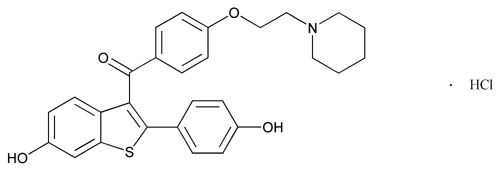
» Raloxifene Hydrochloride Tablets contain not less than 93.0 percent and not more than 107.0 percent of the labeled amount of raloxifene hydrochloride (C28H27NO4S·HCl).
Packaging and storage—
Preserve in tight containers, and store at controlled room temperature.
Identification—
A: Infrared Absorption  197K
197K —Obtain the test specimen as follows. Transfer a quantity of powdered Tablets, equivalent to about 120 mg of raloxifene hydrochloride, to a suitable container, add 20 mL of water, and shake to form a uniform slurry. Centrifuge, and discard the supernatant. Add 5 mL of isopropyl alcohol, shake to form a slurry, filter, and rinse the residue with isopropyl alcohol. Dry the residue at 105
 for 30 minutes. Prepare a potassium bromide dispersion. Similarly prepare the standard specimen, starting with a slurry containing 12 mg of USP Raloxifene Hydrochloride RS per mL of water.
197K
—Obtain the test specimen as follows. Transfer a quantity of powdered Tablets, equivalent to about 120 mg of raloxifene hydrochloride, to a suitable container, add 20 mL of water, and shake to form a uniform slurry. Centrifuge, and discard the supernatant. Add 5 mL of isopropyl alcohol, shake to form a slurry, filter, and rinse the residue with isopropyl alcohol. Dry the residue at 105 for 30 minutes. Prepare a potassium bromide dispersion. Similarly prepare the standard specimen, starting with a slurry containing 12 mg of USP Raloxifene Hydrochloride RS per mL of water.
B:
The retention time of the major peak in the chromatogram of the Assay preparation corresponds to that in the chromatogram of the Standard preparation, as obtained in the Assay.
Dissolution 711—
711—
Medium:
0.1% polysorbate 80; 1000 mL.
Apparatus 2:
50 rpm.
Time:
30 minutes.
Determine the amount of C28H27NO4S·HCl dissolved employing the following method.
Mobile phase—
Prepare a filtered and degassed mixture of acetonitrile, water, and triethylamine (500:500:2). Adjust with phosphoric acid to a pH of 4.0, filter, and degas. Make adjustments if necessary (see System Suitability under Chromatography 621).
621).
Triethylamine phosphate suspension—
Add 2.0 mL of triethylamine to 500 mL of acetonitrile, mix, and adjust with phosphoric acid to a pH of 4.0. [note—Triethylamine phosphate will precipitate; keep the suspension well mixed.]
Standard solution—
Dissolve an accurately weighed quantity of USP Raloxifene Hydrochloride RS in methanol, and dilute quantitatively, and stepwise if necessary, with methanol to obtain a solution having a known concentration equivalent to the expected concentration of the solution under test. Transfer 5.0 mL of this solution to a suitable container, add 5.0 mL of Triethylamine phosphate suspension, and mix.
Test solution—
Pass a portion of the solution under test through an appropriate filter having a porosity of 0.45 µm. Transfer 5.0 mL of the filtrate to a suitable container, add 5.0 mL of Triethylamine phosphate suspension, and mix.
Chromatographic system (see Chromatography 621)—
The liquid chromatograph is equipped with a 290-nm detector and a 4.6-mm × 15-cm column that contains 3.5-µm base-deactivated packing L10. If the analyte peak splits, use a guard column containing packing L3. The flow rate is about 2 mL per minute. Chromatograph the Standard solution, and record the peak responses as directed for Procedure: the relative standard deviation for replicate injections is not more than 2.0%.
621)—
The liquid chromatograph is equipped with a 290-nm detector and a 4.6-mm × 15-cm column that contains 3.5-µm base-deactivated packing L10. If the analyte peak splits, use a guard column containing packing L3. The flow rate is about 2 mL per minute. Chromatograph the Standard solution, and record the peak responses as directed for Procedure: the relative standard deviation for replicate injections is not more than 2.0%.
Procedure—
Separately inject equal volumes (about 50 µL) of the Standard solution and the Test solution into the chromatograph, record the chromatograms, and measure the peak responses. Determine the percentage of C28H27NO4S·HCl dissolved by the formula:
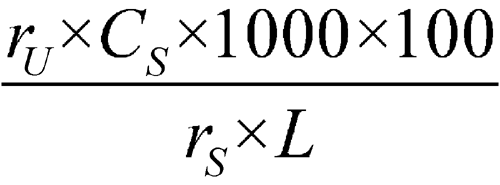 in which rU and rS are the peak responses obtained from the Test solution and the Standard solution, respectively; CS is the concentration, in mg per mL, of raloxifene hydrochloride in the Standard solution; 1000 is the volume, in mL, of Medium; 100 is the conversion factor to percentage; and L is the Tablet label claim, in mg.
Tolerances—
Not less than 80% (Q) of the labeled amount of C28H27NO4S·HCl is dissolved in 30 minutes.
Uniformity of dosage units 905:
meet the requirements.
905:
meet the requirements.
Related compounds—
Buffer solution—
Dissolve 9.0 g of monobasic potassium phosphate in 1000 mL of water, and mix. Add 0.5 mL of phosphoric acid, adjust with phosphoric acid or potassium hydroxide solution to a pH of 3.0 ± 0.1, and mix.
Solution A—
Prepare a filtered and degassed mixture of Buffer solution and acetonitrile (75:25).
Solution B—
Prepare a filtered and degassed mixture of Buffer solution and acetonitrile (50:50).
Mobile phase—
Use variable mixtures of Solution A and Solution B as directed for Chromatographic system. Make adjustments if necessary (see System Suitability under Chromatography 621).
621).
Diluent—
Prepare a mixture of acetonitrile and Buffer solution (60:40).
System suitability stock solution—
Transfer about 6 mg of USP Raloxifene Hydrochloride RS to a 50-mL volumetric flask. Add 15.0 mL of acetonitrile, 3.0 mL of water, and 5.0 mL of 30 percent hydrogen peroxide (unstabilized). Mix and dissolve the raloxifene hydrochloride. Shake the solution for approximately 30 minutes, followed by approximately 30 minutes of sonication. Keep at 30 for at least 6 hours. Dilute with Diluent to 50.0 mL.
[note—Raloxifene hydrochloride is partly converted to raloxifene N-oxide under these conditions. The reaction time can be varied as necessary to achieve an appropriate level of raloxifene N-oxide.]
for at least 6 hours. Dilute with Diluent to 50.0 mL.
[note—Raloxifene hydrochloride is partly converted to raloxifene N-oxide under these conditions. The reaction time can be varied as necessary to achieve an appropriate level of raloxifene N-oxide.]
System suitability solution—
Transfer about 15 mg of USP Raloxifene Hydrochloride RS to a 50-mL volumetric flask, and add 5.0 mL of System suitability stock solution and 20 mL of Diluent. Dilute with Solution A to volume, and mix.
Standard solution—
Dissolve an accurately weighed quantity of USP Raloxifene Hydrochloride RS in Diluent, and dilute quantitatively, and stepwise if necessary, with Diluent to obtain a solution having a known concentration of about 0.06 mg per mL. Transfer 5 mL of this solution to a 100-mL volumetric flask, and add 45 mL of Diluent. Dilute with Solution A to volume to obtain a solution having a known concentration of about 0.003 mg per mL.
Test solution—
Transfer a sufficient quantity of Tablets to a volumetric flask of suitable size to obtain a solution of raloxifene hydrochloride having a concentration of 6 mg per mL, based on the label claim. Add Diluent, and shake to disintegrate the Tablets. Sonicate, if necessary, and add Diluent to volume. Transfer 5 mL of this solution to a 10-mL volumetric flask, and dilute with Solution A to volume to obtain a solution having a concentration of about 3 mg of raloxifene hydrochloride per mL, based on the label claim. Filter, and use the clear solution.
Chromatographic system (see Chromatography 621)—
The liquid chromatograph is equipped with a 280-nm detector and a 4.6-mm × 25-cm column that contains 5-µm base-deactivated L7 packing. The column temperature is maintained at 35. The flow rate is about 1 mL per minute. The chromatograph is programmed as follows.
[note—Adjust the start time of the gradient step on the basis of the instrument's dwell volume.] Chromatograph the System suitability solution, and record the peak responses as directed for Procedure: the resolution, R, between raloxifene and raloxifene N-oxide is not less than 3.0; and the tailing factor for the raloxifene peak is not more than 2.0.
621)—
The liquid chromatograph is equipped with a 280-nm detector and a 4.6-mm × 25-cm column that contains 5-µm base-deactivated L7 packing. The column temperature is maintained at 35. The flow rate is about 1 mL per minute. The chromatograph is programmed as follows.
| Time (minutes) |
Solution A
(%) |
Solution B
(%) |
 Elution Elution |
| 0.00–5.00 | 100 | 0 | isocratic |
| 5.00–36.25 | 100®0 | 0®100 | linear gradient |
| 36.25–38.25 | 0®100 | 100®0 | linear gradient |
| 38.25–48.00 | 100 | 0 | equilibration |
Procedure—
Separately inject equal volumes (about 10 µL) of the Standard solution and Test solution into the chromatograph, record the chromatograms for not less than two times the retention time of the raloxifene peak, and measure all the peak responses. Calculate the percentage of each impurity in the portion of Tablets taken by the formula:
100(CS / CU)(ri / rS)
in which CS is the concentration, in mg per mL, of raloxifene hydrochloride in the Standard solution; CU is the concentration, in mg per mL, of raloxifene hydrochloride in the Test solution; ri is the response for each impurity in the Test solution; and rS is the response of the raloxifene peak obtained from the Standard solution: the limits are as shown in the table below.
| Related Compound | Relative Retention Time | Limit (%) |
| Raloxifene | 1.00 | — |
| Raloxifene N-oxide1 | 1.17 | not more than 0.3 |
| Any unspecified individual impurity | — | not more than 0.2 |
| Total impurities | — | not more than 1.0 |
|
1
Methanone, [6-hydroxy-2-(4-hydroxyphenyl)benzo[b]thien-3-yl][4-[2-(1-oxido-1-piperidinyl)ethoxy]phenyl.
|
||
Assay—
Buffer solution—
Dissolve 7.2 g of monobasic potassium phosphate in 1000 mL of water, and mix. Add 1.3 mL of phosphoric acid, adjust with phosphoric acid or potassium hydroxide solution to a pH of 2.5 ± 0.1, and mix.
Mobile phase—
Prepare a filtered and degassed mixture of the Buffer solution and acetonitrile (67:33). Make adjustments if necessary (see System Suitability under Chromatography 621).
621).
Diluent—
Prepare a mixture of acetonitrile and Buffer solution (60:40).
System suitability stock solution—
Prepare as directed in the test for Related compounds.
Standard preparation—
Dissolve an accurately weighed quantity of USP Raloxifene Hydrochloride RS in Diluent, and dilute quantitatively, and stepwise if necessary, with Diluent to obtain a solution having a known concentration of about 0.06 mg per mL.
Assay preparation—
Transfer a sufficient quantity of Tablets to a volumetric flask of suitable size, add Diluent, and shake to disintegrate the Tablets. Sonicate if necessary. Dilute quantitatively with Diluent to obtain a solution having a concentration of about 0.06 mg of raloxifene hydrochloride per mL, based on the label claim. Filter, and use the clear solution.
Chromatographic system (see Chromatography 621)—
The liquid chromatograph is equipped with a 280-nm detector and a 4.6-mm × 15-cm column that contains 3.5-µm base-deactivated L7 packing. The column temperature is maintained at 35. The flow rate is about 1.5 mL per minute. Chromatograph the System suitability stock solution, and record the peak responses as directed for Procedure: the resolution, R, between raloxifene and raloxifene N-oxide is not less than 2.0; and the tailing factor for the raloxifene peak is not more than 2.0. Chromatograph the Standard preparation, and record the peak responses as directed for Procedure: the relative standard deviation for replicate injections is not more than 1.0%.
621)—
The liquid chromatograph is equipped with a 280-nm detector and a 4.6-mm × 15-cm column that contains 3.5-µm base-deactivated L7 packing. The column temperature is maintained at 35. The flow rate is about 1.5 mL per minute. Chromatograph the System suitability stock solution, and record the peak responses as directed for Procedure: the resolution, R, between raloxifene and raloxifene N-oxide is not less than 2.0; and the tailing factor for the raloxifene peak is not more than 2.0. Chromatograph the Standard preparation, and record the peak responses as directed for Procedure: the relative standard deviation for replicate injections is not more than 1.0%.
Procedure—
Separately inject equal volumes (about 10 µL) of the Standard preparation and the Assay preparation into the chromatograph, record the chromatograms, and measure the responses for the raloxifene peaks. Calculate the percentage of raloxifene hydrochloride (C28H27NO4S·HCl), based on the label claim, in the portion of Tablets taken by the formula:
100(CS / CU)(rU / rS)
in which CS is the concentration, in mg per mL, of raloxifene hydrochloride in the Standard preparation; CU is the concentration, in mg per mL, of raloxifene hydrochloride in the Assay preparation, based on the label claim; and rU and rS are the peak responses obtained from the Assay preparation and the Standard preparation, respectively.
Auxiliary Information—
Please check for your question in the FAQs before contacting USP.
Chromatographic Column—
| Topic/Question | Contact | Expert Committee |
| Monograph | Daniel K. Bempong, Ph.D.
Senior Scientist 1-301-816-8143 |
(MDPS05) Monograph Development-Pulmonary and Steroids |
| Reference Standards | Lili Wang, Technical Services Scientist 1-301-816-8129 RSTech@usp.org |
|
| 711 |
Margareth R.C. Marques, Ph.D.
Senior Scientist 1-301-816-8106 |
(BPC05) Biopharmaceutics05 |
USP32–NF27 Page 3472
Pharmacopeial Forum: Volume No. 33(4) Page 676
Chromatographic columns text is not derived from, and not part of, USP 32 or NF 27.