Bacitracin
Bacitracin
 [1405-87-4].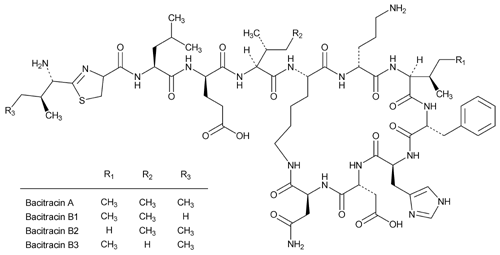
» Bacitracin is a mixture of polypeptides produced by the growth of an organism of the licheniformis group of Bacillus subtilis (Fam. Bacillacaea), the main components being bacitracins A, B1, B2, and B3. It has a potency of not less than 65 Bacitracin Units per mg, calculated on the dried basis.
Packaging and storage—
Preserve in tight containers, and store in a cool place.
Labeling—
Where it is packaged for prescription compounding, label it to indicate that it is not sterile and that the potency cannot be assured for longer than 60 days after opening, and to state the number of Bacitracin Units per milligram. Where it is intended for use in preparing injectable or other sterile dosage forms, the label states that it is sterile or must be subjected to further processing during the preparation of injectable or other sterile dosage forms.
Identification—
A: Thin-Layer Chromatographic Identification Test  201BNP
 :
meets the requirements.
:
meets the requirements.
201BNP:
meets the requirements.
B:
It meets the requirements of the liquid chromatographic procedure in the test for Composition.
pH 791:
between 5.5 and 7.5, in a solution containing 10,000 Bacitracin Units per mL.
791:
between 5.5 and 7.5, in a solution containing 10,000 Bacitracin Units per mL.
Loss on drying 731—
Dry about 100 mg in a capillary-stoppered bottle in vacuum at a pressure not exceeding 5 mm of mercury at 60 for 3 hours: it loses not more than 5.0% of its weight.
731—
Dry about 100 mg in a capillary-stoppered bottle in vacuum at a pressure not exceeding 5 mm of mercury at 60 for 3 hours: it loses not more than 5.0% of its weight.
Residue on ignition 281:
not more than 0.5%.
281:
not more than 0.5%.
Composition—
Buffer—
Dissolve 34.8 g of dibasic potassium phosphate in 1 L of water. Adjust with 27.2 g of monobasic potassium phosphate dissolved in 1 L of water to a pH of 6.0.
Mobile phase—
Prepare a mixture of methanol, water, Buffer, and acetonitrile (26:15:5:2), mix well, and degas.
System suitability solution—
Dissolve an accurately weighed quantity of USP Bacitracin Zinc RS in water, add diluted hydrochloric acid, using about 2% of the final volume, and dilute with water to obtain a solution with a nominal concentration of about 2.0 mg per mL.
Reporting threshold solution—
Dilute quantitatively, with Mobile phase, a suitable volume of System suitability solution to obtain a solution having a known concentration of 0.01 mg per mL. This solution is used to determine the reporting threshold.
Peak identification solution—
Dissolve a suitable quantity of USP Bacitracin Zinc RS in a suitable volume of a 40 g per L solution of sodium edetate (pH adjusted to 7.0 with dilute sodium hydroxide), to obtain a solution having a nominal concentration of about 2.0 mg per mL. Heat in a boiling water bath for 30 minutes. Cool to room temperature.
Test solution—
Dissolve an accurately weighed quantity of Bacitracin in Mobile phase to obtain a solution having a known concentration of about 2.0 mg per mL.
Chromatographic system (see Chromatography 621)—
The liquid chromatograph is equipped with an absorbance detector and an end-capped, 4.6-mm × 25-cm column that contains 5-µm packing L1. The flow rate is 1.0 mL per minute. Set the wavelength of the detector at 300 nm. Inject about 100 µL of the Peak identification solution, and identify the location of bacitracin F, which is a known impurity, using the relative retention time given in Table 1. Change the wavelength of the detector and set it to 254 nm. Chromatograph the System suitability solution, and record the peak responses as directed for Procedure: identify the peaks of the most active components of bacitracin (bacitracins A, B1, B2, and B3), early eluting peptides (those eluting before the peak due to bacitracin B1) and the impurity, bacitracin F, using the relative retention time values given in Table 1. Calculate the peak-to-valley ratio by the formula:
621)—
The liquid chromatograph is equipped with an absorbance detector and an end-capped, 4.6-mm × 25-cm column that contains 5-µm packing L1. The flow rate is 1.0 mL per minute. Set the wavelength of the detector at 300 nm. Inject about 100 µL of the Peak identification solution, and identify the location of bacitracin F, which is a known impurity, using the relative retention time given in Table 1. Change the wavelength of the detector and set it to 254 nm. Chromatograph the System suitability solution, and record the peak responses as directed for Procedure: identify the peaks of the most active components of bacitracin (bacitracins A, B1, B2, and B3), early eluting peptides (those eluting before the peak due to bacitracin B1) and the impurity, bacitracin F, using the relative retention time values given in Table 1. Calculate the peak-to-valley ratio by the formula:
HP / HV
where HP is the height above the baseline of the peak due to bacitracin B1 and HV is the height above the baseline of the lowest point of the curve separating bacitracin B1 peak from the peak due to bacitracin B2. The peak-to-valley ratio is not less than 1.2.
Procedure—
Separately inject equal volumes (about 100 µL) of the Mobile phase, the Test solution, and the Reporting threshold solution. Record the chromatograms for about 3 times the retention time of bacitracin A. Identify the peaks using the relative retention time values given in Table 1. Measure the peak areas of all peaks in the Test solution.
[note—Disregard any peak in the Test solution having an area less than the area of bacitracin A in the Reporting threshold solution; and disregard any peak observed in the blank run.]
Table 1
| Component Name | Relative Retention Time (approximate) |
| Bacitracin C1 | 0.5 |
| Bacitracin C2 | 0.6 |
| Bacitracin C3 | 0.6 |
| Bacitracin B1 | 0.7 |
| Bacitracin B2 | 0.7 |
| Bacitracin B3 | 0.8 |
| Bacitracin A | 1.0 |
| Bacitracin F | 2.4 |
Total area
in the following calculations is defined as the area of all peaks except the reporting threshold.
content of bacitracin a—
Calculate the percentage of bacitracin A, by the formula:
(r A / Total area)×100
where rA is the area response from bacitracin A. The bacitracin A content is not less than 40.0% of the Total area.
content of active bacitracin—
Calculate the percentage of active bacitracin (bacitracin A, B1, B2, and B3) by the formula:
((rA + rB1 + rB2 + rB3) / Total area) × 100
where rA, rB1, rB2, and rB3 are the area responses from bacitracin A, B1, B2, and B3, respectively. The sum of bacitracins A, B1, B2, and B3 is not less than 70.0% of the Total area.
limit of early eluting peptides—
Calculate the percentage of all peaks eluting before the peak due to bacitracin B1, by the formula:
(rPreB1 / Total area) × 100
where rPreB1 is the sum of the responses of all peaks eluting before the peak for bacitracin B1. The limit of early eluting peptides (those eluting before the peak due to bacitracin B1) is not more than 20.0%.
limit of bacitracin f—
Calculate the percentage of bacitracin F by the formula:
100 × (r F / r.A )
where rF is the response of bacitracin F from the Test solution and r.A is the response of bacitracin A from the Test solution. The limit of bacitracin F, a known impurity, is not more than 6.0%.
Other requirements—
Where the label states that Bacitracin is sterile, it meets the requirements for Sterility Tests 71 and, where intended for injectable dosage forms, for Bacterial endotoxins under Bacitracin for Injection. Where the label states that Bacitracin must be subjected to further processing during the preparation of injectable dosage forms, it meets the requirements for Bacterial endotoxins under Bacitracin for Injection.
71 and, where intended for injectable dosage forms, for Bacterial endotoxins under Bacitracin for Injection. Where the label states that Bacitracin must be subjected to further processing during the preparation of injectable dosage forms, it meets the requirements for Bacterial endotoxins under Bacitracin for Injection.
Assay—
Proceed with Bacitracin as directed under Antibiotics—Microbial Assays 81.
81.
Auxiliary Information—
Please check for your question in the FAQs before contacting USP.
Chromatographic Column—
| Topic/Question | Contact | Expert Committee |
| Monograph | Ahalya Wise, M.S.
Scientist 1-301-816-8161 |
(MDANT05) Monograph Development-Antibiotics |
| Reference Standards | Lili Wang, Technical Services Scientist 1-301-816-8129 RSTech@usp.org |
USP32–NF27 Page 1620
Pharmacopeial Forum: Volume No. 33(5) Page 873
Chromatographic columns text is not derived from, and not part of, USP 32 or NF 27.