Anticoagulant Citrate Dextrose Solution
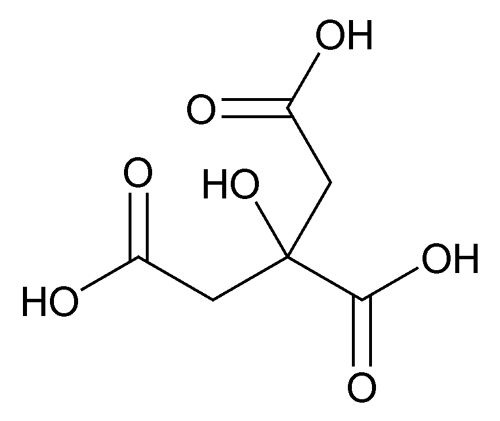
» Anticoagulant Citrate Dextrose Solution is a sterile solution of Citric Acid, Sodium Citrate, and Dextrose in Water for Injection. It contains in each 1000 mL:
| Solution A |
Solution B |
|
| Total Citrate, expressed as citric acid, anhydrous (C6H8O7) | ||
 not less than not less than |
20.59 g | 12.37 g |
| not more than |
22.75 g | 13.67 g |
| Dextrose (C6H12O6·H2O) | ||
| not less than |
23.28 g | 13.96 g |
| not more than |
25.73 g | 15.44 g |
| Sodium (Na) | ||
| not less than |
4.90 g | 2.94 g |
| not more than |
5.42 g | 3.25 g |
It contains no antimicrobial agents.
Prepare Anticoagulant Citrate Dextrose Solution as follows:
| Solution A |
Solution B |
|
| Citric Acid (anhydrous) | 7.3 g | 4.4 g |
| Sodium Citrate (dihydrate) | 22.0 g | 13.2 g |
| Dextrose (monohydrate) | 24.5 g | 14.7 g |
| Water for Injection, a sufficient quantity to make | 1000 mL | 1000 mL |
Dissolve the ingredients, and mix. Filter the solution until clear, place immediately in suitable containers, and sterilize.
If desired, 8 g and 4.8 g of monohydrated citric acid may be used instead of the indicated, respective amounts of anhydrous citric acid; 19.3 g and 11.6 g of anhydrous sodium citrate may be used instead of the indicated, respective amounts of dihydrated sodium citrate; and 22.3 g and 13.4 g of anhydrous dextrose may be used instead of the indicated, respective amounts of monohydrated dextrose.
Packaging and storage—
Preserve in single-dose containers, of colorless, transparent, Type I or Type II glass, or of a suitable plastic material (see Transfusion and Infusion Assemblies and Similar Medical Devices  161
161 ).
).
161).
Labeling—
Label it to indicate the number of mL of Solution required per 100 mL of whole blood or the number of mL of Solution required per volume of whole blood to be collected.
Identification—
It responds to the Identification test under Dextrose, and, when concentrated to one-half its volume, responds to the tests for Citrate 191 and for Sodium 191.
191 and for Sodium 191.
Bacterial endotoxins 85—
It contains not more than 5.56 USP Endotoxin Units per mL.
85—
It contains not more than 5.56 USP Endotoxin Units per mL.
pH 791:
between 4.5 and 5.5.
791:
between 4.5 and 5.5.
Chloride 221—
A 10-mL portion shows no more chloride than corresponds to 0.50 mL of 0.020 N hydrochloric acid (0.0035%).
221—
A 10-mL portion shows no more chloride than corresponds to 0.50 mL of 0.020 N hydrochloric acid (0.0035%).
Other requirements—
It meets the requirements under Injections 1.
1.
Assay for total citrate—
Proceed as directed in the Assay for total citrate under Anticoagulant Citrate Phosphate Dextrose Solution. Report total citrate per L of sample (as citric acid, anhydrous).
(Official until April 1, 2009)
Assay for total citrate—
Mobile Phase, Standard Preparation 1, and Chromatographic System—
Proceed as directed under Assay for Citric Acid/Citrate and Phosphate 345.
345.
Assay preparation—
Pipet 5 mL of Solution into a suitable volumetric flask, and proceed as directed for Assay Preparation for Citric Acid/Citrate Assay under general chapter 345.
345.
Procedure—
Proceed as directed for Procedure under general chapter 345, and calculate the quantity, in mg, of anhydrous citric acid (C6H8O7) in the volume of Solution taken by the formula:
345, and calculate the quantity, in mg, of anhydrous citric acid (C6H8O7) in the volume of Solution taken by the formula:
0.001(192.12/189.10)CS D(rU / rS)
in which 192.12 is the molecular weight of anhydrous citric acid; 189.10 is the molecular weight of citrate (C6H5O7); CS is the concentration, in µg per mL, of citrate in Standard Preparation 1; D is the dilution factor; and rU and rS are the citrate peak areas obtained from the Assay preparation and Standard Preparation 1, respectively.
(Official April 1, 2009)
Assay for sodium—
Proceed as directed in the Assay for sodium under Anticoagulant Citrate Phosphate Dextrose Adenine Solution.
Assay for dextrose—
Determine the angular rotation of Solution in a suitable polarimeter tube (see Optical Rotation 781). Where the Solution is labeled to contain anhydrous dextrose, calculate the percentage (g per 100 mL) of C6H12O6 in the portion of Solution taken by the formula:
781). Where the Solution is labeled to contain anhydrous dextrose, calculate the percentage (g per 100 mL) of C6H12O6 in the portion of Solution taken by the formula:
(100/52.9)AR
in which 100 is the percentage; 52.9 is the midpoint of the specific rotation range for anhydrous dextrose, in degrees; A is 100 mm divided by the length of the polarimeter tube, in mm; and R is the observed rotation, in degrees. Where the Solution is labeled to contain dextrose monohydrate, calculate the percentage (g per 100 mL) C6H12O6·H2O in the portion of Solution taken by the formula:
(100/52.9)(198.17/180.16)AR
in which 100 is the percentage; 52.9 is the midpoint of the specific rotation range for anhydrous dextrose, in degrees; 198.17 and 180.16 are the molecular weights for dextrose monohydrate and anhydrous dextrose, respectively; A is 100 mm divided by the length of the polarimeter tube, in mm; and R is the observed rotation, in degrees.
Auxiliary Information—
Please check for your question in the FAQs before contacting USP.
| Topic/Question | Contact | Expert Committee |
| Monograph | Anita Y. Szajek, Ph.D.
Senior Scientist 1-301-816-8325 |
(BBBBP05) Biologics and Biotechnology - Blood and Blood Products |
| Reference Standards | Lili Wang, Technical Services Scientist 1-301-816-8129 RSTech@usp.org |
|
| 85 |
Radhakrishna S Tirumalai, Ph.D.
Senior Scientist 1-301-816-8339 |
(MSA05) Microbiology and Sterility Assurance |
USP32–NF27 Page 1563
Pharmacopeial Forum: Volume No. 31(3) Page 727