Anticoagulant Citrate Phosphate Dextrose Adenine Solution
» Anticoagulant Citrate Phosphate Dextrose Adenine Solution is a sterile solution of Citric Acid, Sodium Citrate, Monobasic Sodium Phosphate, Dextrose, and Adenine in Water for Injection. It contains, in each 1000 mL, not less than 2.11 g and not more than 2.33 g of monobasic sodium phosphate (NaH2PO4·H2O); not less than 30.30 g and not more than 33.50 g of dextrose (C6H12O6·H2O); not less than 19.16 g and not more than 21.18 g of total citrate, expressed as citric acid, anhydrous (C6H8O7); not less than 6.21 g and not more than 6.86 g of sodium (Na); and not less than 0.247 g and not more than 0.303 g of adenine (C5H5N5). It contains no antimicrobial agents.
Prepare Anticoagulant Citrate Phosphate Dextrose Adenine Solution as follows:
| Citric Acid (anhydrous) | 2.99 g |
| Sodium Citrate (dihydrate) | 26.3 g |
| Monobasic Sodium Phosphate (monohydrate; NaH2PO4·H2O) | 2.22 g |
| Dextrose (monohydrate) | 31.9 g |
| Adenine (C5H5N5) | 0.275 g |
| Water for Injection, a sufficient quantity, to make | 1000 mL |
Dissolve the ingredients, and mix. Filter the solution until clear, place immediately in suitable containers, and sterilize.
If desired, 3.27 g of monohydrated citric acid may be used instead of the indicated amount of anhydrous citric acid; 23.06 g of anhydrous sodium citrate may be used instead of the indicated amount of dihydrated sodium citrate; 1.93 g of anhydrous monobasic sodium phosphate may be used instead of the indicated amount of monohydrated monobasic sodium phosphate; and 29.0 g of anhydrous dextrose may be used instead of the indicated amount of monohydrated dextrose.
Packaging and storage—
Preserve in single-dose containers, of colorless, transparent, Type I or Type II glass, or of a suitable plastic material (see Transfusion and Infusion Assemblies and Similar Medical Devices  161
161 ).
).
161).
Labeling—
Label it to indicate the number of mL of solution required per 100 mL of whole blood or the number of mL of solution required per volume of whole blood to be collected.
USP Reference standards 11—
USP Adenine RS.
USP Citric Acid RS .
.
USP Endotoxin RS.
11—
USP Adenine RS.
USP Citric Acid RS
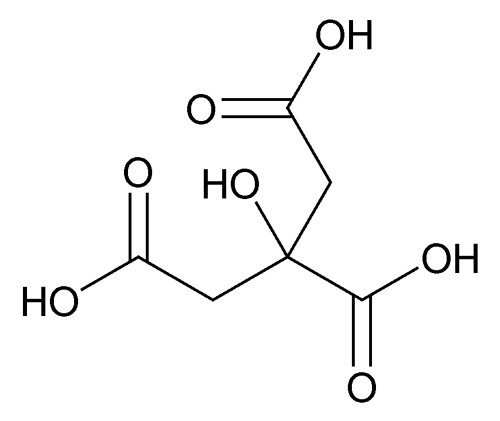 .
.
USP Endotoxin RS.
(Official April 1, 2009)
Bacterial endotoxins 85—
It contains not more than 5.56 USP Endotoxin Units per mL.
85—
It contains not more than 5.56 USP Endotoxin Units per mL.
pH 791:
between 5.0 and 6.0.
791:
between 5.0 and 6.0.
Chloride 221—
A 10-mL portion shows no more chloride than corresponds to 0.50 mL of 0.020 N hydrochloric acid (0.0035%).
221—
A 10-mL portion shows no more chloride than corresponds to 0.50 mL of 0.020 N hydrochloric acid (0.0035%).
Other requirements—
It meets the requirements under Injections 1.
1.
Assay for total citrate and total phosphate—
Mobile Phase, Standard Preparation 2, and Chromatographic System—
Proceed as directed under Assay for Citric Acid/Citrate and Phosphate 345.
345.
Assay preparation for total citrate assay—
Pipet 10 mL of Solution into a suitable volumetric flask, and proceed as directed for Assay Preparation for Citric Acid/Citrate Assay under general chapter 345.
345.
Assay preparation for total phosphate assay—
Pipet 5 mL of Solution into a suitable volumetric flask, and proceed as directed for Assay Preparation for Phosphate Assay under general chapter 345.
345.
Procedure—
Proceed as directed for Procedure under general chapter 345, and calculate the quantity, in mg, of anhydrous citric acid (C6H8O7) in the volume of Solution taken by the formula:
345, and calculate the quantity, in mg, of anhydrous citric acid (C6H8O7) in the volume of Solution taken by the formula:
0.001(192.12/189.10)CS D(rU / rS)
in which 192.12 is the molecular weight of anhydrous citric acid; 189.10 is the molecular weight of citrate (C6H5O7); CS is the concentration, in µg per mL, of citrate in Standard Preparation 2; D is the dilution factor; and rU and rS are the citrate peak areas obtained from the Assay preparation for total citrate assay and Standard Preparation 2, respectively.
Calculate the quantity, in mg, of phosphate, expressed as monobasic sodium phosphate monohydrate (NaH2PO4·H2O), in the volume of Solution taken by the formula:
0.001(137.99/94.97)CS D(rU / rS)
in which 137.99 is the molecular weight of monobasic sodium phosphate monohydrate; 94.97 is the molecular weight of phosphate (PO4); CS is the concentration, in µg per mL, of phosphate in Standard Preparation 2; D is the dilution factor; and rU and rS are the phosphate peak areas obtained from the Assay preparation for total phosphate assay and Standard Preparation 2, respectively.
(Official April 1, 2009)
Assay for sodium—
Lithium diluent solution—
Transfer 1.04 g of lithium nitrate to a 1000-mL volumetric flask, add a suitable nonionic surfactant, then add water to volume, and mix. This solution contains 15 mEq of lithium per L.
Standard preparation—
Transfer 8.18 g of sodium chloride, previously dried at 105 for 2 hours and accurately weighed, to a 1000-mL volumetric flask, dilute with water to volume, and mix. This solution contains 140 mEq of sodium per L. Transfer 50 µL of this solution to a 10-mL volumetric flask, dilute with Lithium diluent solution to volume, and mix.
for 2 hours and accurately weighed, to a 1000-mL volumetric flask, dilute with water to volume, and mix. This solution contains 140 mEq of sodium per L. Transfer 50 µL of this solution to a 10-mL volumetric flask, dilute with Lithium diluent solution to volume, and mix.
Assay preparation—
Pipet 25 mL of Solution into a 50-mL volumetric flask, dilute with water to volume, and mix. Transfer 50 µL of this solution to a 10-mL volumetric flask, dilute with Lithium diluent solution to volume, and mix.
Procedure—
Using a suitable flame photometer, adjusted to read zero with Lithium diluent solution, concomitantly determine the sodium flame emission readings for the Standard preparation and the Assay preparation at the wavelength of maximum emission at about 589 nm. Calculate the quantity, in g, of Na in 1000 mL of Anticoagulant Citrate Phosphate Dextrose Adenine Solution taken by the formula:
2(8.18)(22.99/58.44)(RU/RS)
in which 8.18 is the weight, in g, of sodium chloride taken to make the Standard preparation; 22.99 is the atomic weight of sodium; 58.44 is the molecular weight of sodium chloride; and RU and RS are the sodium emission readings obtained from the Assay preparation and the Standard preparation, respectively.
Assay for dextrose—
Tare a clean, medium-porosity filtering crucible containing several carborundum boiling chips or glass beads. Pipet 50 mL of freshly mixed alkaline cupric tartrate TS into a 400-mL beaker. Add the boiling chips or glass beads from the tared crucible, 45 mL of water, and 5.0 mL of Solution to the beaker. Heat the beaker and contents over a burner that has been adjusted to cause boiling of the solution to start in 3.5 to 4 minutes. Boil the solution for 2 minutes, accurately timed, and filter immediately through the tared crucible, taking care to transfer all of the boiling chips or glass beads to the crucible. Wash the precipitate with hot water and 10 mL of alcohol. Dry the crucible and contents at 110 to constant weight. Perform a blank determination, and make any necessary correction. Each mg of cuprous oxide precipitate obtained is equivalent to 0.496 mg of C6H12O6·H2O.
to constant weight. Perform a blank determination, and make any necessary correction. Each mg of cuprous oxide precipitate obtained is equivalent to 0.496 mg of C6H12O6·H2O.
Assay for adenine—
Mobile phase—
Dissolve 3.45 g of ammonium dihydrogen phosphate in 950 mL of water in a 1000-mL volumetric flask, add 10 mL of glacial acetic acid, dilute with water to volume, mix, pass through a membrane filter having a 1-µm or finer porosity, and degas.
Standard preparations—
Dissolve accurately weighed quantities of USP Adenine RS in dilute hydrochloric acid (1 in 120) in three separate volumetric flasks, dilute with the dilute hydrochloric acid solution to volume, and mix to obtain Standard preparations having known concentrations of about 0.25, 0.275, and 0.30 mg of adenine per mL, respectively. Protect from light.
Chromatographic system
(see Chromatography 621)—The liquid chromatograph is equipped with a 254-nm detector and a 4-mm × 30-cm stainless steel column that contains packing L9. The flow rate is about 2.0 mL per minute. Prepare a solution containing USP Adenine RS and purine, each at about 0.275 mg per mL, in dilute hydrochloric acid (1 in 120), and chromatograph not less than four injections (about 20 µL) of this solution: the relative standard deviation of the peak response of adenine is not more than 2.5%, the relative standard deviation of the retention time of adenine is not more than 2.0%, and the resolution of adenine and purine is not less than 3.0.
621)—The liquid chromatograph is equipped with a 254-nm detector and a 4-mm × 30-cm stainless steel column that contains packing L9. The flow rate is about 2.0 mL per minute. Prepare a solution containing USP Adenine RS and purine, each at about 0.275 mg per mL, in dilute hydrochloric acid (1 in 120), and chromatograph not less than four injections (about 20 µL) of this solution: the relative standard deviation of the peak response of adenine is not more than 2.5%, the relative standard deviation of the retention time of adenine is not more than 2.0%, and the resolution of adenine and purine is not less than 3.0.
Procedure—
Separately inject equal volumes (about 20 µL) of the Solution and the Standard preparations, record the chromatograms, and measure the responses for the major peaks. Plot the responses against the concentrations, in mg of USP Adenine RS per mL of the Standard preparations. Calculate the quantity, in mg, of C5H5N5 in each mL of the Solution taken as the value read directly from the Standard curve corresponding to the response obtained from the portion of the Anticoagulant Citrate Phosphate Dextrose Adenine Solution chromatographed.
Auxiliary Information—
Please check for your question in the FAQs before contacting USP.
Chromatographic Column—
| Topic/Question | Contact | Expert Committee |
| Monograph | Anita Y. Szajek, Ph.D.
Senior Scientist 1-301-816-8325 |
(BBBBP05) Biologics and Biotechnology - Blood and Blood Products |
| Reference Standards | Lili Wang, Technical Services Scientist 1-301-816-8129 RSTech@usp.org |
|
| 85 |
Radhakrishna S Tirumalai, Ph.D.
Senior Scientist 1-301-816-8339 |
(MSA05) Microbiology and Sterility Assurance |
USP32–NF27 Page 1565
Pharmacopeial Forum: Volume No. 31(3) Page 728
Chromatographic columns text is not derived from, and not part of, USP 32 or NF 27.