Isradipine
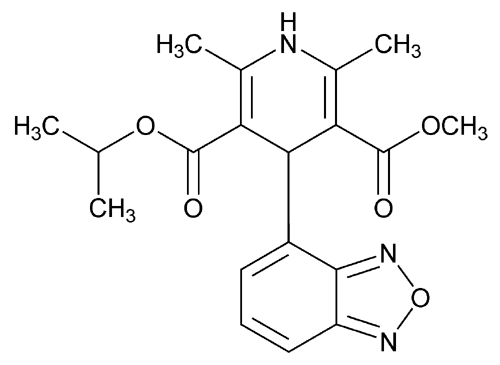
 371.39
3,5-Pyridinedicarboxylic acid, 4-(4-benzofurazanyl)-1,4-dihydro-2,6-dimethyl-, methyl 1-methylethyl ester, (±)-.
Isopropyl methyl (±)-4-(4-benzofurazanyl)-1,4-dihydro-2,6-dimethyl-3,5-pyridinedicarboxylate
[75695-93-1].» Isradipine contains not less than 98.0 percent and not more than 102.0 percent of C19H21N3O5, calculated on the dried basis.
Packaging and storage—
Preserve in well-closed, light-resistant containers.
Loss on drying  731
731 —
Dry it at 105
—
Dry it at 105 for 4 hours: it loses not more than 0.2% of its weight.
731—
Dry it at 105 for 4 hours: it loses not more than 0.2% of its weight.
Residue on ignition 281:
not more than 0.1%.
281:
not more than 0.1%.
Heavy metals, Method II 231:
0.002%.
231:
0.002%.
Chromatographic purity—
[note—Use low-actinic glassware throughout this procedure, and otherwise protect the test specimen, the Reference Standard, and all solutions containing them from unnecessary exposure to light.]
Mobile phase—
Prepare as directed in the Assay.
Standard solution—
Dissolve an accurately weighed quantity of USP Isradipine RS in Mobile phase, with the aid of sonication if necessary, and dilute quantitatively and stepwise with Mobile phase to obtain a solution having a known concentration of about 6 µg per mL. [note—If necessary, use 1 mL of methanol per 20 mL of Mobile phase to dissolve the Reference Standard prior to diluting with Mobile phase.]
Test solution—
Transfer about 50 mg of Isradipine, accurately weighed, to a 25-mL volumetric flask, and add 5.0 mL of methanol to dissolve, using sonication if necessary. Dilute with Mobile phase to volume, and mix.
Chromatographic system
(see Chromatography 621)—The liquid chromatograph is equipped with a 230-nm detector and a 4.6-mm × 10-cm column that contains packing L1. The flow rate is about 1.7 mL per minute. Chromatograph replicate injections of the Resolution solution, and record the peak responses as directed under Procedure: the resolution, R, between isradipine and isradipine related compound A is not less than 1.5, and the relative standard deviation for replicate injections is not more than 1.5%.
621)—The liquid chromatograph is equipped with a 230-nm detector and a 4.6-mm × 10-cm column that contains packing L1. The flow rate is about 1.7 mL per minute. Chromatograph replicate injections of the Resolution solution, and record the peak responses as directed under Procedure: the resolution, R, between isradipine and isradipine related compound A is not less than 1.5, and the relative standard deviation for replicate injections is not more than 1.5%.
Procedure—
Separately inject equal volumes (about 25 µL) of the Standard solution and the Test solution into the chromatograph, and allow the Test solution to elute for not less than three times the retention time of isradipine. Record the chromatograms, and measure the responses for all of the peaks: the sum of the peak responses, other than that of isradipine, in the chromatogram of the Test solution is not more than four times the isradipine response obtained from the Standard solution (1.2%), the response of the largest peak, other than that of isradipine, in the chromatogram of the Test solution is not more than 1.6 times greater than the isradipine response obtained from the Standard solution (0.5%), and no other peak response, other than that of isradipine, is greater than the isradipine response obtained from the Standard solution (0.3%).
Assay—
[note—Use low-actinic glassware throughout this procedure, and otherwise protect the test specimen, the Reference Standard, and all solutions containing them, from unnecessary exposure to light.]
Mobile phase—
Prepare a filtered and degassed mixture of water, methanol, and tetrahydrofuran (50:40:10). Make adjustments, if necessary (see System Suitability under Chromatography 621).
621).
Standard preparation—
Dissolve, with the aid of sonication, if necessary, accurately weighed quantities of USP Isradipine RS and USP Isradipine Related Compound A RS in Mobile phase, and dilute quantitatively, and stepwise, if necessary, with Mobile phase to obtain a solution having known concentrations of 0.2 mg and 10 µg of USP Isradipine RS and USP Isradipine Related Compound A RS, respectively, per mL. [note—If necessary, 1 mL of methanol per 20 mL of Mobile phase may be added to dissolve the Reference Standards.]
Assay preparation—
Transfer about 20 mg of Isradipine, accurately weighed, to a 100-mL volumetric flask. Add sufficient methanol to dissolve, using sonication, if necessary. Dilute with Mobile phase to volume, and mix.
Chromatographic system
(see Chromatography 621)—The liquid chromatograph is equipped with a 326-nm detector and a 4.6-mm × 10-cm column that contains packing L1. The flow rate is about 1.7 mL per minute. Chromatograph the Standard preparation, and record the peak responses as directed for Procedure: the resolution, R, between isradipine and isradipine related compound A is not less than 1.5, and the relative standard deviation for replicate injections is not more than 1.5%.
621)—The liquid chromatograph is equipped with a 326-nm detector and a 4.6-mm × 10-cm column that contains packing L1. The flow rate is about 1.7 mL per minute. Chromatograph the Standard preparation, and record the peak responses as directed for Procedure: the resolution, R, between isradipine and isradipine related compound A is not less than 1.5, and the relative standard deviation for replicate injections is not more than 1.5%.
Procedure—
Separately inject equal volumes (about 25 µL) of the Standard preparation and the Assay preparation into the chromatograph, record the chromatograms, and measure the responses for the major peaks. Calculate the quantity, in mg, of C19H21N3O5 in the portion of Isradipine taken by the formula:
100C(rU / rS)
in which C is the concentration, in mg per mL, of USP Isradipine RS in the Standard preparation; and rU and rS are the isradipine peak responses obtained from the Assay preparation and the Standard preparation, respectively.
Auxiliary Information—
Please check for your question in the FAQs before contacting USP.
| Topic/Question | Contact | Expert Committee |
| Monograph | Sujatha Ramakrishna, Ph.D.
Scientist 1-301-816-8349 |
(MDCV05) Monograph Development-Cardiovascular |
| Reference Standards | Lili Wang, Technical Services Scientist 1-301-816-8129 RSTech@usp.org |
USP32–NF27 Page 2726