Fexofenadine Hydrochloride and Pseudoephedrine Hydrochloride Extended-Release Tablets
» Fexofenadine Hydrochloride and Pseudoephedrine Hydrochloride Extended-Release Tablets contain not less than 95.0 percent and not more than 105.0 percent of the labeled amounts of fexofenadine hydrochloride (C32H39NO4·HCl) and pseudoephedrine hydrochloride (C10H15NO·HCl).
Packaging and storage—
Preserve in well-closed containers, and store at controlled room temperature.
Add the following:
 Labeling—
When more than one Dissolution test is given, the labeling states the test used only if Test 1 is not used.3
Labeling—
When more than one Dissolution test is given, the labeling states the test used only if Test 1 is not used.3
USP Reference standards  11
11 —
—
USP Fexofenadine Hydrochloride RS.
USP Fexofenadine Related Compound A RS .
.
USP Pseudoephedrine Hydrochloride RS.
11—
USP Fexofenadine Hydrochloride RS.
USP Fexofenadine Related Compound A RS
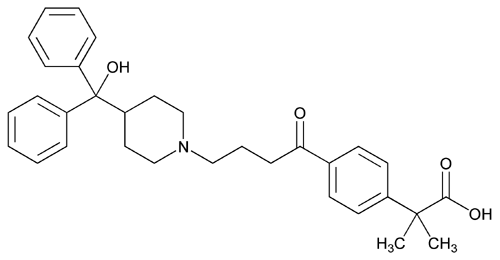 .
.
USP Pseudoephedrine Hydrochloride RS.
Change to read:
Identification—
A: Infrared Absorption 197K—
(for bilayer tablets)
197K—
(for bilayer tablets)
fexofenadine hydrochloride—
Test specimen—
Grind the fexofenadine hydrochloride layer of 1 Tablet, and transfer it into a 30-mL capped centrifuge tube. Add 20 mL of 1 N sodium hydroxide, mix in a vortex mixer for 1 to 2 minutes, then centrifuge for 3 to 5 minutes at approximately 2500 rpm or greater. Decant the solution, and pass through a 25-mm glass syringe filter. Add 10 mL of 10% hydrochloric acid, and heat this solution, with stirring, to near boiling. Cool, and centrifuge for 3 to 5 minutes. Decant and discard the liquid, wash the precipitate with 10 mL of water, and centrifuge for 1 to 2 minutes. Decant and discard the water, and dry the precipitate in an oven for 1 hour at 105 .
.
.
Standard specimen—
Transfer a quantity, in mg, of USP Fexofenadine Hydrochloride RS, equivalent to the labeled amount of fexofenadine hydrochloride, to a 30-mL capped centrifuge tube, and proceed as directed for Test specimen, beginning with “Add 20 mL of 1 N sodium hydroxide”.
pseudoephedrine hydrochloride—
Test specimen—
Grind the pseudoephedrine hydrochloride layer of 1 Tablet, and transfer it into a capped 30-mL centrifuge tube. Add 20 mL of 0.1 N hydrochloric acid, mix on a vortex mixer for 1 to 2 minutes, and centrifuge for 3 to 5 minutes at approximately 2500 rpm or greater. Decant the solution, and pass through a 0.45-µm nylon filter; discard the residue. Add 10 mL of 1 N sodium hydroxide, and pour it into a separatory funnel containing 15 mL of methylene chloride. Carefully rotate and shake the funnel using care not to form an emulsion. Allow the layers to separate for about 10 minutes. Decant the methylene chloride (lower) layer into a 50-mL beaker, and filter through a glass funnel loaded with a glass wool plug and 1 to 2 g of sodium sulfate. Evaporate to dryness. [Note—Do not exceed 75 if a hot plate is used to aid evaporation.]
if a hot plate is used to aid evaporation.]
Standard specimen—
Transfer a quantity, in mg, of USP Pseudoephedrine Hydrochloride RS equivalent to the labeled amount of pseudoephedrine hydrochloride to a 30-mL capped centrifuge tube, and proceed as directed for Test specimen, beginning with “Add 20 mL of 0.1 N hydrochloric acid”.
B:
The retention times of the major peaks in the chromatogram of the Assay preparation correspond to those in the chromatogram of the Standard preparation, as obtained in the Assay.
C: Thin-Layer Chromatographic Identification Test 201 4
201 4
Adsorbent:
0.2-mm layer of high-performance thin-layer chromatographic silica gel mixture. Dry the plate at 105 for one hour before use.
for one hour before use.
Test solution—
Weigh and finely powder not fewer than 4 Tablets. Transfer powdered tablets, equivalent to 30 mg of fexofenadine hydrochloride and 60 mg of pseudoephedrine hydrochloride, into a suitable vessel, and add 5 mL of methanol. Cap the vessel, and shake vigorously for about 2 minutes. Pass the resulting suspension through a suitable 0.45-µm filter. Use the filtrate.
Fexofenadine hydrochloride standard solution—
Dissolve an accurately weighed quantity of USP Fexofenadine Hydrochloride RS in methanol to obtain a solution having a known concentration of about 6 mg per mL.
Pseudoephedrine hydrochloride standard solution—
Dissolve an accurately weighed quantity of USP Pseudoephedrine Hydrochloride RS in methanol to obtain a solution having a known concentration of about 12 mg per mL.
Application volume:
10 µL.
Developing solvent solution:
a mixture of toluene, dehydrated alcohol, and ammonium hydroxide (50:45:5).
Procedure—
Proceed as directed in the chapter, using the Developing solvent system. After removal of the plate, mark the solvent front, and allow the plate to air-dry. Heat the plate at 105 until the odor of ammonia disappears (approximately 5 minutes). Allow the plate to cool, and examine under UV light at 254 nm. The RF values are about 0.17 for fexofenadine and 0.39 for pseudoephedrine. The RF value of fexofenadine hydrochloride in the test sample is comparable to that of fexofenadine hydrochloride in the Standard solution. The RF value of pseudoephedrine hydrochloride in the test sample is comparable to that of pseudoephedrine hydrochloride in the Standard solution.
until the odor of ammonia disappears (approximately 5 minutes). Allow the plate to cool, and examine under UV light at 254 nm. The RF values are about 0.17 for fexofenadine and 0.39 for pseudoephedrine. The RF value of fexofenadine hydrochloride in the test sample is comparable to that of fexofenadine hydrochloride in the Standard solution. The RF value of pseudoephedrine hydrochloride in the test sample is comparable to that of pseudoephedrine hydrochloride in the Standard solution.
Change to read:
Dissolution 711—
test 1—3
Medium:
0.001 N hydrochloric acid; 900 mL.
Apparatus 2:
50 rpm.
Times:
fexofenadine hydrochloride: 15 and 45 minutes; pseudoephedrine hydrochloride: 45 minutes; 3, 5, and 12 hours.
Determine the percentages of the labeled amounts of fexofenadine hydrochloride (C32H39NO4·HCl) and of pseudoephedrine hydrochloride (C10H15NO·HCl) dissolved by using the following method.
Buffer solution—
Dissolve 14.0 g of monobasic sodium phosphate monohydrate in 2 L of water. Adjust with 85% phosphoric acid to a pH of 2.00 ± 0.05.
Mobile phase—
Prepare a filtered and degassed mixture of Buffer solution and acetonitrile (55:45). Make adjustments if necessary (see System suitability under Chromatography 621).
621).
Standard solution—
[Note—A small amount of methanol, not to exceed 0.5% of the total volume, can be used to dissolve the fexofenadine hydrochloride.] Dissolve accurately weighed quantities of USP Fexofenadine Hydrochloride RS and USP Pseudoephedrine Hydrochloride RS in Medium, and dilute quantitatively, and stepwise if necessary, to obtain a solution containing known concentrations similar to those expected in the solution under test.
Test solution—
Use portions of the solution under test passed through a 0.45-µm nylon filter.
Chromatographic system
(see Chromatography 621)—The liquid chromatograph is equipped with a 210-nm detector and a 4.6-mm × 25-cm column containing packing L6. The flow rate is about 1.0 mL per minute. Chromatograph the Standard solution, and record the peak responses as directed for Procedure: the resolution, R, between fexofenadine and pseudoephedrine is not less than 3.0; the tailing factor is not more than 1.5 for fexofenadine and for pseudoephedrine; and the relative standard deviation for replicate injections is not more than 2.0%.
621)—The liquid chromatograph is equipped with a 210-nm detector and a 4.6-mm × 25-cm column containing packing L6. The flow rate is about 1.0 mL per minute. Chromatograph the Standard solution, and record the peak responses as directed for Procedure: the resolution, R, between fexofenadine and pseudoephedrine is not less than 3.0; the tailing factor is not more than 1.5 for fexofenadine and for pseudoephedrine; and the relative standard deviation for replicate injections is not more than 2.0%.
Procedure—
Separately inject equal volumes (about 10 µL) of the Standard solution and the Test solution into the chromatograph, and record the peak responses for fexofenadine and pseudoephedrine. Calculate the amounts of fexofenadine hydrochloride (C32H39NO4·HCl) and pseudoephedrine hydrochloride (C10H15NO·HCl) dissolved.
Tolerances—
For fexofenadine hydrochloride (C32H39NO4·HCl), not less than 65% (Q) of the labeled amount is dissolved in 15 minutes and not less than 80% (Q) of the labeled amount is dissolved in 45 minutes; the percentages of the labeled amount of pseudoephedrine hydrochloride (C10H15NO·HCl) dissolved at the times specified conform to Acceptance Table 2 under Dissolution 711.
711.
| Time | Amount dissolved (average) |
| 45 minutes | not more than 36% |
| 3 hours | between 45% and 69% |
| 5 hours | between 61% and 80% |
| 12 hours | not less than 80% |
test 2—
If the product complies with this test, the labeling indicates that the product meets USP Dissolution Test 2.
Medium:
0.001 N hydrochloric acid; 900 mL.
Apparatus 2:
50 rpm.
Times:
fexofenadine hydrochloride: 45 minutes; pseudoephedrine hydrochloride: 30 minutes; 2, 4, and 12 hours.
Determine the percentages of the labeled amounts of fexofenadine hydrochloride (C32H39NO4·HCl) and of pseudoephedrine hydrochloride (C10H15NO·HCl) dissolved by using the following method.
Buffer solution—
Dissolve about 2.7 g of monobasic potassium phosphate and 2.2 g of sodium 1-octanesulfonate in 1000 mL of water. Adjust with phosphoric acid to a pH of 2.50 ± 0.05.
Mobile phase—
Prepare a filtered and degassed mixture of Buffer solution, methanol, and acetonitrile (4:3:3). Make adjustments if necessary (see System Suitability under Chromatography 621).
621).
Fexofenadine standard stock solution—
Transfer about 66 mg, accurately weighed, of USP Fexofenadine Hydrochloride RS to a 100-mL volumetric flask. Add 10 mL of methanol, and swirl until dissolved. Add about 50 mL of Medium, and mix. Allow the solution to equilibrate to room temperature, and dilute with Medium to volume.
Pseudoephedrine standard stock solution—
Transfer about 66 mg, accurately weighed, of USP Pseudoephedrine Hydrochloride RS to a 100-mL volumetric flask. Add 10 mL of methanol, and swirl until dissolved. Add about 50 mL of Medium, and mix. Allow the solution to equilibrate to room temperature, and dilute with Medium to volume.
Working standard solution—
Transfer 10.0 mL of Fexofenadine standard stock solution and 20.0 mL of Pseudoephedrine standard stock solution to a 100-mL volumetric flask, dilute with Medium to volume, and mix.
Test solution—
Pass a portion of the solution under test through a suitable filter having a porosity of 0.45 µm.
Chromatographic system—
The liquid chromatograph is equipped with a 215-nm detector and a 4.6-mm × 25-cm column containing 5-µm packing L7. The flow rate is about 1.5 mL per minute. Chromatograph the Working standard solution, and record the peak responses as directed for Procedure: the resolution, R, between fexofenadine and pseudoephedrine is not less than 2.0; the tailing factor for the fexofenadine peak is not more than 2.0, and for the pseudoephedrine peak, not more than 2.5; and the relative standard deviation for replicate injections for both peaks is not more than 2.0%.
Procedure—
Separately inject equal volumes (about 10 µL) of the Working standard solution and the Test solution into the chromatograph, and record the peak responses for fexofenadine and pseudoephedrine. Calculate the amounts of fexofenadine hydrochloride (C32H39NO4·HCl) and pseudoephedrine hydrochloride (C10H15NO·HCl) dissolved.
Tolerances—
For fexofenadine hydrochloride (C32H39NO4·HCl), not less than 80% (Q) of the labeled amount is dissolved in 45 minutes; and the percentages of the labeled amount of pseudoephedrine hydrochloride (C10H15NO·HCl) dissolved at the times specified conform to Acceptance Table 2 under Dissolution 711.
711.
| Time | Amount dissolved (average) |
| 30 minutes | not more than 35% |
| 2 hours | between 38% and 58% |
| 4 hours | between 56% and 76% |
| 12 hours | not less than 80% |
3
Uniformity of dosage units 905:
meet the requirements.
905:
meet the requirements.
Change to read:
Related compounds—
Buffer solution, Mobile phase, System suitability preparation, and Chromatographic system—
Proceed as directed in the Assay.
Standard solution—
Use the Standard preparation, prepared as directed in the Assay.
Reference solution—
Use the Assay preparation.
Test solution—
Use the Assay stock preparation, prepared as directed in the Assay.
Chromatographic system (see Chromatography 621)—
Chromatograph the System suitability preparation as directed for Procedure: the relative retention times are about 1.2 for ephedrone and 1.0 for pseudoephedrine; the resolution, R, between pseudoephedrine and ephedrone is not less than 1.7; and the relative standard deviation for replicate injections is not more than 1.0% based on the pseudoephedrine peak. Chromatograph the Standard solution, and record the peak responses as directed for Procedure: the relative retention times are about 1.2 for fexofenadine related compound A, 3.1 for decarboxylated degradant, and 1.0 for fexofenadine; the resolution, R, between fexofenadine and fexofenadine related compound A is not less than 2.0; and the relative standard deviation for replicate injections is not more than 1.0% based on the fexofenadine peak and not more than 3.0% based on the individual peaks for fexofenadine related compound A and decarboxylated degradant.
621)—
Chromatograph the System suitability preparation as directed for Procedure: the relative retention times are about 1.2 for ephedrone and 1.0 for pseudoephedrine; the resolution, R, between pseudoephedrine and ephedrone is not less than 1.7; and the relative standard deviation for replicate injections is not more than 1.0% based on the pseudoephedrine peak. Chromatograph the Standard solution, and record the peak responses as directed for Procedure: the relative retention times are about 1.2 for fexofenadine related compound A, 3.1 for decarboxylated degradant, and 1.0 for fexofenadine; the resolution, R, between fexofenadine and fexofenadine related compound A is not less than 2.0; and the relative standard deviation for replicate injections is not more than 1.0% based on the fexofenadine peak and not more than 3.0% based on the individual peaks for fexofenadine related compound A and decarboxylated degradant.
Procedure—
Separately inject equal volumes (about 20 µL) of the Test solution and the Reference solution into the chromatograph, record the chromatograms, and measure all of the peak responses. Calculate the percentage of fexofenadine related compound A and decarboxylated degradant in the portion of Tablets taken by the formula:
hydrochloride4 in the Test solution; ri is the individual peak area of either fexofenadine related compound A or decarboxylated degradant obtained from the Test solution; and rS is the peak area of fexofenadine related compound A obtained from the Standard solution. Calculate the percentage of ephedrone in the portion of Tablets taken by the formula:
hydrochloride4 in the Test solution; ri is the peak height for ephedrone obtained from the Test solution; and rS is the peak height for pseudoephedrine obtained from the Standard solution. Calculate the percentage of any other impurities in the portion of Tablets taken by the formula:
hydrochloride4 obtained from the Reference solution; and rT is the sum of the peak area responses of all unknown impurities in the Test solution. Disregard any peak below 0.05%.
100(CS / CT)(ri / rS)
in which CS is the concentration, in mg per mL, of either USP Fexofenadine Related Compound A RS or decarboxylated degradant in the Standard solution; CT is the nominal concentration, in mg per mL, of fexofenadine hydrochloride4 in the Test solution; ri is the individual peak area of either fexofenadine related compound A or decarboxylated degradant obtained from the Test solution; and rS is the peak area of fexofenadine related compound A obtained from the Standard solution. Calculate the percentage of ephedrone in the portion of Tablets taken by the formula:
(100/F)(CS / CT)(ri / rS)
in which F is the relative response factor for ephedrone (F is 0.394); CS is the concentration, in mg per mL, of USP Pseudoephedrine Hydrochloride RS in the Standard solution; CT is the nominal concentration, in mg per mL, of pseudoephedrine hydrochloride4 in the Test solution; ri is the peak height for ephedrone obtained from the Test solution; and rS is the peak height for pseudoephedrine obtained from the Standard solution. Calculate the percentage of any other impurities in the portion of Tablets taken by the formula:
100ri / (25rS + rT)
in which ri is the individual peak area response for an individual unknown impurity in the Test solution; 25 is the difference in concentration between the Test solution and the Reference solution; rS is the peak area response for fexofenadine hydrochloride4 obtained from the Reference solution; and rT is the sum of the peak area responses of all unknown impurities in the Test solution. Disregard any peak below 0.05%.
| Compound | Relative Retention Time | Acceptance Criteria |
| Pseudoephedrine | 1.0 | — |
| Ephedrone | 1.2a | not more than 0.2% |
| Fexofenadine | 1.0 | — |
| Fexofenadine related compound A |
1.2b | not more than 0.4% |
| Decarboxylated degradant1 | 3.1b | not more than 0.2% |
| Tertiary dehydrated impurity24 |
1.8 | not more than 0.2% |
| Any individual other impurity |
— | not more than 0.2%4 |
| 4 |
||
| Total impurities | — | not more than 0.8% |
|
a
Relative to pseudoephedrine.
b
Relative to fexofenadine.
1
(±)-4-(1-Hydroxy-4-[4-(hydroxydiphenylmethyl)-1-piperidinyl]-butyl]-isopropylbenzene.
2
4-[4{4-(Diphenylmethylene)-1-piperidinyl}-1-hydroxybutyl]-2,2-dimethyl phenyl acetic acid.
4 |
||
Change to read:
Assay—
Buffer solution—
Dissolve 6.8 g of sodium acetate and 16.22 g of sodium 1-octanesulfonate in water, and dilute with water to 1 L. Adjust with glacial acetic acid to a pH of 4.6.
Mobile phase—
Prepare a filtered and degassed mixture of methanol and Buffer solution (65:35). Make adjustments if necessary (see System Suitability under Chromatography 621).
621).
System suitability preparation—
Transfer an accurately weighed quantity, about 40 mg, of USP Pseudoephedrine Hydrochloride RS to a 50-mL volumetric flask. Add 5 mL of tert-butylhydroperoxide solution, and sonicate. Cover the flask opening with aluminum foil, and place the flask in an oven at about 90 for 60 minutes. Remove from the oven, and allow to cool. Add 35 mL of Mobile phase, and cool to room temperature. Dilute with Mobile phase to volume, and mix. The degradation of pseudoephedrine hydrochloride by this process produces the related compound ephedrone.
for 60 minutes. Remove from the oven, and allow to cool. Add 35 mL of Mobile phase, and cool to room temperature. Dilute with Mobile phase to volume, and mix. The degradation of pseudoephedrine hydrochloride by this process produces the related compound ephedrone.
Related compounds preparation—
Dissolve accurately weighed quantities of USP Fexofenadine Related Compound A RS and decarboxylated degradant*4 in a volume of methanol, and dilute quantitatively, and stepwise if necessary, with Buffer solution to maintain a ratio of methanol and Buffer solution (60:40). Dilute quantitatively, and stepwise if necessary, with methanol and Buffer solution (60:40) to obtain a solution having known concentrations of 0.2 mg per mL for each component. Dilute 10.0 mL of this solution with Mobile phase to 100 mL to obtain a final solution having known concentrations of 0.02 mg per mL for each component.
*4 in a volume of methanol, and dilute quantitatively, and stepwise if necessary, with Buffer solution to maintain a ratio of methanol and Buffer solution (60:40). Dilute quantitatively, and stepwise if necessary, with methanol and Buffer solution (60:40) to obtain a solution having known concentrations of 0.2 mg per mL for each component. Dilute 10.0 mL of this solution with Mobile phase to 100 mL to obtain a final solution having known concentrations of 0.02 mg per mL for each component.
Standard stock preparation—
Dissolve accurately weighed quantities of USP Fexofenadine Hydrochloride RS and USP Pseudoephedrine Hydrochloride RS in Mobile phase, and dilute quantitatively, and stepwise if necessary, with Mobile phase to obtain a solution having known concentrations of about 0.4 mg per mL and 0.8 mg per mL of fexofenadine hydrochloride4 and pseudoephedrine hydrochloride,4 respectively.
hydrochloride4 and pseudoephedrine hydrochloride,4 respectively.
Standard preparation—
Dilute 6.0 mL of the Standard stock preparation and 15.0 mL of the Related compounds preparation with Mobile phase to 50 mL to obtain a solution having known concentrations of about 0.048 mg of fexofenadine hydrochloride per mL, 0.096 mg of pseudoephedrine hydrochloride per mL, 0.006 mg of fexofenadine related compound A per mL, and 0.006 mg of decarboxylated degradant per mL.
Assay stock preparation—
Transfer not fewer than 10 whole Tablets to a 500-mL volumetric flask. Add 300 mL of methanol, and shake by mechanical means at high speed for 60 minutes. Sonicate the flask for 60 minutes at 40. Add 150 mL of Buffer solution, and sonicate for 60 minutes at 40. Vent the flask, and vigorously shake the flask by hand at 15-minute intervals during the mechanical shaking and sonication steps. Cool to room temperature, and dilute with Buffer solution to volume to obtain a solution containing approximately 1.2 mg of fexofenadine hydrochloride4 per mL and 2.4 mg of pseudoephedrine hydrochloride4 per mL. Pass a portion of this solution through a filter having a 0.45-µm or finer porosity, and use the filtrate.
. Add 150 mL of Buffer solution, and sonicate for 60 minutes at 40. Vent the flask, and vigorously shake the flask by hand at 15-minute intervals during the mechanical shaking and sonication steps. Cool to room temperature, and dilute with Buffer solution to volume to obtain a solution containing approximately 1.2 mg of fexofenadine hydrochloride4 per mL and 2.4 mg of pseudoephedrine hydrochloride4 per mL. Pass a portion of this solution through a filter having a 0.45-µm or finer porosity, and use the filtrate.
Assay preparation—
Dilute 4.0 mL of the Assay stock preparation filtrate with Mobile phase to 100 mL. The final concentrations of fexofenadine hydrochloride4 and pseudoephedrine hydrochloride4 are 0.048 mg per mL and 0.096 mg per mL, respectively.
hydrochloride4 and pseudoephedrine hydrochloride4 are 0.048 mg per mL and 0.096 mg per mL, respectively.
Chromatographic system (see Chromatography 621)—
The liquid chromatograph is equipped with a 215-nm detector and a 4.6-mm × 5-cm column that contains 5-µm packing L6 connected in series to a 4.6-mm × 25-cm column that contains 5-µm packing L11. The flow rate is about 1.5 mL per minute. The column temperature is maintained at 35. Chromatograph the System suitability preparation as directed for Procedure: the relative retention times are about 1.2 for ephedrone and 1.0 for pseudoephedrine; the resolution, R, between pseudoephedrine and ephedrone is not less than 1.7; and the relative standard deviation for replicate injections is not more than 1.0% based on the pseudoephedrine peak. Chromatograph the Standard preparation,4 and record the peak responses as directed for Procedure: the relative retention times are about 1.2 for fexofenadine related compound A, 3.1 for decarboxylated degradant, and 1.0 for fexofenadine; the resolution, R, between fexofenadine and fexofenadine related compound A is not less than 2.0; and the relative standard deviation for replicate injections is not more than 1.0% based on the fexofenadine peak.
621)—
The liquid chromatograph is equipped with a 215-nm detector and a 4.6-mm × 5-cm column that contains 5-µm packing L6 connected in series to a 4.6-mm × 25-cm column that contains 5-µm packing L11. The flow rate is about 1.5 mL per minute. The column temperature is maintained at 35. Chromatograph the System suitability preparation as directed for Procedure: the relative retention times are about 1.2 for ephedrone and 1.0 for pseudoephedrine; the resolution, R, between pseudoephedrine and ephedrone is not less than 1.7; and the relative standard deviation for replicate injections is not more than 1.0% based on the pseudoephedrine peak. Chromatograph the Standard preparation,4 and record the peak responses as directed for Procedure: the relative retention times are about 1.2 for fexofenadine related compound A, 3.1 for decarboxylated degradant, and 1.0 for fexofenadine; the resolution, R, between fexofenadine and fexofenadine related compound A is not less than 2.0; and the relative standard deviation for replicate injections is not more than 1.0% based on the fexofenadine peak.
Procedure—
Separately inject equal volumes (about 20 µL) of the Standard preparation and Assay preparation into the chromatograph, record the chromatograms, and measure the responses for the fexofenadine and pseudoephedrine peaks. Calculate the percentage of the label claim of fexofenadine hydrochloride (C32H39NO4·HCl) and pseudoephedrine hydrochloride (C10H15NO·HCl) in the portion of Tablets taken by the formula:
hydrochloride4 or pseudoephedrine hydrochloride4 in the Assay preparation; and rU and rS are the peak responses obtained for either fexofenadine or pseudoephedrine from the Assay preparation and the Standard preparation, respectively.
100(CS / CT)(rU / rS)
in which CS is the concentration, in mg per mL, of either USP Fexofenadine Hydrochloride RS or USP Pseudoephedrine Hydrochloride RS in the Standard preparation; CT is the nominal concentration, in mg per mL, of either fexofenadine hydrochloride4 or pseudoephedrine hydrochloride4 in the Assay preparation; and rU and rS are the peak responses obtained for either fexofenadine or pseudoephedrine from the Assay preparation and the Standard preparation, respectively.
*
Available from USP as USP Fexofenadine Related Compound C AS, Cat# 1270446.4
Auxiliary Information—
Please check for your question in the FAQs before contacting USP.
Chromatographic Column—
| Topic/Question | Contact | Expert Committee |
| Monograph | Daniel K. Bempong, Ph.D.
Senior Scientist 1-301-816-8143 |
(MDPS05) Monograph Development-Pulmonary and Steroids |
| Reference Standards | Lili Wang, Technical Services Scientist 1-301-816-8129 RSTech@usp.org |
|
| 711 |
Margareth R.C. Marques, Ph.D.
Senior Scientist 1-301-816-8106 |
(BPC05) Biopharmaceutics05 |
USP32–NF27 Page 2374
Pharmacopeial Forum: Volume No. 34(6) Page 1445
Chromatographic columns text is not derived from, and not part of, USP 32 or NF 27.