Dichlorodifluoromethane
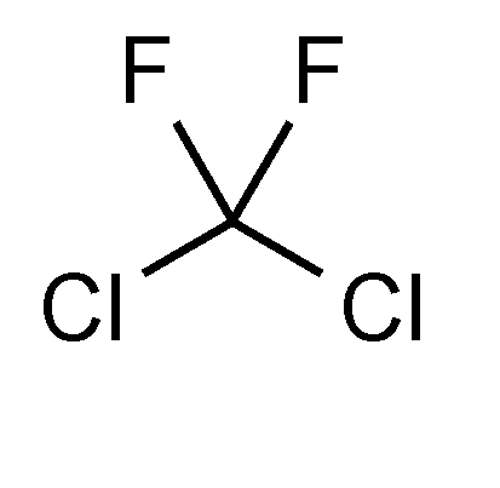
 120.91
Methane, dichlorodifluoro-.
Dichlorodifluoromethane
[75-71-8].» Dichlorodifluoromethane contains not less than 99.6 percent and not more than 100.0 percent of CCl2F2, calculated on the anhydrous basis.
Dichlorodifluoromethane contains not less than 99.6 percent and not more than 100.0 percent of CCl2F2, calculated on the anhydrous basis.
Packaging and storage—
Preserve in tight cylinders, and avoid exposure to excessive heat.
Identification—
The IR absorption spectrum of it, determined in a 10-cm cell with sodium chloride windows, at atmospheric pressure, exhibits maxima, among others, at the following wavelengths, in µm: 4.33 (m), 4.46 (m), 4.56 (m), 6.29 (m), 7.25 (m), 8.05 (s), 8.63 (s), 9.1 (vs), 10.7 (vs), 10.8 (vs), 11.2 (m), 11.3 (m), 13.1 (w), and 13.9 (w). The stronger maxima are best obtained at pressures less than 10 mm of mercury.
Boiling temperature:
approximately  30
30 , determined as directed under Approximate Boiling Temperature (see Aerosols, Nasal Sprays, Metered-Dose Inhalers, and Dry Powder Inhalers
  601
601 ).
).
30, determined as directed under Approximate Boiling Temperature (see Aerosols, Nasal Sprays, Metered-Dose Inhalers, and Dry Powder Inhalers 601).
Water:
not more than 0.001%, determined as directed under Water Content (see Aerosols, Nasal Sprays, Metered-Dose Inhalers, and Dry Powder Inhalers 601 and Method Ic under Water Determination 921).
601 and Method Ic under Water Determination 921).
High-boiling residues:
not more than 0.01%, determined as directed for High-Boiling Residues, Method I, under Aerosols, Nasal Sprays, Metered-Dose Inhalers, and Dry Powder Inhalers 601.
601.
Chromatographic purity—
In the chromatogram recorded for the Assay, identify the peaks due to dichlorotetrafluoroethane and trichloromonofluoromethane from relative retention times observed on chromatographing the Resolution preparation: the sum of these two peak areas is not greater than 0.2% of the total of all peak areas, and the sum of the areas of all peaks other than that for dichlorodifluoromethane is not greater than 0.4% of the total of all peak areas.
Inorganic chlorides—
Place 5 mL of anhydrous methanol in a test tube, add 3 drops of a saturated solution of silver nitrate in anhydrous methanol, shake, and add 7 g of Dichlorodifluoromethane: no opalescence or turbidity is produced.
Assay—
Resolution preparation—
Introduce a liquid-phase mixture of dichlorodifluoromethane, dichlorotetrafluoroethane, and trichloromonofluoromethane into an evacuated headspace vial.
Assay preparation—
Introduce the liquid phase of Dichlorodifluoromethane into an evacuated headspace vial.
Chromatographic system
(see Chromatography 621)—The gas chromatograph is equipped with a flame-ionization detector, a headspace sampler, and a 2-mm × 1.8-m stainless steel column containing 1% phase G25 on support S12. For the headspace sampler, the bath temperature is 100, the valve/loop temperature is 105, and the sampling time is 3 seconds. [note—Make adjustments as necessary to optimize peak areas to record trace level impurities.] The carrier gas is helium maintained at a flow rate of 20 mL per minute. The injection port and detector temperatures are maintained at 110 and 200, respectively. The column temperature is programmed to rise from 70 at the time of injection to 170 at the rate of 10 per minute, after which it is maintained at 170 for 5 minutes. Inject the gas phase headspace Resolution preparation and obtain the chromatogram as directed for Procedure: the approximate relative retention times are 0.5 for dichlorodifluoromethane, 0.8 for dichlorotetrafluoroethane, and 1.0 for trichloromonofluoromethane; and the resolution, R, between dichlorotetrafluoroethane and trichloromonofluoromethane is not less than 2.0.
621)—The gas chromatograph is equipped with a flame-ionization detector, a headspace sampler, and a 2-mm × 1.8-m stainless steel column containing 1% phase G25 on support S12. For the headspace sampler, the bath temperature is 100, the valve/loop temperature is 105, and the sampling time is 3 seconds. [note—Make adjustments as necessary to optimize peak areas to record trace level impurities.] The carrier gas is helium maintained at a flow rate of 20 mL per minute. The injection port and detector temperatures are maintained at 110 and 200, respectively. The column temperature is programmed to rise from 70 at the time of injection to 170 at the rate of 10 per minute, after which it is maintained at 170 for 5 minutes. Inject the gas phase headspace Resolution preparation and obtain the chromatogram as directed for Procedure: the approximate relative retention times are 0.5 for dichlorodifluoromethane, 0.8 for dichlorotetrafluoroethane, and 1.0 for trichloromonofluoromethane; and the resolution, R, between dichlorotetrafluoroethane and trichloromonofluoromethane is not less than 2.0.
Procedure—
Inject the gas phase headspace Assay preparation into the chromatograph, record the chromatogram, and measure the peak areas. Calculate the percentage (a/a) of CCl2F2 in the portion of Dichlorodifluoromethane taken.
Auxiliary Information—
Please check for your question in the FAQs before contacting USP.
Chromatographic Column—
| Topic/Question | Contact | Expert Committee |
| Monograph | Daniel K. Bempong, Ph.D.
Senior Scientist 1-301-816-8143 |
(MDPS05) Monograph Development-Pulmonary and Steroids |
USP32–NF27 Page 1225
Pharmacopeial Forum: Volume No. 27(1) Page 1825
Chromatographic columns text is not derived from, and not part of, USP 32 or NF 27.