Cromolyn Sodium
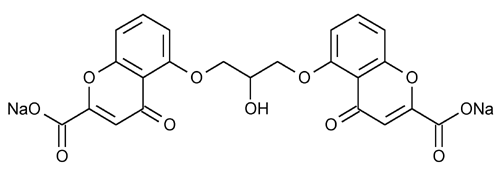
 512.34
4H-1-Benzopyran-2-carboxylic acid, 5,5¢-[(2-hydroxy-1,3-propanediyl)bis(oxy)bis[4-oxo-, disodium salt].
Disodium 5,5¢-[(2-hydroxytrimethylene)dioxy]bis[4-oxo-4H-1-benzopyran-2-carboxylate]
[15826-37-6].» Cromolyn Sodium contains not less than 98.0 percent and not more than 101.0 percent of C23H14Na2O11, calculated on the anhydrous basis.
Packaging and storage—
Preserve in tight containers.
Identification—
A:
The IR absorption spectrum of a potassium bromide dispersion of it, previously dried in vacuum at 105 to constant weight, exhibits maxima only at the same wavelengths as that of a similar preparation of USP Cromolyn Sodium RS.
to constant weight, exhibits maxima only at the same wavelengths as that of a similar preparation of USP Cromolyn Sodium RS.
B:
The UV absorption spectrum of a 1 in 40,000 solution in pH 7.4 sodium phosphate buffer prepared as directed in the Assay exhibits maxima at the same wavelengths as that of a similar solution of USP Cromolyn Sodium RS, concomitantly measured.
Acidity or alkalinity—
Dissolve 1.0 g in 25 mL of carbon dioxide-free water, and add two drops of bromothymol blue TS. If the solution is yellow, not more than 0.25 mL of 0.1 N sodium hydroxide is required to produce a blue color. If the solution is blue, not more than 0.25 mL of 0.1 N hydrochloric acid is required to produce a yellow color.
Water, Method I  921
921 :
not more than 10.0%.
:
not more than 10.0%.
921:
not more than 10.0%.
Heavy metals, Method II 231:
0.002%.
231:
0.002%.
Limit of oxalate—
Dissolve 100 mg in 20 mL of water, add 5.0 mL of iron salicylate TS, and dilute with water to 50 mL. Determine the absorbance of the solution at 480 nm against a water blank. The absorbance is not less than that of a solution containing 350 µg of oxalic acid prepared in the same manner (0.35%).
Related compounds—
Dissolve 100 mg of Cromolyn Sodium in 10.0 mL of a mixture of water, stabilizer-free tetrahydrofuran, and acetone (6:4:1). Similarly prepare a solution of USP Cromolyn Sodium RS in the same solvent mixture having a concentration of 10 mg per mL (Standard solution A). Quantitatively dilute a volume of Standard solution A with the same solvent mixture to obtain a diluted standard solution having a concentration of 0.05 mg per mL (Standard solution B). Apply 10-µL portions of the test solution, Standard solution A, and Standard solution B to a suitable thin-layer chromatographic plate (see Chromatography 621) coated with a 0.25-mm layer of chromatographic silica gel mixture. Allow the spots to dry, and develop the chromatogram in a solvent system consisting of a mixture of chloroform, methanol, and glacial acetic acid (9:9:2) until the solvent front has moved about three-fourths of the length of the plate. Remove the plate from the developing chamber, mark the solvent front, and allow the solvent to evaporate. Locate the spots on the plate by viewing under short-wavelength UV light: the RF value of the principal spot obtained from the test solution corresponds to that obtained from Standard solution A. Any spot in the chromatogram obtained from the test solution moving ahead of the principal spot is not more intense than the spot in the chromatogram obtained from Standard solution B (0.5%).
621) coated with a 0.25-mm layer of chromatographic silica gel mixture. Allow the spots to dry, and develop the chromatogram in a solvent system consisting of a mixture of chloroform, methanol, and glacial acetic acid (9:9:2) until the solvent front has moved about three-fourths of the length of the plate. Remove the plate from the developing chamber, mark the solvent front, and allow the solvent to evaporate. Locate the spots on the plate by viewing under short-wavelength UV light: the RF value of the principal spot obtained from the test solution corresponds to that obtained from Standard solution A. Any spot in the chromatogram obtained from the test solution moving ahead of the principal spot is not more intense than the spot in the chromatogram obtained from Standard solution B (0.5%).
Assay—
pH 7.4 Sodium phosphate buffer—
Dissolve 70 g of anhydrous dibasic sodium phosphate in 900 mL of water. Adjust to a pH of 7.4 by the addition of dilute phosphoric acid (1 in 10). Dilute with water to 1000 mL, and mix. Transfer 10 mL of this solution to a 100-mL volumetric flask, dilute with water to volume, and mix.
Standard preparation—
Dissolve an accurately weighed quantity of USP Cromolyn Sodium RS in water to obtain a solution having a known concentration of about 250 µg per mL. Transfer 10 mL of this solution to a 100-mL volumetric flask, add 1 mL of pH 7.4 Sodium phosphate buffer, dilute with water to volume, and mix. The final concentration is about 25 µg per mL.
Assay preparation—
Transfer about 100 mg of Cromolyn Sodium, accurately weighed, to a 1000-mL volumetric flask, dissolve in about 100 mL of water, dilute with water to volume, and mix. Pipet 25 mL of this solution into a 100-mL volumetric flask, add 1 mL of pH 7.4 Sodium phosphate buffer, dilute with water to volume, and mix.
Procedure—
Concomitantly determine the absorbances of the Standard preparation and the Assay preparation in 1-cm cells at the wavelength of maximum absorbance at about 326 nm, with a suitable spectrophotometer, using a 1 in 100 solution of pH 7.4 Sodium phosphate buffer as the blank. Calculate the quantity, in mg, of C23H14Na2O11 in the Cromolyn Sodium taken by the formula:
4C(AU / AS)
in which C is the concentration, in µg per mL, of USP Cromolyn Sodium RS in the Standard preparation; and AU and AS are the absorbances of the solutions from the Assay preparation and the Standard preparation, respectively.
Auxiliary Information—
Please check for your question in the FAQs before contacting USP.
Chromatographic Column—
| Topic/Question | Contact | Expert Committee |
| Monograph | Kahkashan Zaidi, Ph.D.
Senior Scientist 1-301-816-8269 |
(AER05) Aerosols05 |
| Reference Standards | Lili Wang, Technical Services Scientist 1-301-816-8129 RSTech@usp.org |
USP32–NF27 Page 2030
Chromatographic columns text is not derived from, and not part of, USP 32 or NF 27.