Copper Gluconate
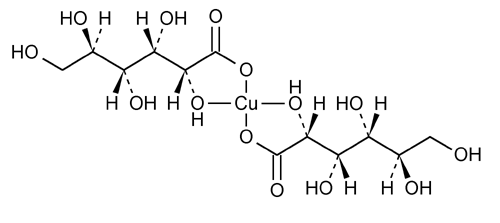
 453.84
Copper, bis(d-gluconato-O1,O2)-.
Copper d-gluconate (1:2)
[527-09-3].» Copper Gluconate contains not less than 98.0 percent and not more than 102.0 percent of C12H22CuO14.
Packaging and storage—
Preserve in well-closed containers.
Identification—
A:
A solution (1 in 20) responds to the test for Copper  191
191 .
.
191.
Chloride 221—
A 1.0-g portion shows no more chloride than corresponds to 1 mL of 0.020 N hydrochloric acid (0.07%).
221—
A 1.0-g portion shows no more chloride than corresponds to 1 mL of 0.020 N hydrochloric acid (0.07%).
Sulfate 221—
A 2.0-g portion dissolved in boiling water shows no more sulfate than corresponds to 1 mL of 0.020 N sulfuric acid (0.05%).
221—
A 2.0-g portion dissolved in boiling water shows no more sulfate than corresponds to 1 mL of 0.020 N sulfuric acid (0.05%).
Arsenic, Method I 211—
Dissolve 1.0 g in 35 mL of water: the limit is 3 ppm.
211—
Dissolve 1.0 g in 35 mL of water: the limit is 3 ppm.
Lead—
[note—For the preparation of all aqueous solutions and for the rinsing of glassware before use, employ water that has been passed through a strong-acid, strong-base, mixed-bed ion-exchange resin before use. Select all reagents to have as low a content of lead as practicable, and store all reagent solutions in containers of borosilicate glass. Cleanse glassware before use by soaking in warm 8 N nitric acid for 30 minutes and by rinsing with deionized water.]
Standard preparation—
Transfer 10.0 mL of Lead Nitrate Stock Solution, prepared as directed in the test for Heavy Metals 231, to a 100-mL volumetric flask, add 40 mL of water and 5 mL of nitric acid, dilute with water to volume, and mix. Transfer 0.40 mL of this solution to a second 100-mL volumetric flask, add 50 mL of water and 1 mL of nitric acid, dilute with water to volume, and mix. This solution contains 0.04 µg of lead per mL.
231, to a 100-mL volumetric flask, add 40 mL of water and 5 mL of nitric acid, dilute with water to volume, and mix. Transfer 0.40 mL of this solution to a second 100-mL volumetric flask, add 50 mL of water and 1 mL of nitric acid, dilute with water to volume, and mix. This solution contains 0.04 µg of lead per mL.
Test preparation—
Transfer about 4 g of Copper Gluconate, accurately weighed, to a 100-mL volumetric flask. Add 50 mL of water and 5 mL of nitric acid, and sonicate to dissolve the specimen. Dilute with water to volume, and mix. Transfer 4.0 mL of this solution to a second 100-mL volumetric flask, add 50 mL of water and 1 mL of nitric acid, dilute with water to volume, and mix.
Blank—
Transfer 1.2 mL of nitric acid to a 100-mL volumetric flask, dilute with water to volume, and mix.
Test solutions—
Prepare mixtures of the Test preparation, the Standard preparation, and the Blank with the following proportional compositions, by volume: 10.0:0:10.0, 10.0:4.0:6.0, 10.0:7.0:3.0, and 10.0:10.0:0. These Test solutions contain, respectively, 0, 0.008, 0.014, and 0.020 µg per mL, of lead from the Standard preparation.
Procedure—
Separately inject equal volumes (about 20 µL) of the Test solutions and the Blank into the graphite tube of a suitable graphite furnace atomic absorption spectrophotometer, temperature-programmed as follows to reach 2000 in about 2 minutes, using an argon gas flow of about 3 L per minute, except where indicated: 70 for 10 seconds, 90 for 60 seconds, 120 for 15 seconds, 250 for 5 seconds (no gas flow), 250 for 10 seconds, 250 for 2 seconds (no gas flow), and 2000 for 3.2 seconds. When the temperature reaches 2000, determine the absorbance at the lead emission line at 283.3 nm, corrected for background absorption. Correct the absorbance values obtained from the Test solutions by subtracting from each the absorbance value obtained from the Blank. Plot the corrected absorbances of the Test solutions versus their contents of lead, in µg per mL, as furnished by the Standard preparation, draw the straight line best fitting the four points, and extrapolate the line until it intercepts the concentration axis. From the intercept determine the concentration, C, in µg per mL, of lead in each mL of the test solution containing 0 µg of lead from the Test preparation. Calculate the percentage of lead in the specimen taken by the formula:
in about 2 minutes, using an argon gas flow of about 3 L per minute, except where indicated: 70 for 10 seconds, 90 for 60 seconds, 120 for 15 seconds, 250 for 5 seconds (no gas flow), 250 for 10 seconds, 250 for 2 seconds (no gas flow), and 2000 for 3.2 seconds. When the temperature reaches 2000, determine the absorbance at the lead emission line at 283.3 nm, corrected for background absorption. Correct the absorbance values obtained from the Test solutions by subtracting from each the absorbance value obtained from the Blank. Plot the corrected absorbances of the Test solutions versus their contents of lead, in µg per mL, as furnished by the Standard preparation, draw the straight line best fitting the four points, and extrapolate the line until it intercepts the concentration axis. From the intercept determine the concentration, C, in µg per mL, of lead in each mL of the test solution containing 0 µg of lead from the Test preparation. Calculate the percentage of lead in the specimen taken by the formula:
0.5C / W
in which W is the weight, in g, of Copper Gluconate taken to prepare the Test preparation: the limit is 0.0025%.
Reducing substances—
Transfer 1.0 g to a 250-mL conical flask, dissolve in 10 mL of water, and add 25 mL of alkaline cupric citrate TS. Cover the flask, boil gently for 5 minutes, accurately timed, and cool rapidly to room temperature. Add 25 mL of 0.6 N acetic acid, 10.0 mL of 0.1 N iodine VS, and 10 mL of 3 N hydrochloric acid, and titrate with 0.1 N sodium thiosulfate VS, adding 3 mL of starch TS as the endpoint is approached. Perform a blank determination, omitting the specimen, and note the difference in volumes required. Each mL of the difference in volume of 0.1 N sodium thiosulfate consumed is equivalent to 2.7 mg of reducing substances (as dextrose): the limit is 1.0%.
Assay—
Dissolve about 1.5 g of Copper Gluconate, accurately weighed, in 100 mL of water. Add 2 mL of glacial acetic acid and 5 g of potassium iodide, mix, and titrate with 0.1 N sodium thiosulfate VS to a light yellow color. Add 2 g of ammonium thiocyanate, mix, add 3 mL of starch TS, and continue titrating to a milk-white endpoint. Each mL of 0.1 N sodium thiosulfate is equivalent to 45.38 mg of C12H22CuO14.
Auxiliary Information—
Please check for your question in the FAQs before contacting USP.
| Topic/Question | Contact | Expert Committee |
| Monograph | Curtis Phinney
1-301-816-8540 |
(DSN05) Dietary Supplements - Non-Botanicals |
| Reference Standards | Lili Wang, Technical Services Scientist 1-301-816-8129 RSTech@usp.org |
USP32–NF27 Page 2024