Calcium Gluconate
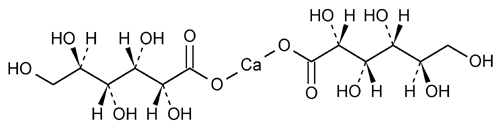
 430.37
d-Gluconic acid, calcium salt (2:1).
Calcium d-gluconate (1:2)
[299-28-5].Monohydrate 448.39
» Calcium Gluconate is anhydrous or contains one molecule of water of hydration. The anhydrous form contains not less than 98.0 percent and not more than 102.0 percent of C12H22CaO14, calculated on the dried basis. The monohydrate form contains not less than 99.0 percent and not more than 101.0 percent of C12H22CaO14·H2O where labeled as intended for use in preparing injectable dosage forms, and not less than 98.5 percent and not more than 102.0 percent of C12H22CaO14·H2O where labeled as not intended for use in preparing injectable dosage forms.
Packaging and storage—
Preserve in well-closed containers.
Labeling—
Label it to indicate whether it is the anhydrous or the monohydrate. Where the quantity of calcium gluconate is indicated in the labeling of any preparation containing Calcium Gluconate, this shall be understood to be in terms of anhydrous calcium gluconate (C12H22CaO14). Calcium Gluconate intended for use in preparing injectable dosage forms is so labeled. Calcium Gluconate not intended for use in preparing injectable dosage forms is so labeled; in addition, it may be labeled also as intended for use in preparing oral dosage forms.
USP Reference standards  11
11 —
—
USP Potassium Gluconate RS.
11—
USP Potassium Gluconate RS.
Identification—
A:
A solution (1 in 50) responds to the test for Calcium 191.
191.
B:
Dissolve a quantity of it in water to obtain a test solution containing 10 mg per mL, heating in a water bath at 60 if necessary. Similarly, prepare a Standard solution of USP Potassium Gluconate RS in water containing 10 mg per mL. Apply separate 5-µL portions of the test solution and the Standard solution to a suitable thin-layer chromatographic plate (see Chromatography 621) coated with a 0.25-mm layer of chromatographic silica gel, and allow to dry. Develop the chromatogram in a solvent system consisting of a mixture of alcohol, water, ammonium hydroxide, and ethyl acetate (50:30:10:10) until the solvent front has moved about three-fourths of the length of the plate. Remove the plate from the chamber, and dry at 110 for 20 minutes. Allow to cool, spray with a spray reagent prepared as follows. Dissolve 2.5 g of ammonium molybdate in about 50 mL of 2 N sulfuric acid in a 100-mL volumetric flask, add 1.0 g of ceric sulfate, swirl to dissolve, dilute with 2 N sulfuric acid to volume, and mix. Heat the plate at 110 for about 10 minutes: the principal spot obtained from the test solution corresponds in color, size, and RF value to that obtained from the Standard solution.
if necessary. Similarly, prepare a Standard solution of USP Potassium Gluconate RS in water containing 10 mg per mL. Apply separate 5-µL portions of the test solution and the Standard solution to a suitable thin-layer chromatographic plate (see Chromatography 621) coated with a 0.25-mm layer of chromatographic silica gel, and allow to dry. Develop the chromatogram in a solvent system consisting of a mixture of alcohol, water, ammonium hydroxide, and ethyl acetate (50:30:10:10) until the solvent front has moved about three-fourths of the length of the plate. Remove the plate from the chamber, and dry at 110 for 20 minutes. Allow to cool, spray with a spray reagent prepared as follows. Dissolve 2.5 g of ammonium molybdate in about 50 mL of 2 N sulfuric acid in a 100-mL volumetric flask, add 1.0 g of ceric sulfate, swirl to dissolve, dilute with 2 N sulfuric acid to volume, and mix. Heat the plate at 110 for about 10 minutes: the principal spot obtained from the test solution corresponds in color, size, and RF value to that obtained from the Standard solution.
Loss on drying 731—
Dry it at 105 for 16 hours: the anhydrous form loses not more than 3.0% of its weight; the monohydrate form, where labeled as intended for use in preparing injectable dosage forms, loses not more than 1.0% of its weight, and where labeled as not intended for use in preparing injectable dosage forms loses not more than 2.0% of its weight.
731—
Dry it at 105 for 16 hours: the anhydrous form loses not more than 3.0% of its weight; the monohydrate form, where labeled as intended for use in preparing injectable dosage forms, loses not more than 1.0% of its weight, and where labeled as not intended for use in preparing injectable dosage forms loses not more than 2.0% of its weight.
Chloride 221—
A 1.0-g portion shows no more chloride than corresponds to 0.07 mL of 0.020 N hydrochloric acid (0.005%). Where it is labeled as not intended for use in the preparation of injectable dosage forms, a 1.0-g portion shows no more chloride than corresponds to 1 mL of 0.020 N hydrochloric acid (0.07%).
221—
A 1.0-g portion shows no more chloride than corresponds to 0.07 mL of 0.020 N hydrochloric acid (0.005%). Where it is labeled as not intended for use in the preparation of injectable dosage forms, a 1.0-g portion shows no more chloride than corresponds to 1 mL of 0.020 N hydrochloric acid (0.07%).
Limit of oxalate—
[note—Use deionized water where water is indicated.]
Mobile phase—
Prepare a solution in water that is 0.0017 M with respect to sodium bicarbonate and 0.0018 M with respect to sodium carbonate. Make adjustments if necessary (see System Suitability under Chromatography 621).
621).
Suppressor regeneration solution—
Prepare a solution in water that is 0.0125 M with respect to sulfuric acid.
Dilute hydrochloric acid—
Dilute 1 mL of hydrochloric acid with water to obtain 1200 mL of solution.
Standard preparation—
Dissolve an accurately weighed quantity of sodium oxalate in Dilute hydrochloric acid to obtain a solution having a known concentration of about 1.5 µg per mL.
Test preparation—
Transfer 500 mg of Calcium Gluconate to a 25-mL volumetric flask, dissolve in Dilute hydrochloric acid, sonicating if necessary, dilute with Dilute hydrochloric acid to volume, and mix.
Chromatographic system (see Chromatography 621)—
The ion chromatograph is equipped with a conductance detector, a 4-mm × 5-cm guard column that contains 15-µm packing L12, a 4-mm × 25-cm analytical column that contains 15-µm packing L12, and a micromembrane anion suppressor column, connected in series with the guard and analytical columns. The anion suppressor column is equipped with a micromembrane that separates the Mobile phase from the Suppressor regeneration solution flowing countercurrent to the Mobile phase at a rate of about 7 mL per minute. Condition the system for about 15 minutes with Mobile phase, using a flow rate of about 2 mL per minute. Chromatograph the Standard preparation, and record the peak responses as directed for Procedure: the column efficiency determined from the analyte peak is not less than 2500 theoretical plates; the tailing factor is not more than 1.2; and the relative standard deviation for replicate injections is not more than 2.0%.
621)—
The ion chromatograph is equipped with a conductance detector, a 4-mm × 5-cm guard column that contains 15-µm packing L12, a 4-mm × 25-cm analytical column that contains 15-µm packing L12, and a micromembrane anion suppressor column, connected in series with the guard and analytical columns. The anion suppressor column is equipped with a micromembrane that separates the Mobile phase from the Suppressor regeneration solution flowing countercurrent to the Mobile phase at a rate of about 7 mL per minute. Condition the system for about 15 minutes with Mobile phase, using a flow rate of about 2 mL per minute. Chromatograph the Standard preparation, and record the peak responses as directed for Procedure: the column efficiency determined from the analyte peak is not less than 2500 theoretical plates; the tailing factor is not more than 1.2; and the relative standard deviation for replicate injections is not more than 2.0%.
Procedure—
Separately inject equal volumes (about 50 µL) of the Standard preparation and the Test preparation into the chromatograph, record the chromatograms, and measure the responses for the major peaks. Calculate the percentage of oxalate in the specimen taken by the formula:
(88.03/134.00)(0.005C)(rU / rS)
in which 88.03 and 134.00 are the molecular weights of oxalate and sodium oxalate, respectively; C is the concentration, in µg per mL, of sodium oxalate in the Standard preparation; and rU and rS are the oxalate peak responses obtained from the Test preparation and the Standard preparation, respectively: not more than 0.01% is found. [note—Calcium Gluconate labeled as not intended for use in the preparation of injectable dosage forms is exempt from this requirement.]
Limit of phosphate—
To 10.0 g add 90 mL of hot water, (70 to 80), and heat to boiling, with swirling, for 10 seconds to obtain a clear solution. Dilute 1 mL of this hot solution with water to obtain 100 mL of solution (test solution). Dilute 1.0 mL of a solution containing 0.716 mg of monobasic potassium phosphate per mL with water to obtain 100 mL of solution. To 2.0 mL of this solution add 98 mL of water (Standard solution). To the test solution and the Standard solution add 4 mL of sulfomolybdic acid TS, and mix. To both solutions add 0.1 mL of a freshly prepared mixture of 3 N hydrochloric acid and stronger acid stannous chloride TS (10:1), and mix. After 10 minutes any color observed in the test solution is not more intense than that obtained from the Standard solution (0.01%). [note—Calcium Gluconate labeled as not intended for use in the preparation of injectable dosage forms is exempt from this requirement.]
to 80), and heat to boiling, with swirling, for 10 seconds to obtain a clear solution. Dilute 1 mL of this hot solution with water to obtain 100 mL of solution (test solution). Dilute 1.0 mL of a solution containing 0.716 mg of monobasic potassium phosphate per mL with water to obtain 100 mL of solution. To 2.0 mL of this solution add 98 mL of water (Standard solution). To the test solution and the Standard solution add 4 mL of sulfomolybdic acid TS, and mix. To both solutions add 0.1 mL of a freshly prepared mixture of 3 N hydrochloric acid and stronger acid stannous chloride TS (10:1), and mix. After 10 minutes any color observed in the test solution is not more intense than that obtained from the Standard solution (0.01%). [note—Calcium Gluconate labeled as not intended for use in the preparation of injectable dosage forms is exempt from this requirement.]
Sulfate 221—
A 2.0-g portion dissolved in boiling water shows no more sulfate than corresponds to 0.1 mL of 0.020 N sulfuric acid (0.005%). Where it is labeled as not intended for use in the preparation of injectable dosage forms, a 2.0-g portion dissolved in boiling water shows no more sulfate than corresponds to 1 mL of 0.020 N sulfuric acid (0.05%).
221—
A 2.0-g portion dissolved in boiling water shows no more sulfate than corresponds to 0.1 mL of 0.020 N sulfuric acid (0.005%). Where it is labeled as not intended for use in the preparation of injectable dosage forms, a 2.0-g portion dissolved in boiling water shows no more sulfate than corresponds to 1 mL of 0.020 N sulfuric acid (0.05%).
Arsenic, Method I 211—
Dissolve 1.0 g in a mixture of 10 mL of hydrochloric acid and 20 mL of water, and dilute with water to 55 mL: the resulting solution meets the requirements of the test, the addition of 20 mL of 7 N sulfuric acid specified under Procedure being omitted. The limit is 3 ppm.
211—
Dissolve 1.0 g in a mixture of 10 mL of hydrochloric acid and 20 mL of water, and dilute with water to 55 mL: the resulting solution meets the requirements of the test, the addition of 20 mL of 7 N sulfuric acid specified under Procedure being omitted. The limit is 3 ppm.
Heavy metals, Method II 231:
0.001%. [note—Where Calcium Gluconate is labeled as not intended for use in the preparation of injectable dosage forms, the limit is 0.002%.]
231:
0.001%. [note—Where Calcium Gluconate is labeled as not intended for use in the preparation of injectable dosage forms, the limit is 0.002%.]
Limit of magnesium and alkali metals—
Dissolve completely 1.0 g in 100 mL of boiling water, add 10 mL of ammonium chloride TS, 1 mL of ammonium hydroxide, and 50 mL of hot, maintained at 70 to 80, ammonium oxalate TS. Allow to stand for 4 hours, dilute with water to 200 mL, and filter. Evaporate 100 mL of the filtrate to dryness, and ignite to constant weight. The weight of the residue does not exceed 2 mg (0.4%). [note—Calcium Gluconate labeled as not intended for use in preparing injectable dosage forms is exempt from this requirement.]
to 80, ammonium oxalate TS. Allow to stand for 4 hours, dilute with water to 200 mL, and filter. Evaporate 100 mL of the filtrate to dryness, and ignite to constant weight. The weight of the residue does not exceed 2 mg (0.4%). [note—Calcium Gluconate labeled as not intended for use in preparing injectable dosage forms is exempt from this requirement.]
Limit of iron—
Standard preparations—
Separately transfer 2.0, 4.0, and 10.0 mL of Standard Iron Solution, prepared as directed under Iron 241, to 100-mL volumetric flasks, each containing 1.37 g of calcium chloride, previously tested and shown to contain less than 5 ppm of iron, dilute with 2 N hydrochloric acid to volume, and mix. These solutions contain, respectively, 0.2, 0.4, and 1.0 µg of iron per mL.
241, to 100-mL volumetric flasks, each containing 1.37 g of calcium chloride, previously tested and shown to contain less than 5 ppm of iron, dilute with 2 N hydrochloric acid to volume, and mix. These solutions contain, respectively, 0.2, 0.4, and 1.0 µg of iron per mL.
Test preparation—
Transfer 1.0 g of Calcium Gluconate to a 100-mL quartz glass flask, add 20 mL of 12 N nitric acid, and heat to boiling until fumes are evolved. Add 0.5 mL of 30% hydrogen peroxide, and heat again until fumes are evolved. Repeat this process until the volume is reduced to about 5 mL. Cool, add 1.0 mL of perchloric acid, and heat to boiling. [Caution—Do not heat above 190 or evaporate to dryness because of danger of explosion.
] Transfer this solution to a 25-mL volumetric flask, dilute with 2 N hydrochloric acid to volume, and mix.
or evaporate to dryness because of danger of explosion.
] Transfer this solution to a 25-mL volumetric flask, dilute with 2 N hydrochloric acid to volume, and mix.
Blank solution—
Using 0.34 g of calcium chloride, previously tested and shown to contain less than 5 ppm of iron, instead of Calcium Gluconate, prepare as directed under Test preparation.
Procedure—
Concomitantly determine the absorbances of the Standard preparations and the Test preparation at the iron emission line of 248.3 nm, with a suitable atomic absorption spectrophotometer (see Spectrophotometry and Light-Scattering 851) equipped with an iron hollow-cathode lamp and an air–acetylene flame, using the Blank solution as the blank and making deuterium background corrections. Plot the absorbances of the Standard preparations versus concentration, in µg per mL, of iron, and draw the straight line best fitting the three plotted points. From the graph so obtained, determine the concentration, C, in µg per mL, of iron in the Test preparation. Calculate the concentration of iron, in ppm, in the specimen taken by the formula:
851) equipped with an iron hollow-cathode lamp and an air–acetylene flame, using the Blank solution as the blank and making deuterium background corrections. Plot the absorbances of the Standard preparations versus concentration, in µg per mL, of iron, and draw the straight line best fitting the three plotted points. From the graph so obtained, determine the concentration, C, in µg per mL, of iron in the Test preparation. Calculate the concentration of iron, in ppm, in the specimen taken by the formula:
25C.
The limit is 5 ppm. [note—Calcium Gluconate labeled as not intended for use in the preparation of injectable dosage forms is exempt from this requirement.]
Reducing substances—
Transfer 1.0 g to a 250-mL conical flask, dissolve in 20 mL of hot water, cool, and add 25 mL of alkaline cupric citrate TS. Cover the flask, boil gently for 5 minutes, accurately timed, and cool rapidly to room temperature. Add 25 mL of 0.6 N acetic acid, 10.0 mL of 0.1 N iodine VS, and 10 mL of 3 N hydrochloric acid, and titrate with 0.1 N sodium thiosulfate VS, adding 3 mL of starch TS as the endpoint is approached. Perform a blank determination, omitting the specimen, and note the difference in volumes required. Each mL of the difference in volume of 0.1 N sodium thiosulfate consumed is equivalent to 2.7 mg of reducing substances (as dextrose): the limit is 1.0%.
Assay—
Dissolve about 800 mg of Calcium Gluconate, accurately weighed, in 150 mL of water containing 2 mL of 3 N hydrochloric acid. While stirring, preferably with a magnetic stirrer, add about 30 mL of 0.05 M edetate disodium VS from a 50-mL buret. Add 15 mL of 1 N sodium hydroxide and 300 mg of hydroxy naphthol blue, and continue the titration to a blue endpoint. Each mL of 0.05 M edetate disodium is equivalent to 21.52 mg of C12H22CaO14.
Auxiliary Information—
Please check for your question in the FAQs before contacting USP.
Chromatographic Column—
| Topic/Question | Contact | Expert Committee |
| Monograph | Curtis Phinney
1-301-816-8540 |
(DSN05) Dietary Supplements - Non-Botanicals |
| Reference Standards | Lili Wang, Technical Services Scientist 1-301-816-8129 RSTech@usp.org |
USP32–NF27 Page 1763
Pharmacopeial Forum: Volume No. 27(6) Page 3258
Chromatographic columns text is not derived from, and not part of, USP 32 or NF 27.