


Imipramine Pamoate
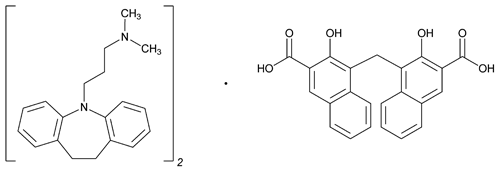
(C19H24N2)2·C23H16O6 949.18
Naphthalenecarboxylic acid, 4,4'-methylenebis[3-hydroxy-, compd. with 5H-dibenz[b,f]azepine-5-propanamine, 10,11-dihydro-N,N-dimethyl-, 2- (1:2);
5-[3-(Dimethylamino)propyl]-10,11-dihydro-5H-dibenz[b,f]azepine compound (2:1) with 4,4'-methylenebis(3-hydroxy-2-naphthoic acid);
3-[10,11-Dihydro-5H-dibenzo[b,f]azepin-5-yl)-N,N-dimethylpropan-1-amine 4,4'-methylenebis(3-hydroxy-2-naphthoate) salt (2:1) [10075-24-8].

 231
231 :
:
+'&img=../../images/v38332/cas-10075-24-8.gif&casNumber=10075-24-8&usp=38&nf=33&chemicalStructureImage=true&ID='+parent.myID,600,500);)
(C19H24N2)2·C23H16O6 949.18
Naphthalenecarboxylic acid, 4,4'-methylenebis[3-hydroxy-, compd. with 5H-dibenz[b,f]azepine-5-propanamine, 10,11-dihydro-N,N-dimethyl-, 2- (1:2);
5-[3-(Dimethylamino)propyl]-10,11-dihydro-5H-dibenz[b,f]azepine compound (2:1) with 4,4'-methylenebis(3-hydroxy-2-naphthoic acid);
3-[10,11-Dihydro-5H-dibenzo[b,f]azepin-5-yl)-N,N-dimethylpropan-1-amine 4,4'-methylenebis(3-hydroxy-2-naphthoate) salt (2:1)
[10075-24-8].DEFINITION
Imipramine Pamoate contains NLT 98.0% and NMT 102.0% of imipramine pamoate [(C19H24N2)2·C23H16O6], calculated on anhydrous basis.
IDENTIFICATION
• B.
The retention times of the major peaks of the Sample solution correspond to those of the Standard solution, as obtained in the Assay.
ASSAY
• Procedure
Buffer:
5.2 g/L of dibasic potassium phosphate in water
Solution A:
Acetonitrile and Buffer (15:85). Adjust with phosphoric acid to a pH of 8.0.
Solution B:
Acetonitrile and Buffer (38:62). Adjust with phosphoric acid to a pH of 8.0.
Mobile phase:
See Table 1.
Table 1
| Time (min) |
Solution A (%) |
Solution B (%) |
|---|---|---|
| 0 | 90 | 10 |
| 10 | 70 | 30 |
| 20 | 35 | 65 |
| 30 | 35 | 65 |
| 31 | 90 | 10 |
| 35 | 90 | 10 |
Diluent:
Acetonitrile and water (75:25)
Standard stock solution:
2 mg/mL of USP Imipramine Pamoate RS in Diluent
Standard solution:
0.2 mg/mL of USP Imipramine Pamoate RS from Standard stock solution in Solution A
Sample stock solution:
2 mg/mL of Imipramine Pamoate in Diluent
Sample solution:
0.2 mg/mL of Imipramine Pamoate from Sample stock solution in Solution A
Chromatographic system
Mode:
LC
Detector:
UV 269 nm
Column:
4.6-mm × 15-cm; 5-µm packing L1
Autosampler temperature:
10
Flow rate:
1.5 mL/min
Injection volume:
20 µL
System suitability
Sample:
Standard solution
[Note—Approximate relative retention times for pamoic acid and imipramine are 0.3 and 1.0, respectively. ]
Suitability requirements
Resolution:
NLT 2.0 between pamoic acid and imipramine
Tailing factor:
NMT 1.8 for imipramine
Relative standard deviation:
NMT 2.0% for imipramine
Analysis
Samples:
Standard solution and Sample solution
Calculate the percentage of imipramine pamoate [(C19H24N2)2·C23H16O6] in the portion of Imipramine Pamoate taken:
Result = (rU/rS) × (CS/CU) × 100
| rU | = | = peak response of imipramine from the Sample solution |
| rS | = | = peak response of imipramine from the Standard solution |
| CS | = | = concentration of USP Imipramine Pamoate RS in the Standard solution (mg/mL) |
| CU | = | = concentration of Imipramine Pamoate in the Sample solution (mg/mL) |
Acceptance criteria:
98.0%–102.0% on the anhydrous basis
IMPURITIES
• Residue on Ignition 281:
NMT 0.10%
281:
NMT 0.10%
Delete the following:
231:
(Official 1-Dec-2015)
• Organic Impurities
Buffer:
5.2 g/L of dibasic potassium phosphate in water
Solution A:
Acetonitrile and Buffer (38:62). Adjust with phosphoric acid to a pH of 7.9.
Solution B:
Acetonitrile and Buffer (70:30). Adjust with phosphoric acid to a pH of 6.0.
Mobile phase:
See Table 2.
Table 2
| Time (min) |
Solution A (%) |
Solution B (%) |
|---|---|---|
| 0 | 100 | 0 |
| 15 | 100 | 0 |
| 50 | 0 | 100 |
| 60 | 0 | 100 |
| 61 | 100 | 0 |
| 75 | 100 | 0 |
Diluent:
Acetonitrile and water (75:25)
System suitability solution:
0.5 mg/mL of USP Imipramine Pamoate RS, 0.02 mg/mL of USP Depramine RS, and 0.02 mg/mL USP Iminodibenzyl RS in Diluent
Standard solution:
0.002 mg/mL of USP Imipramine Pamoate RS in Diluent
Sample solution:
2 mg/mL of Imipramine Pamoate in Diluent
Chromatographic system
Mode:
LC
Detector:
UV 220 nm
Column:
4.6-mm × 15-cm; 5-µm packing L1
Temperatures
Column:
40
Autosampler:
10
Flow rate:
1.0 mL/min
Injection volume:
10 µL
System suitability
Samples:
System suitability solution and Standard solution
[Note—See Table 3 for relative retention times. ]
Suitability requirements
Resolution:
NLT 5.0 between imipramine and depramine, System suitability solution
Relative standard deviation:
NMT 5.0%, Standard solution
Analysis
Samples:
Standard solution and Sample solution
Calculate the percentage of each impurity in the portion of Imipramine Pamoate taken:
Result = (rU/rS) × (CS/CU) × 100
| rU | = | = peak response of each impurity from the Sample solution |
| rS | = | = peak response of imipramine from the Standard solution |
| CS | = | = concentration of USP Imipramine Pamoate RS in the Standard solution (mg/mL) |
| CU | = | = concentration of Imipramine Pamoate in the Sample solution (mg/mL) |
Acceptance criteria:
See Table 3. Disregard peaks that are less than 0.05% of the imipramine peak.
Table 3
| Name | Relative Retention Time |
Acceptance Criteria, NMT (%) |
|---|---|---|
| Pamoic acid (Pamoate)a | 0.2 | — |
| Desipramineb | 0.5 | 0.10 |
| Depramine | 0.7 | 0.10 |
| Imipramine | 1.0 | — |
| Iminodibenzyl | 3.7 | 0.10 |
| Any individual, unspecified impurity |
— | 0.10 |
| Total impurities | — | 0.75 |
|
a
Pamoic acid is not an impurity. It is listed for identification purposes only.
b
10,11-Dihydro-5-[3-(methylamino)propyl]-5H-dibenz[b,f]azepine.
|
||
SPECIFIC TESTS
• Water Determination, Method I 921:
NMT 2.0%
921:
NMT 2.0%
ADDITIONAL REQUIREMENTS
• Packaging and Storage:
Preserve in tight containers, and store at controlled room temperature.
• USP Reference Standards 11
11
USP Depramine RS 
3-(5H-Dibenzo[b,f]azepin-5-yl)-N,N-dimethylpropan-1-amine.
C19H22N2 278.39
') + '&img=../../images/v38332/cas-303-54-8.gif',600,500);)
3-(5H-Dibenzo[b,f]azepin-5-yl)-N,N-dimethylpropan-1-amine.
C19H22N2 278.39
USP Iminodibenzyl RS
10,11-Dihydro-5H-dibenzo[b,f]azepine.
C14H13N 195.28
') + '&img=../../images/v38332/c11rs623.gif',600,500);)
10,11-Dihydro-5H-dibenzo[b,f]azepine.
C14H13N 195.28
USP Imipramine Pamoate RS
') + '&img=../../images/v38332/cas-10075-24-8.gif',600,500);)
Auxiliary Information—
Please check for your question in the FAQs before contacting USP.
| Topic/Question | Contact | Expert Committee |
|---|---|---|
| Monograph | Heather R. Joyce, Ph.D.
Associate Scientific Liaison (301) 998-6792 |
(SM42010) Monographs - Small Molecules 4 |
| Reference Standards | RS Technical Services 1-301-816-8129 rstech@usp.org |
USP38–NF33 Page 3844
Pharmacopeial Forum: Volume No. 39(5)