


Famotidine
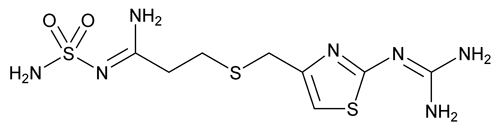
C8H15N7O2S3 337.45
Propanimidamide, N'-(aminosulfonyl)-3-[[[2-[(diaminomethylene)amino]-4-thiazolyl]methyl]thio]-;
[1-Amino-3-[[[2-[(diaminomethylene)amino]-4-thiazolyl]methyl]thio]propylidene]sulfamide;
3-[[2-(Diaminomethyleneamino)thiazol-4-yl]methylthio]-N¢-sulfamoylpropanimidamide [76824-35-6].

 231
231 :
:
(fam oh' ti deen).
+'&img=../../images/v38332/cas-76824-35-6.gif&casNumber=76824-35-6&usp=38&nf=33&chemicalStructureImage=true&ID='+parent.myID,600,500);)
C8H15N7O2S3 337.45
Propanimidamide, N'-(aminosulfonyl)-3-[[[2-[(diaminomethylene)amino]-4-thiazolyl]methyl]thio]-;
[1-Amino-3-[[[2-[(diaminomethylene)amino]-4-thiazolyl]methyl]thio]propylidene]sulfamide;
3-[[2-(Diaminomethyleneamino)thiazol-4-yl]methylthio]-N¢-sulfamoylpropanimidamide
[76824-35-6].DEFINITION
Famotidine contains NLT 98.5% and NMT 101.0% of famotidine (C8H15N7O2S3), calculated on the dried basis.
IDENTIFICATION
ASSAY
• Procedure
Sample:
Dissolve 250 mg of Famotidine in 80 mL of glacial acetic acid.
Analysis:
Titrate with 0.1 N perchloric acid VS (see Titrimetry 541), using a suitable anhydrous electrode system. Perform a blank determination, and make any necessary correction. Each mL of 0.1 N perchloric acid is equivalent to 16.87 mg of C8H15N7O2S3.
541), using a suitable anhydrous electrode system. Perform a blank determination, and make any necessary correction. Each mL of 0.1 N perchloric acid is equivalent to 16.87 mg of C8H15N7O2S3.
Acceptance criteria:
98.5%–101.0% on the dried basis
IMPURITIES
• Residue on Ignition 281:
NMT 0.1%
281:
NMT 0.1%
Delete the following:
231:
(Official 1-Dec-2015)
• Organic Impurities
Buffer:
1.882 g/L of sodium 1-hexanesulfonate in water, adjusted with acetic acid to a pH of 3.5
Solution A:
Acetonitrile, methanol, and Buffer (94:6:900)
Solution B:
Acetonitrile
Mobile phase:
See Table 1. [Note—If necessary, adjust the Mobile phase to achieve a retention time of 19–23 min for the famotidine peak and a maximum of 48 min for the famotidine related compound E peak. ]
Table 1
| Time (min) |
Solution A (%) |
Solution B (%) |
Flow Rate (mL/min) |
|---|---|---|---|
| 0 | 100 | 0 | 1 |
| 23 | 96 | 4 | 1 |
| 27 | 96 | 4 | 2 |
| 47 | 78 | 22 | 2 |
| 48 | 100 | 0 | 2 |
| 54 | 100 | 0 | 1 |
Standard stock solution:
0.5 mg/mL of USP Famotidine RS in Solution A
Standard solution:
0.5 µg/mL of USP Famotidine RS in Solution A
System suitability stock solution:
0.25 mg/mL of USP Famotidine Related Compound D RS in methanol
System suitability solution:
Transfer 1 mL of the System suitability stock solution and 0.5 mL of the Standard stock solution into a 100-mL volumetric flask, and dilute with Solution A to volume.
Sample solution:
0.5 mg/mL of Famotidine in Solution A
Identification solution:
0.5 mg/mL of USP Famotidine RS and 1.5 µg/mL of each of USP Famotidine Related Compound B RS, USP Famotidine Related Compound C RS, USP Famotidine Related Compound D RS, USP Famotidine Related Compound E RS, and USP Famotidine Related Compound F RS in Solution A
[Note—To address the poor solubility of USP Famotidine Related Compound F RS in Solution A, it may be first dissolved in a minimal amount of 0.1 N sodium hydroxide. ]
Chromatographic system
Mode:
LC
Detector:
UV 265 nm
Column:
4.6-mm × 25-cm; 5-µm packing L1
Column temperature:
50
Flow rate:
See Table 1.
Injection volume:
20 µL
System suitability
Sample:
System suitability solution
Suitability requirements
Resolution:
NLT 3.5 between famotidine and famotidine related compound D
Analysis
Samples:
Standard solution, Sample solution, and Identification solution
Chromatograph the Identification solution, and identify the components on the basis of their relative retention times, given in Table 2.
Calculate the percentage of each impurity in the portion of Famotidine taken:
Result = (rU/rS) × (CS/CU) × (1/F) × 100
| rU | = | = peak response of each impurity from the Sample solution |
| rS | = | = peak response of famotidine from the Standard solution |
| CS | = | = concentration of USP Famotidine RS in the Standard solution (mg/mL) |
| CU | = | = concentration of Famotidine in the Sample solution (mg/mL) |
| F | = | = relative response factor (see Table 2) |
Acceptance criteria:
See Table 2.
Table 2
| Name | Relative Retention Time |
Relative Response Factor |
Acceptance Criteria, NMT (%) |
|---|---|---|---|
| Famotidine | 1.0 | — | — |
| Famotidine related compound Da | 1.1 | 1.0 | 0.3 |
| Famotidine related compound Cb | 1.2 | 0.53 | 0.3 |
| Famotidine cyanoamidinec | 1.4 | 0.71 | 0.2 |
| Famotidine related compound Fd | 1.5 | 0.59 | 0.1 |
| Famotidine amidinee | 1.6 | 0.53 | 0.2 |
| Famotidine related compound Bf | 2.0 | 0.40 | 0.3 |
| Famotidine related compound Eg | 2.1 | 1.0 | 0.3 |
| Any other individual impurity | — | 1.0 | 0.1 |
| Total impurities | — | — | 1.0 |
|
a
Famotidine propanamide.
b
Famotidine sulfamoyl propanamide.
c
N-Cyano-3-[[2-(diaminomethyleneamino)thiazol-4-yl]methylthio]propanimidamide.
d
Famotidine propionic acid.
e
3-[[2-(Diaminomethyleneamino)thiazol-4-yl]methylthio]propanimidamide.
f
Famotidine dimer.
g
Famotidine disulfide.
|
|||
SPECIFIC TESTS
• Loss on Drying 731
731
Analysis:
Dry a sample at a pressure not exceeding 5 mm of mercury at 80 for 5 h.
for 5 h.
Acceptance criteria:
NMT 0.5%
ADDITIONAL REQUIREMENTS
• Packaging and Storage:
Preserve in well-closed containers, protected from light. Store at room temperature.
• USP Reference Standards 11
11
USP Famotidine RS 
') + '&img=../../images/v38332/cas-76824-35-6.gif',600,500);)
USP Famotidine Related Compound B RS
3,5-Bis[2-[[2-[(diaminomethylene)amino]thiazol-4-yl]methylthio]ethyl]-4H-1,2,4,6-thiatriazine 1,1-dioxide.
C16H23N11O2S5 561.73
') + '&img=../../images/v38332/c11rs4860.gif',600,500);)
3,5-Bis[2-[[2-[(diaminomethylene)amino]thiazol-4-yl]methylthio]ethyl]-4H-1,2,4,6-thiatriazine 1,1-dioxide.
C16H23N11O2S5 561.73
USP Famotidine Related Compound C RS
3-[[2-(Diaminomethyleneamino)thiazol-4-yl]methylthio]-N-sulfamoylpropanamide hydrochloride.
C8H15ClN6O3S3 374.88
') + '&img=../../images/v38332/c11rs4861.gif',600,500);)
3-[[2-(Diaminomethyleneamino)thiazol-4-yl]methylthio]-N-sulfamoylpropanamide hydrochloride.
C8H15ClN6O3S3 374.88
USP Famotidine Related Compound D RS
3-[[2-(Diaminomethyleneamino)thiazol-4-yl]methylthio]propanamide.
C8H13N5OS2 259.35
') + '&img=../../images/v38332/c11rs4862.gif',600,500);)
3-[[2-(Diaminomethyleneamino)thiazol-4-yl]methylthio]propanamide.
C8H13N5OS2 259.35
USP Famotidine Related Compound E RS
2,2¢-[4,4¢-Disulfanediylbis(methylene)bis(thiazole-4,2-diyl)]diguanidine.
C10H14N8S4 374.53
') + '&img=../../images/v38332/c11rs4863.gif',600,500);)
2,2¢-[4,4¢-Disulfanediylbis(methylene)bis(thiazole-4,2-diyl)]diguanidine.
C10H14N8S4 374.53
USP Famotidine Related Compound F RS
3-[[2-(Diaminomethyleneamino)thiazol-4-yl]methylthio]propanoic acid.
C8H12N4O2S2 260.34
') + '&img=../../images/v38332/c11rs4864.gif',600,500);)
3-[[2-(Diaminomethyleneamino)thiazol-4-yl]methylthio]propanoic acid.
C8H12N4O2S2 260.34
Auxiliary Information—
Please check for your question in the FAQs before contacting USP.
| Topic/Question | Contact | Expert Committee |
|---|---|---|
| Monograph | Elena Gonikberg, Ph.D.
Director - Chemical Medicines (301) 816-8251 |
(SM32010) Monographs - Small Molecules 3 |
| Reference Standards | RS Technical Services 1-301-816-8129 rstech@usp.org |
USP38–NF33 Page 3437
Pharmacopeial Forum: Volume No. 39(1)