


 121
121 INSULIN ASSAYS
INTRODUCTION
Change to read:
The most prominent manifestation of insulin activity, an abrupt decrease in blood glucose, was the basis for biologic assay from the time of its first clinical use. The assay, although relatively cumbersome, has the great merit of accurately reflecting the effect on the diabetic patient. The advent of practical yet sophisticated physicochemical methods (e.g., liquid chromatography) to measure insulin potency quantitatively has resulted in a more accurate and precise compendial test for insulin and insulin products. However, the bioidentity of insulin and insulin products cannot be assessed by these methods. Thus, a

(IRA 1-Mar-2015)
The Rabbit Blood Sugar Method—Quantitative is used to determine the potency of Insulin Reference Standards, for the validation of the stability of new insulin preparations, and to determine the specific activities of insulin analogs.
ASSAY
Change to read:
• Rabbit Blood Sugar Method—Quantitative
Diluent:
Prepare an aqueous solution containing 0.1%–0.25% (w/v) of either cresol or phenol, 1.4%–1.8% (w/v) of glycerin, and sufficient hydrochloric acid to produce a pH between 2.5 and 3.5, unless otherwise directed in the individual monograph.
Standard stock solution:
(IRA 1-Mar-2015)
Standard solutions:
Dilute portions of the Standard stock solution with Diluent to make two solutions, one to contain 1.0 USP Insulin Unit/mL (Standard solution 1), and the other to contain 2.0 USP Insulin Units/mL (Standard solution 2).
Sample stock solution:
Proceed as directed in the Standard stock solution, except to use a suitable quantity of the preparation under test in place of USP Insulin RS of the appropriate species. The Sample stock solution contains about 40 USP Insulin Units/mL.
Sample solutions:
Dilute portions of the Sample stock solution with Diluent to make two dilutions of the preparation under test, one of which may be expected, on the basis of the assumed potency, to contain 1.0 USP Insulin Unit/mL (Sample solution 1), and the other to contain 2.0 USP Insulin Units/mL (Sample solution 2). In the case of neutral insulin injection, adjust to a pH of 2.5–3.5 before making the dilutions.
Doses of the solutions to be injected:
Select, on the basis of trial or experience, the dose of the dilutions to be injected, the volume of which usually will be between 0.30 and 0.50 mL. For each animal, the volume of the Standard solution is the same as that of the Sample solution.
Preparation of animal:
Select suitable, healthy rabbits, each weighing NLT 1.8 kg. Keep the rabbits in the laboratory for NLT 1 week before use in the assay, maintaining them on an adequate uniform diet, with water available at all times.
Analysis:
Divide the rabbits into four equal groups of preferably NLT six rabbits each. On the preceding day, approximately 20 h before the assay, provide each rabbit with an amount of food that will be consumed within 6 h. Follow the same feeding schedule before each test day. During the assay, withhold all food until after the final blood specimen is taken. Handle the rabbits with care to avoid undue excitement, and inject subcutaneously the doses indicated in the following design (see Table 1), the second injection being made on the day after the first injection, or NMT 1 week later. The time between the first and second injections is the same for all rabbits.
Table 1
| Group
|
First Injection | Second Injection |
|---|---|---|
| 1 | Standard solution 2 | Sample solution 1 |
| 2 | Standard solution 1 | Sample solution 2 |
| 3 | Sample solution 2 | Standard solution 1 |
| 4 | Sample solution 1 | Standard solution 2 |
Blood samples:
At 1 h ± 5 min and 2.5 h ± 5 min after the time of injection, obtain from each rabbit a suitable blood specimen from a marginal ear vein. Blood can also be collected effectively from the central auricular artery.
Dextrose determination:
Determine the dextrose content of the blood specimens by a suitable procedure that is adapted to automated analysis. The following procedure may be used.
Anticoagulant solution:
Dissolve 1 g of edetate sodium and 200 mg of sodium fluoride in 1 L of water, and mix.
Dextrose standard preparations:
Transfer known concentrations of USP Dextrose RS to suitable vessels, and dilute quantitatively and stepwise with Anticoagulant solution (1:9) to obtain a range of Dextrose standard preparations containing between 20 and 100 mg per 100 mL, having known concentrations similar to the concentrations in the rabbit blood samples.
Sample preparations:
Pipet into separate, suitable vessels 0.1 mL of each Blood sample and 0.9 mL of Anticoagulant solution.
Analysis:
Subject the Sample preparations to dialysis across a semipermeable membrane for a sufficient time so that the dextrose passes through the membrane into a saline TS solution containing glucose oxidase, horseradish peroxidase, 3-methyl-2-benzothiazolinone hydrazone hydrochloride TS, and N,N-dimethylaniline. The absorbances of the Sample preparations are determined at 600 nm in a recording colorimeter. The absorbances of the Dextrose standard preparations are similarly determined at the start and the end of each run.
Calculation:
Calculate the response of each rabbit to each injection from the sum of the two blood sugar values, and subtract its response, disregarding the chronological order in which the responses were observed, to obtain the individual differences, y, as shown in Table 2.
When the data for one or more rabbits are missing in an assay, do not use the confidence interval formulas given here, but seek statistical help. The data can still be analyzed with proper analysis of variance.
When the number of rabbits, f, carried through the assay is the same in each group, total the y's in each group and compute:
Ta =  T1 + T2 + T3 T4
T1 + T2 + T3 T4
and
Tb = T1 + T2 + T3 + T4
The logarithm of the relative potency of the test dilutions is M¢ = 0.301Ta/Tb. The potency of the injection in USP Units/mg equals the antilog (log R + M¢), where:
R = vS/vU
| vS | = | = number of USP Units/mL of the Standard solution |
| vU | = | = number of mg/mL of insulin of the corresponding Sample solution |
Determine the 95% confidence interval for the log-relative potency using Fieller's Theorem (see Appendix and Design and Analysis of Biological Assays 111). If the confidence interval is more than 0.082, which corresponds at P = 0.95 to confidence limits of about ±10% of the computed potency, repeat the assay until the combined data of the two or more assays, redetermined as described in Combination of Independent Assays in 111, meet this acceptable limit.
111). If the confidence interval is more than 0.082, which corresponds at P = 0.95 to confidence limits of about ±10% of the computed potency, repeat the assay until the combined data of the two or more assays, redetermined as described in Combination of Independent Assays in 111, meet this acceptable limit.
Table 2
| Group | Differences | Individual Response (y) |
Total Response (T) |
Standard Deviations of Differences (S) |
|---|---|---|---|---|
| 1 | Standard solution 2 Sample solution 1 |
y1 | T1 | S1 |
| 2 | Sample solution 2 Standard solution 1 |
y2 | T2 | S2 |
| 3 | Sample solution 2 Standard solution 1 |
y3 | T3 | S3 |
| 4 | Standard solution 2 Sample solution 1 |
y4 | T4 | S4 |
Appendix: Fieller's Theorem for Determining the Confidence Interval for a Ratio
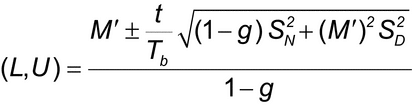



This version of Fieller's Theorem is for the case where the numerator and denominator are uncorrelated. The equation assumes that the numerator and denominator are normally distributed and that the groups of rabbits are of equal sizes.
Then, the 95% confidence interval for the ratio is:
+'&img=../../images/v38332/c121-eq1-pf405.gif&casNumber=&usp=38&nf=33&chemicalStructureImage=false&ID='+parent.myID,600,500);)
where f (degrees of freedom in the standard errors) = 4(k 1), where k is the number of rabbits in a group, t is the upper 97.5 percentile of the t-distribution with f degrees of freedom, and
1), where k is the number of rabbits in a group, t is the upper 97.5 percentile of the t-distribution with f degrees of freedom, and +'&img=../../images/v38332/c121-eq2-pf405.gif&casNumber=&usp=38&nf=33&chemicalStructureImage=false&ID='+parent.myID,600,500);)
If g  1, the denominator is not significantly different from 0 and the formula does not work.
1, the denominator is not significantly different from 0 and the formula does not work. +'&img=../../images/v38332/c121-eq3-pf405.gif&casNumber=&usp=38&nf=33&chemicalStructureImage=false&ID='+parent.myID,600,500);)
+'&img=../../images/v38332/c121-eq4-pf405.gif&casNumber=&usp=38&nf=33&chemicalStructureImage=false&ID='+parent.myID,600,500);)
• Bioidentity Test
Proceed as directed in Rabbit Blood Sugar Method—Quantitative with the following modifications.
Procedure:
Divide the rabbits into four equal groups of two rabbits each.
Calculation:
Proceed as directed for Calculation in Rabbit Blood Sugar Method—Quantitative, but do not determine the confidence interval of the log-relative potency, M¢.
Interpretation:
If the potency value obtained is NLT 15 USP Units/mg, the Bioidentity Test requirement is met. If the potency value is less than 15 USP Units/mg, repeat the test using eight more rabbits. If the average potency of the two sets of tests is NLT 15 USP Units/mg, the requirement of the test is met.
ADDITIONAL REQUIREMENTS
Change to read:
• USP Reference Standards 11
USP Dextrose RS 
') + '&img=../../images/v38332/c11rs374.gif',600,500);) (IRA 1-Mar-2015)
(IRA 1-Mar-2015)
USP Insulin Beef RS
') + '&img=../../images/v38332/cas-11070-73-8.gif',600,500);) (IRA 1-Mar-2015)
(IRA 1-Mar-2015)
USP Insulin Human RS
') + '&img=../../images/v38332/cas-11061-68-0.gif',600,500);) (IRA 1-Mar-2015)
(IRA 1-Mar-2015)
USP Insulin Pork RS
') + '&img=../../images/v38332/cas-12584-58-6.gif',600,500);)
Auxiliary Information—
Please check for your question in the FAQs before contacting USP.
| Topic/Question | Contact | Expert Committee |
|---|---|---|
| General Chapter | Edith Chang, Ph.D.
Scientific Liaison (301) 816-8392 |
(BIO12010) Monographs - Biologics and Biotechnology 1 |
| Reference Standards | RS Technical Services 1-301-816-8129 rstech@usp.org |
USP38–NF33 Page 193
USP38–NF33 Supplement : No. 2 Page 7580
Pharmacopeial Forum: Volume No. 40(5)