Tryptophan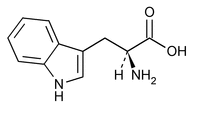


C11H12N2O2204.23
l-Tryptophan [73-22-3].
(trip' toe fan).
+'&img=../../images/v35300/g-860.gif&casNumber=73-22-3&usp=35&nf=30&chemicalStructureImage=true&ID='+parent.myID,600,500);)
+'&img=../../images/v35300/g-860.gif&casNumber=73-22-3&usp=35&nf=30&chemicalStructureImage=true&ID='+parent.myID,600,500);)
C11H12N2O2204.23
l-Tryptophan
[73-22-3].DEFINITION
Tryptophan contains NLT 98.5% and NMT 101.5% of C11H12N2O2, as l-tryptophan, calculated on the dried basis.
IDENTIFICATION
ASSAY
• Procedure
Sample solution: Place 200 mg of Tryptophan in a 125-mL flask. Dissolve in a mixture of 3 mL of formic acid and 50 mL of glacial acetic acid.
Analysis: Titrate with 0.1 N perchloric acid VS, determining the endpoint potentiometrically. Perform a blank determination, and make any necessary correction (see Titrimetry  541
541 ). Each mL of 0.1 N perchloric acid is equivalent to 20.42 mg of C11H12N2O2.
541). Each mL of 0.1 N perchloric acid is equivalent to 20.42 mg of C11H12N2O2.Acceptance criteria: 98.5%–101.5% on the dried basis
IMPURITIES
Inorganic Impurities
• Residue on Ignition 281: NMT 0.1%
281: NMT 0.1%• Chloride and Sulfate, Chloride 221: A 0.73-g portion shows no more chloride than corresponds to 0.50 mL of 0.020 N hydrochloric acid (0.05%). [Note—Gently heat the sample preparation to dissolve, if necessary. ]
221: A 0.73-g portion shows no more chloride than corresponds to 0.50 mL of 0.020 N hydrochloric acid (0.05%). [Note—Gently heat the sample preparation to dissolve, if necessary. ] • Chloride and Sulfate, Sulfate 221: A 0.33-g portion shows no more sulfate than corresponds to 0.10 mL of 0.020 N sulfuric acid (0.03%). [Note—Gently heat the sample preparation to dissolve, if necessary. ]
221: A 0.33-g portion shows no more sulfate than corresponds to 0.10 mL of 0.020 N sulfuric acid (0.03%). [Note—Gently heat the sample preparation to dissolve, if necessary. ] • Iron 241: NMT 30 ppm
241: NMT 30 ppm• Heavy Metals, Method II 231: NMT 15 ppm
231: NMT 15 ppmOrganic Impurities
• Procedure 1
Solution A: Trifluoroacetic acid in water (1 mL/L)
Solution B: Trifluoroacetic acid in an acetonitrile and water solution (80:20) (1 mL/L trifluoroacetic acid solution)
Standard solution: 1.0 mg/L each of USP Tryptophan Related Compound A RS and USP Tryptophan Related Compound B RS in water
Sample solution: 10.0 mg/mL of tryptophan in water
System suitability solution: 1.0 mg/L of USP Tryptophan Related Compound B RS in water
Mobile phase: See the gradient table below.
| Time (min) | Solution A (%) | Solution B (%) |
|---|---|---|
| 0 | 95 | 5 |
| 2 | 95 | 5 |
| 37 | 35 | 65 |
| 42 | 0 | 100 |
| 47 | 0 | 100 |
| 50 | 95 | 5 |
| 60 | 95 | 5 |
Chromatographic system
Mode: LC
Detector: UV 220 nm
Column: 4.6-mm × 25-cm; 5-µm packing L1
Column temperature: 30
Flow rate: 1 mL/min
Injection size: 20 µL
System suitability
Sample: System suitability solution
Suitability requirement
Relative standard deviation: NMT 5.0%
Analysis
Samples: Standard solution and Sample solution
Calculate the percentage of each unspecified impurity in the portion of Tryptophan taken:
Result = (rU/rS) × (CS/CU) × 100
| rU | = | = peak area of each unspecified impurity in the Sample solution |
| rS | = | = peak area of tryptophan related compound B in the Standard solution |
| CS | = | = concentration of USP Tryptophan Related Compound B RS in the Standard solution (µg/mL) |
| CU | = | = concentration of Tryptophan in the Sample solution (µg/mL) |
Acceptance criteria
Total impurities 1: NMT 0.01% of the total impurities eluting prior to the tryptophan peak
Total impurities 2: NMT 0.03% of the total impurities eluting after the tryptophan peak. [Note—Exclude the peak for tryptophan related compound B. ]
Tryptophan related compound A: If a peak for tryptophan related compound A is observed in the Sample solution, then perform the test for Procedure 2: Limit of Tryptophan Related Compound A, below.
• Procedure 2: Limit of Tryptophan Related Compound A
Solution A: 18 mM monobasic sodium phosphate, filtered and degassed (pH 2.5), and acetonitrile (9:1)
Solution B: 10 mM monobasic sodium phosphate, filtered and degassed (pH 2.5), and acetonitrile (1:1)
Solution C: Acetonitrile in water (7:3)
Standard solution: 0.1 mg/L of USP Tryptophan Related Compound A RS in water
Sample solution: 10.0 mg/mL of Tryptophan in water
Mobile phase: See the gradient table below.
| Time (min) | Solution A (%) | Solution B (%) | Solution C (%) |
|---|---|---|---|
| 0 | 100 | 0 | 0 |
| 30 | 44 | 56 | 0 |
| 30.1 | 0 | 0 | 100 |
| 45 | 0 | 0 | 100 |
| 45.1 | 100 | 0 | 0 |
| 60 | 100 | 0 | 0 |
Chromatographic system
Mode: LC
Detector: UV 216 nm
Column: 3.9-mm × 15-cm; 5-µm packing L1
Column temperature: 30
Flow rate: 1 mL/min
Injection size: 20 µL
System suitability
Sample: Standard solution
Suitability requirement
Relative standard deviation: NMT 5.0%
Analysis
Samples: Standard solution and Sample solution
Calculate the percentage of tryptophan related compound A in the portion of Tryptophan taken:
Result = (rU/rS) × (CS/CU) × 100
| rU | = | = peak area of tryptophan related compound A in the Sample solution |
| rS | = | = peak area of tryptophan related compound A in the Standard solution |
| CS | = | = concentration of USP Tryptophan Related Compound A RS in the Standard solution (µg/mL) |
| CU | = | = concentration of Tryptophan in the Sample solution (µg/mL) |
Acceptance criteria: NMT 10 ppm
SPECIFIC TESTS
• Optical Rotation, Specific Rotation 781S:  29.4 to 32.8
781S: 29.4 to 32.8Sample solution: 10 mg/mL, in water. [Note—Heat gently to dissolve, if necessary. ]
• pH 791: 5.5–7.0, in a solution (1 in 100)
791: 5.5–7.0, in a solution (1 in 100)• Loss on Drying 731: Dry a sample at 105 for 3 h: it loses NMT 0.3% of its weight.
731: Dry a sample at 105 for 3 h: it loses NMT 0.3% of its weight.ADDITIONAL REQUIREMENTS
• Packaging and Storage: Preserve in well-closed containers.
• USP Reference Standards 11
11 USP l-Tryptophan RS 
') + '&img=../../images/v35300/cas-73-22-3.gif',600,500);)
USP Tryptophan Related Compound A RS
3,3¢-[Ethylidenebis(1H-indole-1,3-diyl)]bis[2S)-2-aminopropanoic]acid.
C24H26N4O4 432.49
3,3¢-[Ethylidenebis(1H-indole-1,3-diyl)]bis[2S)-2-aminopropanoic]acid.
C24H26N4O4 432.49
USP Tryptophan Related Compound B RS
2-Acetamido-3-(1H-indol-3-yl)propanoic acid.
C13H14N2O3 246.3
2-Acetamido-3-(1H-indol-3-yl)propanoic acid.
C13H14N2O3 246.3
Auxiliary Information— Please check for your question in the FAQs before contacting USP.
| Topic/Question | Contact | Expert Committee |
|---|---|---|
| Monograph | Huy T. Dinh, M.S. Scientific Liaison 1-301-816-8594 | (DS2010) Monographs - Dietary Supplements |
| Reference Standards | RS Technical Services 1-301-816-8129 rstech@usp.org |
USP35–NF30 Page 4970
Pharmacopeial Forum: Volume No. 33(6) Page 1214Chromatographic Column—
Chromatographic columns text is not derived from, and not part of, USP 35 or NF 30.