Aspartic Acid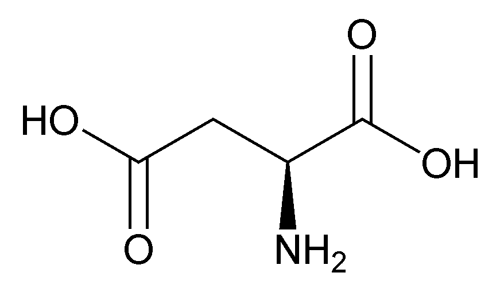


C4H7NO4133.10
l-Aspartic acid [56-84-8].
(as par' tik as' id).
+'&img=../../images/v35300/cas-56-84-8.gif&casNumber=56-84-8&usp=35&nf=30&chemicalStructureImage=true&ID='+parent.myID,600,500);)
+'&img=../../images/v35300/cas-56-84-8.gif&casNumber=56-84-8&usp=35&nf=30&chemicalStructureImage=true&ID='+parent.myID,600,500);)
C4H7NO4133.10
l-Aspartic acid
[56-84-8].DEFINITION
Aspartic Acid contains NLT 98.5% and NMT 101.5% of aspartic acid (C4H7NO4), calculated on the dried basis.
IDENTIFICATION
ASSAY
• Procedure
Sample: 100 mg of Aspartic Acid
Titrimetric system
(See Titrimetry  541
541 .)
.)
541.)Mode: Direct titration
Titrant: 0.1 N sodium hydroxide VS
Endpoint detection: Visual
Blank: 50 mL of carbon dioxide-free water. Add 0.1 mL of bromothymol blue TS.
Analysis: Transfer the Sample to a 125-mL flask, and dissolve in 50 mL of carbon dioxide-free water. Heat slightly if necessary. Cool, add 0.1 mL of bromothymol blue TS, and titrate with Titrant until the color changes from yellow to blue.
Calculate the percentage of aspartic acid (C4H7NO4) in the portion of Aspartic Acid taken:
Result = [(V  B) × N × F × 100]/W
B) × N × F × 100]/W| V | = | = sample titrant volume (mL) |
| B | = | = blank titrant volume (mL) |
| N | = | = titrant normality (mEq/mL) |
| F | = | = equivalency factor, 133.1 mg/mEq |
| W | = | = weight of Sample (mg) |
Acceptance criteria: 98.5%–101.5% on the dried basis
IMPURITIES
• Residue on Ignition 281: NMT 0.1%
281: NMT 0.1%• Chloride and Sulfate, Chloride 221
221 Sample solution: Dissolve 0.7 g of Aspartic Acid in 10 mL of diluted nitric acid, and dilute with water to 15 mL.
Acceptance criteria: The Sample solution shows no more chloride than corresponds to 0.20 mL of 0.020 N hydrochloric acid (NMT 0.02%).
• Chloride and Sulfate, Sulfate 221
221 Sample solution: Dissolve 0.8 g of Aspartic Acid in 4 mL of hydrochloric acid, and dilute with water to 15 mL.
Acceptance criteria: The Sample solution shows no more sulfate than corresponds to 0.25 mL of 0.020 N sulfuric acid (NMT 0.03%).
• Iron 241: NMT 10 ppm
241: NMT 10 ppm• Heavy Metals, Method II 231: NMT 10 ppm
231: NMT 10 ppm• Chromatographic Purity
System suitability solution: 10 mg each of USP Aspartic Acid RS and glutamic acid in 2 mL of ammonia TS. Dilute with water to 25.0 mL.
Standard solution: Transfer 5 mg of USP Aspartic Acid RS to a 100-mL volumetric flask, dissolve in 2 mL of 17% ammonia solution (prepared by diluting ammonium hydroxide, 6 in 10), and dilute with water to volume.
Sample solution: Transfer 0.1 g of Aspartic Acid to a 10-mL volumetric flask, dissolve in 2 mL of 17% ammonia solution (prepared by diluting ammonium hydroxide, 6 in 10), and dilute with water to volume.
Chromatographic system
Mode: TLC
Adsorbent: 0.25-mm layer of chromatographic silica gel mixture
Application volume: 5 µL
Developing solvent system: Butyl alcohol, glacial acetic acid, and water (3:1:1)
Spray reagent: 2 mg/mL of ninhydrin in a mixture of butyl alcohol and 2 N acetic acid (95:5)
System suitability
Sample: System suitability solution
Suitability requirement: The chromatogram of the System suitability solution exhibits two clearly separated spots.
Analysis
Samples: System suitability solution, Standard solution, and Sample solution
Proceed as directed in the chapter, except dry the plate at 80 for 30 min, spray with Spray reagent, and heat at 80 for 30 min. Examine the plate under white light.
for 30 min, spray with Spray reagent, and heat at 80 for 30 min. Examine the plate under white light.Acceptance criteria: No secondary spot from the Sample solution is larger or more intense than the principal spot from the Standard solution.
Individual impurities: NMT 0.5%
Total impurities: NMT 2.0%
SPECIFIC TESTS
• Optical Rotation, Specific Rotation 781S
781S Sample solution: 80 mg/mL in 6 N hydrochloric acid
Acceptance criteria: +24.0 to +26.0, at 20
to +26.0, at 20• Loss on Drying 731: Dry a sample at 105 for 3 h: it loses NMT 0.5% of its weight.
731: Dry a sample at 105 for 3 h: it loses NMT 0.5% of its weight.ADDITIONAL REQUIREMENTS
• Packaging and Storage: Preserve in well-closed containers, and store protected from light.
• USP Reference Standards 11
11 USP Aspartic Acid RS 
') + '&img=../../images/v35300/cas-56-84-8.gif',600,500);)
Auxiliary Information— Please check for your question in the FAQs before contacting USP.
| Topic/Question | Contact | Expert Committee |
|---|---|---|
| Monograph | Huy T. Dinh, M.S. Scientific Liaison 1-301-816-8594 | (DS2010) Monographs - Dietary Supplements |
| Reference Standards | RS Technical Services 1-301-816-8129 rstech@usp.org |
USP35–NF30 Page 2244
Pharmacopeial Forum: Volume No. 31(5) Page 1345