Thiamine Hydrochloride
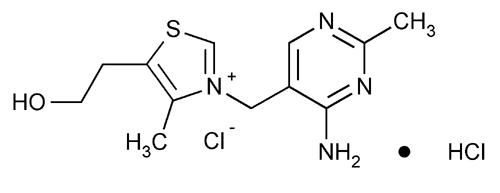
 337.27
Thiazolium, 3-[(4-amino-2-methyl-5-pyrimidinyl)methyl]-5-(2-hydroxyethyl)-4-methyl-, chloride, monohydrochloride.
Thiamine monohydrochloride
[67-03-8].» Thiamine Hydrochloride contains not less than 98.0 percent and not more than 102.0 percent of C12H17ClN4OS·HCl, calculated on the anhydrous basis.
Packaging and storage—
Preserve in tight, light-resistant containers.
Identification—
 for 2 hours.
B:
A solution (1 in 50) responds to the tests for Chloride  191
191 .
.
191.
pH 791:
between 2.7 and 3.4, in a solution (1 in 100).
791:
between 2.7 and 3.4, in a solution (1 in 100).
Water, Method I 921:
not more than 5.0%.
921:
not more than 5.0%.
Residue on ignition 281:
not more than 0.2%.
281:
not more than 0.2%.
Absorbance of solution—
Dissolve 1.0 g in water to make 10 mL. The absorbance of this solution, after filtration through a fine-porosity, sintered-glass funnel, determined in 1-cm cells at a wavelength of 400 nm, with a suitable spectrophotometer, water being used as the blank, does not exceed 0.025.
Limit of nitrate—
To 2 mL of a solution (1 in 50) add 2 mL of sulfuric acid, cool, and superimpose 2 mL of ferrous sulfate TS: no brown ring is produced at the junction of the two layers.
Chromatographic purity—
Solution A
, Solution B, and Mobile phase—Prepare as directed in the Assay.
Test solution—
Dissolve quantitatively an accurately weighed quantity of Thiamine Hydrochloride in Mobile phase to obtain a solution having a concentration of about 1.0 mg per mL.
Chromatographic system
(see Chromatography 621)—The liquid chromatograph is equipped with a 254-nm detector and a 4.0-mm × 15-cm column that contains packing L1. The flow rate is about 0.75 mL per minute.
621)—The liquid chromatograph is equipped with a 254-nm detector and a 4.0-mm × 15-cm column that contains packing L1. The flow rate is about 0.75 mL per minute.
Procedure—
Inject about 10 µL of the Test solution into the chromatograph, and allow the Test solution to elute for not less than three times the retention time of the main peak. Record the chromatogram and measure the areas of the peak responses: the total of the responses of all secondary peaks is not greater than 1.0% of the total of the responses of all of the peaks.
Assay—
Solution A—
Prepare a 0.005 M solution of sodium 1-octanesulfonate in dilute glacial acetic acid (1 in 100).
Solution B—
Prepare a mixture of methanol and acetonitrile (3:2).
Mobile phase—
Prepare a mixture of Solution A and Solution B (60:40), filter, and degas. Make adjustments if necessary (see System Suitability under Chromatography 621).
621).
Internal standard solution—
Transfer 2.0 mL of methylbenzoate to a 100-mL volumetric flask, dilute with methanol to volume, and mix.
Standard preparation—
Dissolve an accurately weighed quantity of USP Thiamine Hydrochloride RS in Mobile phase to obtain a solution having a known concentration of about 1 mg per mL. Transfer 20.0 mL of this solution to a 50-mL volumetric flask, add 5.0 mL of Internal standard solution, dilute with Mobile phase to volume, and mix to obtain a Standard preparation having a known concentration of about 400 µg per mL.
Assay preparation—
Transfer an accurately weighed quantity of about 200 mg of Thiamine Hydrochloride to a 100-mL volumetric flask, dissolve in and dilute with Mobile phase to volume, and mix. Transfer 10.0 mL of this solution to a 50-mL volumetric flask, add 5.0 mL of Internal standard solution, dilute with Mobile phase to volume, and mix.
Chromatographic system
(see Chromatography 621)—The liquid chromatograph is equipped with a 254-nm detector and a 4-mm × 30-cm column that contains packing L1. The flow rate is about 1 mL per minute. [note—The flow rate may be adjusted as needed to obtain a retention time of about 12 minutes for thiamine hydrochloride.] Chromatograph the Standard preparation, and record the peak responses as directed for Procedure: the resolution, R, between the thiamine and methylbenzoate peaks is not less than 4.0; the tailing factor for the thiamine peak is not more than 2.0; the column efficiency determined from the thiamine peak is not less than 1500 theoretical plates; and the relative standard deviation for replicate injections is not more than 2.0%.
621)—The liquid chromatograph is equipped with a 254-nm detector and a 4-mm × 30-cm column that contains packing L1. The flow rate is about 1 mL per minute. [note—The flow rate may be adjusted as needed to obtain a retention time of about 12 minutes for thiamine hydrochloride.] Chromatograph the Standard preparation, and record the peak responses as directed for Procedure: the resolution, R, between the thiamine and methylbenzoate peaks is not less than 4.0; the tailing factor for the thiamine peak is not more than 2.0; the column efficiency determined from the thiamine peak is not less than 1500 theoretical plates; and the relative standard deviation for replicate injections is not more than 2.0%.
Procedure—
Separately inject equal volumes (about 10 µL) of the Standard preparation and the Assay preparation into the chromatograph, record the chromatograms, and measure the areas of the major peaks. Calculate the quantity, in mg, of C12H17ClN4OS·HCl in the Thiamine Hydrochloride taken by the formula:
0.5C(RU / RS)
in which C is the concentration, in µg per mL, of USP Thiamine Hydrochloride RS in the Standard preparation; and RU and RS are the ratios of the peak areas of thiamine to methylbenzoate obtained from the Assay preparation and the Standard preparation, respectively.
Auxiliary Information—
Please check for your question in the FAQs before contacting USP.
Chromatographic Column—
| Topic/Question | Contact | Expert Committee |
| Monograph | Curtis Phinney
1-301-816-8540 |
(DSN05) Dietary Supplements - Non-Botanicals |
| Reference Standards | Lili Wang, Technical Services Scientist 1-301-816-8129 RSTech@usp.org |
USP32–NF27 Page 3718
Chromatographic columns text is not derived from, and not part of, USP 32 or NF 27.