Terbutaline Sulfate Inhalation Aerosol
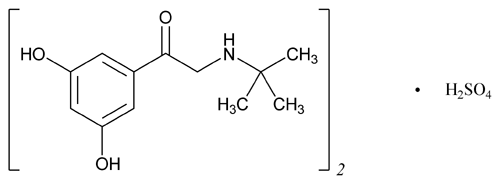
» Terbutaline Sulfate Inhalation Aerosol is a suspension of microfine Terbutaline Sulfate in suitable propellants in a pressurized container. It contains not less than 90.0 percent and not more than 110.0 percent of the labeled amount of (C12H19NO3)2·H2SO4.
Packaging and storage—
Preserve in small, nonreactive, light-resistant aerosol containers equipped with metered-dose valves and provided with oral inhalation actuators. Store at controlled room temperature.
Identification—
Chill 10 filled containers to about  75
75 in a dry ice-acetone mixture for 15 to 20 minutes. Carefully remove the top of each container with a tube cutter, allow to stand for 15 minutes, and pour the contents into a 100-mL beaker. Pour about 5 mL of the combined contents into a 100-mL beaker containing 50 mL of chloroform, shake, and filter through a medium-porosity sintered-glass funnel. Wash the residue with five 10-mL portions of chloroform. Allow the residue to dry by drawing air through the funnel: the IR absorption spectrum of a potassium bromide dispersion of the residue so obtained exhibits maxima only at the same wavelengths as that of a similar preparation of USP Terbutaline Sulfate RS.
75 in a dry ice-acetone mixture for 15 to 20 minutes. Carefully remove the top of each container with a tube cutter, allow to stand for 15 minutes, and pour the contents into a 100-mL beaker. Pour about 5 mL of the combined contents into a 100-mL beaker containing 50 mL of chloroform, shake, and filter through a medium-porosity sintered-glass funnel. Wash the residue with five 10-mL portions of chloroform. Allow the residue to dry by drawing air through the funnel: the IR absorption spectrum of a potassium bromide dispersion of the residue so obtained exhibits maxima only at the same wavelengths as that of a similar preparation of USP Terbutaline Sulfate RS.
Water, Method I  921
921 —
Transfer the contents of a weighed container to the titration vessel by attaching the valve stem to an inlet tube. Weigh the empty container, and determine the weight of the specimen taken. The Water content, determined by Method I 921, is not more than 0.02%.
—
Transfer the contents of a weighed container to the titration vessel by attaching the valve stem to an inlet tube. Weigh the empty container, and determine the weight of the specimen taken. The Water content, determined by Method I 921, is not more than 0.02%.
921—
Transfer the contents of a weighed container to the titration vessel by attaching the valve stem to an inlet tube. Weigh the empty container, and determine the weight of the specimen taken. The Water content, determined by Method I 921, is not more than 0.02%.
Delivered dose uniformity over the entire contents:
meets the requirements for Metered-Dose Inhalers under Aerosols, Nasal Sprays, Metered-Dose Inhalers, and Dry Powder Inhalers 601.
601.
procedure for dose uniformity—
4-Aminoantipyrine solution—
On the day of use, prepare a solution of 4-aminoantipyrine in water having a concentration of 20 mg per mL.
Potassium ferricyanide solution—
On the day of use, prepare a solution of potassium ferricyanide in water having a concentration of 80 mg per mL.
Standard preparation—
Dissolve an accurately weighed quantity of USP Terbutaline Sulfate RS in water, and dilute quantitatively and stepwise with water to obtain a solution having a known concentration of about 20 µg of terbutaline sulfate per mL.
Test preparation—
Discharge the minimum recommended dose into the sampling apparatus and detach the inhaler as directed. Rinse the apparatus (filter and interior) with four 4.0-mL portions of 0.01 N sulfuric acid, and quantitatively transfer the resulting solutions to a 50-mL centrifuge tube. Wash the apparatus (filter and interior) with 10 mL of chloroform, and add the washing to the solution in the centrifuge tube. Wash the apparatus (filter and interior) with 4.0 mL of 0.01 N sulfuric acid, and quantitatively transfer the resulting liquid to the same centrifuge tube. Shake vigorously for 1 minute, and centrifuge for 10 minutes. Use the clear aqueous phase as the Test preparation.
Procedure—
Pipet 2 mL of the Test preparation, 2 mL of the Standard preparation, and 2 mL of water to serve as a reagent blank, into separate 1-cm stoppered cells. To each cell add 0.5 mL of 4-Aminoantipyrine solution, and mix. Add 0.5 mL of Potassium ferricyanide solution to each cell, and mix. Thirty seconds, accurately timed, after the addition of the Potassium ferricyanide solution, determine the absorbances of the solutions against the blank, at the wavelength of maximum absorbance at about 550 nm. Calculate the quantity, in µg, of (C12H19NO3)2·H2SO4 contained in the minimum dose taken by the formula:
10CN(AU / AS)
in which C is the concentration, in µg per mL, of USP Terbutaline Sulfate RS in the Standard preparation; N is the number of sprays discharged to obtain the minimum dose; and AU and AS are the absorbances of the solutions from the Test preparation and the Standard preparation, respectively, corrected for the absorbances of the reagent blank solution.
Particle size—
Prime the valve of Aerosol container by alternately shaking and firing it several times, and actuate one measured spray onto a clean, dry microscope slide held 5 cm from the end of the oral inhalation actuator, perpendicular to the direction of the spray. Carefully rinse the slide with about 2 mL of carbon tetrachloride, and allow to dry. Prepare four additional slides in the same manner from four additional containers. Examine each slide under a microscope equipped with a calibrated ocular micrometer, using 450× magnification. Focus on the particles of 5 fields of view on each slide, near the center of the test specimen pattern, and note the size of the majority of individual particles. They are less than 5 µm along the longest axis. Record the number and size of all individual crystalline particles (not agglomerates) more than 10 µm in length, measured along the longest axis: not more than 10 such particles are observed.
Assay—
Mobile phase—
Prepare a solution containing 750 mL of water, 140 mL of methanol, 110 mL of tetrahydrofuran, and 1.08 g of sodium 1-octanesulfonate. Filter and degas. Make adjustments if necessary (see System Suitability under Chromatography 621).
621).
Resolution solution—
Dissolve suitable quantities of USP Terbutaline Sulfate RS and USP Terbutaline Related Compound A RS in water to obtain a solution containing about 50 µg per mL and 20 µg per mL, respectively.
Standard preparation—
Dissolve an accurately weighed quantity of USP Terbutaline Sulfate RS in water to obtain a solution having a known concentration of about 0.3 mg per mL.
Assay preparation—
Accurately weigh not fewer than three containers, and separately perform the following procedure for each of the units. Chill in a dry ice–acetone mixture to about 75 for 15 to 20 minutes. Quickly and carefully remove the top of the container with a tube cutter. Allow the propellants to evaporate at room temperature for 10 to 15 minutes. [note—Avoid complete evaporation of the propellants.] Quantitatively transfer the suspension to a 500-mL separatory funnel with the aid of chloroform. Wash all parts of the container alternately with several small portions of chloroform followed by small portions of 0.01 N sulfuric acid. Transfer the washings to the separatory funnel, and adjust the phase volumes to about 100 mL each with chloroform and 0.01 N sulfuric acid, respectively. Dry the container and all of its parts at 105 for 1 hour. Cool to room temperature, and weigh. Shake the separatory funnel for 1 minute, allow the phases to separate, and discard the chloroform layer. Pass the acidic aqueous phase through filter paper into a 250-mL volumetric flask. Wash the separatory funnel with two 10-mL portions of water, and transfer the washings to the volumetric flask. Dilute with water to volume, mix, and filter, discarding the first 2 mL of the filtrate.
75 for 15 to 20 minutes. Quickly and carefully remove the top of the container with a tube cutter. Allow the propellants to evaporate at room temperature for 10 to 15 minutes. [note—Avoid complete evaporation of the propellants.] Quantitatively transfer the suspension to a 500-mL separatory funnel with the aid of chloroform. Wash all parts of the container alternately with several small portions of chloroform followed by small portions of 0.01 N sulfuric acid. Transfer the washings to the separatory funnel, and adjust the phase volumes to about 100 mL each with chloroform and 0.01 N sulfuric acid, respectively. Dry the container and all of its parts at 105 for 1 hour. Cool to room temperature, and weigh. Shake the separatory funnel for 1 minute, allow the phases to separate, and discard the chloroform layer. Pass the acidic aqueous phase through filter paper into a 250-mL volumetric flask. Wash the separatory funnel with two 10-mL portions of water, and transfer the washings to the volumetric flask. Dilute with water to volume, mix, and filter, discarding the first 2 mL of the filtrate.
Chromatographic system
(see Chromatography 621)—The liquid chromatograph is equipped with a 280-nm detector, a 0.5-µm precolumn, and a 6.2-mm × 8-cm column that contains 3-µm packing L7. The column temperature is maintained at 40. The flow rate is about 1.5 mL per minute. Chromatograph the Resolution solution, and record the peak responses as directed for Procedure: the relative retention times are about 1.0 and 0.83 for terbutaline and terbutaline related compound A, respectively; and the resolution, R, between terbutaline sulfate and terbutaline related compound A is not less than 1.6. Chromatograph the Standard preparation, and record the peak responses as directed for Procedure: the relative standard deviation for replicate injections is not more than 2.0%.
621)—The liquid chromatograph is equipped with a 280-nm detector, a 0.5-µm precolumn, and a 6.2-mm × 8-cm column that contains 3-µm packing L7. The column temperature is maintained at 40. The flow rate is about 1.5 mL per minute. Chromatograph the Resolution solution, and record the peak responses as directed for Procedure: the relative retention times are about 1.0 and 0.83 for terbutaline and terbutaline related compound A, respectively; and the resolution, R, between terbutaline sulfate and terbutaline related compound A is not less than 1.6. Chromatograph the Standard preparation, and record the peak responses as directed for Procedure: the relative standard deviation for replicate injections is not more than 2.0%.
Procedure—
Separately inject equal volumes (about 20 µL) of the Standard preparation and the Assay preparation into the chromatograph, record the chromatograms, and measure the responses for the major peaks. Calculate the quantity, in mg, of terbutaline sulfate [(C12H19NO3)2·H2SO4] in each container taken by the formula:
250C(rU / rS)
in which C is the concentration, in mg per mL, of USP Terbutaline Sulfate RS in the Standard preparation; and rU and rS are the peak responses obtained from the Assay preparation and the Standard preparation, respectively.
Auxiliary Information—
Please check for your question in the FAQs before contacting USP.
Chromatographic Column—
| Topic/Question | Contact | Expert Committee |
| Monograph | Kahkashan Zaidi, Ph.D.
Senior Scientist 1-301-816-8269 |
(AER05) Aerosols05 |
| Reference Standards | Lili Wang, Technical Services Scientist 1-301-816-8129 RSTech@usp.org |
USP32–NF27 Page 3679
Pharmacopeial Forum: Volume No. 31(2) Page 450
Chromatographic columns text is not derived from, and not part of, USP 32 or NF 27.