Arsanilic Acid
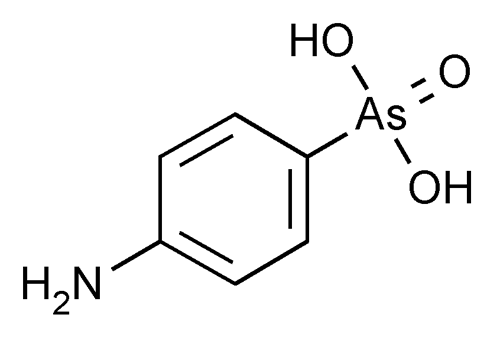
 217.05
p-Aminobenzenearsonic acid
[98-50-0].» Arsanilic Acid contains not less than 98.0 percent and not more than 102.0 percent of C6H8AsNO3, calculated on the dried basis.
Packaging and storage—
Preserve in well-closed containers.
Labeling—
Label it to indicate that it is for veterinary use only.
Identification, Infrared Absorption  197K
197K .
.
197K.
Loss on drying 731—
Dry it in vacuum at 80 for 4 hours: it loses not more than 0.5% of its weight.
731—
Dry it in vacuum at 80 for 4 hours: it loses not more than 0.5% of its weight.
Limit of o-arsanilic acid—
Mobile phase—
Dissolve 4.04 g of monobasic potassium phosphate in 985 mL of water, add 2 mL of phosphoric acid, and mix. Add 10 mL of methanol, mix, and degas. Make adjustments if necessary (see System Suitability under Chromatography 621).
621).
Standard solution—
Transfer about 67 mg of o-arsanilic acid, accurately weighed, to a 100-mL volumetric flask, add about 65 mg of warm (about 70 to 80) water, and shake or sonicate to dissolve. Allow to cool, dilute with water to volume, and mix. Dilute a portion of this solution quantitatively and stepwise with water to obtain a solution having a known concentration of about 0.0012 mg of o-arsanilic acid per mL.
to 80) water, and shake or sonicate to dissolve. Allow to cool, dilute with water to volume, and mix. Dilute a portion of this solution quantitatively and stepwise with water to obtain a solution having a known concentration of about 0.0012 mg of o-arsanilic acid per mL.
Test solution—
Transfer about 50 mg of Arsanilic Acid, accurately weighed, to a 50-mL volumetric flask, add about 30 mL of warm water, and shake or sonicate to dissolve. Allow to cool, dilute with water to volume, and mix.
Chromatographic system
(see Chromatography 621)—The liquid chromatograph is equipped with a 242-nm detector and a 4.6-mm × 15-cm column that contains 5-µm base-deactivated packing L1 and is maintained at a constant temperature of about 30. The flow rate is about 1.5 mL per minute. Chromatograph the Standard solution, and record the peak responses as directed for Procedure: the capacity factor, k¢, for the o-arsanilic acid peak is between 2.8 and 3.8; and the relative standard deviation for replicate injections is not more than 2.5%.
621)—The liquid chromatograph is equipped with a 242-nm detector and a 4.6-mm × 15-cm column that contains 5-µm base-deactivated packing L1 and is maintained at a constant temperature of about 30. The flow rate is about 1.5 mL per minute. Chromatograph the Standard solution, and record the peak responses as directed for Procedure: the capacity factor, k¢, for the o-arsanilic acid peak is between 2.8 and 3.8; and the relative standard deviation for replicate injections is not more than 2.5%.
Procedure—
Separately inject equal volumes (about 20 µL) of the Standard solution and the Test solution into the chromatograph, record the chromatograms, and measure the areas of the responses for the o-arsanilic acid peaks. Calculate the percentage of o-arsanilic acid in the portion of Arsanilic Acid taken by the formula:
5000(C / W)(rU / rS)
in which C is the concentration, in mg per mL, of o-arsanilic acid in the Standard solution; W is the weight, in mg, of Arsanilic Acid taken to prepare the Test solution; and rU and rS are the responses of the o-arsanilic acid peaks obtained from the Test solution and the Standard solution, respectively: not more than 0.12% is found.
Limit of aniline—
Mobile phase—
Dissolve 7.76 g of monobasic potassium phosphate in 950 mL of water, add 50 mL of methanol, mix, and degas. Make adjustments if necessary (see System Suitability under Chromatography 621).
621).
Standard solution—
Transfer about 176 mg of aniline, accurately weighed, to a 25-mL volumetric flask, add about 1 mL of methanol, swirl, then add about 15 mL of water, and shake to dissolve. Dilute with water to volume, and mix. Dilute a portion of this solution quantitatively and stepwise with water to obtain a solution having a known concentration of about 0.00045 mg of aniline per mL.
Test solution—
Transfer about 50 mg of Arsanilic Acid, accurately weighed, to a 50-mL volumetric flask, add about 30 mL of warm (about 70 to 80) water, and shake or sonicate to dissolve. Allow to cool, dilute with water to volume, and mix.
to 80) water, and shake or sonicate to dissolve. Allow to cool, dilute with water to volume, and mix.
Chromatographic system
(see Chromatography 621)—The liquid chromatograph is equipped with a 235-nm detector and a 4.6-mm × 15-cm column that contains 5-µm base-deactivated packing L1 and is maintained at a constant temperature of about 30. The flow rate is about 1.5 mL per minute. Chromatograph the Standard solution, and record the peak responses as directed for Procedure: the capacity factor, k¢, for the aniline peak is between 2.3 and 3.3; and the relative standard deviation for replicate injections is not more than 3.0%.
621)—The liquid chromatograph is equipped with a 235-nm detector and a 4.6-mm × 15-cm column that contains 5-µm base-deactivated packing L1 and is maintained at a constant temperature of about 30. The flow rate is about 1.5 mL per minute. Chromatograph the Standard solution, and record the peak responses as directed for Procedure: the capacity factor, k¢, for the aniline peak is between 2.3 and 3.3; and the relative standard deviation for replicate injections is not more than 3.0%.
Procedure—
Separately inject equal volumes (about 50 µL) of the Standard solution and the Test solution into the chromatograph, record the chromatograms, and measure the areas of the responses for the aniline peaks. Calculate the percentage of aniline in the portion of Arsanilic Acid taken by the formula:
5000(C / W)(rU / rS)
in which C is the concentration, in mg per mL, of aniline in the Standard solution; W is the weight, in mg, of Arsanilic Acid taken to prepare the Test solution; and rU and rS are the responses of the aniline peaks obtained from the Test solution and the Standard solution, respectively: not more than 0.045% is found.
Assay—
Transfer about 125 mg of Arsanilic Acid, accurately weighed, to a 50-mL conical flask, and add 10.0 mL of a mixture of sulfuric acid, nitric acid, and perchloric acid (1000:50:50) and several glass beads. Digest on a hot plate for about 1 hour, increasing the temperature of the hot plate in steps until a ring of sulfuric acid rises into the neck of the flask. Allow to cool, to the colorless solution add about 400 mg of hydrazine sulfate, and heat the flask vigorously on a hot plate until a ring of sulfuric acid rises into the neck of the flask. Allow to cool, and wash down the rim, neck, and insides of the flask with about 1 mL of water. Heat the flask again until a ring of sulfuric acid rises into the neck of the flask. Allow to cool, and transfer the colorless solution, with the aid of about 80 mL of water, to a 125-mL conical flask. Add 10 mL of hydrochloric acid and several drops of 0.002 M potassium iodide, cool to between 0 and 5, and titrate with 0.1 N potassium permanganate VS to a pale pink endpoint, maintaining the temperature between 0 and 5 during the titration. Perform a blank determination, and make any necessary correction. Each mL of 0.1 N potassium permanganate is equivalent to 10.852 mg of C6H8AsNO3.
and 5, and titrate with 0.1 N potassium permanganate VS to a pale pink endpoint, maintaining the temperature between 0 and 5 during the titration. Perform a blank determination, and make any necessary correction. Each mL of 0.1 N potassium permanganate is equivalent to 10.852 mg of C6H8AsNO3.
Auxiliary Information—
Please check for your question in the FAQs before contacting USP.
Chromatographic Column—
| Topic/Question | Contact | Expert Committee |
| Monograph | Ian DeVeau, Ph.D.
Director, Veterinary Drugs and Radiopharmaceuticals 1-301-816-8178 |
(VET05) Veterinary Drugs 05 |
| Reference Standards | Lili Wang, Technical Services Scientist 1-301-816-8129 RSTech@usp.org |
USP32–NF27 Page 1579
Chromatographic columns text is not derived from, and not part of, USP 32 or NF 27.