Antithrombin III Human
» Antithrombin III Human is a glycoprotein, which is the major inhibitor of thrombin and other activated clotting factors, including factors IX, X, XI, and XII, and the cofactor through which heparin exerts its effect. It is obtained from human plasma of healthy donors who must, as far as can be ascertained, be free from detectable agents of infection transmissible by transfusion of blood or blood derivatives. The method of manufacturing includes steps that have been shown to remove or inactivate known agents of infection. If substances are used for inactivation of viruses during production, the subsequent purification procedure must be validated to demonstrate that the concentration of these substances is reduced to an acceptable level and any residues are such as not to compromise the safety of the preparation for patients. The antithrombin III concentrate is passed through a bacteria-retentive filter, filled aseptically into its final, sterile containers, and immediately frozen. It is then freeze-dried, and the containers are closed under vacuum. No antimicrobial preservative is added at any stage of production. Antithrombin III Human complies with the requirements for Biologics  1041
1041 . When reconstituted in the recommended volume of diluent, the potency is not less than 25 USP Antithrombin III Units per mL. [note—One USP Antithrombin III Unit is the amount of antithrombin III that forms a complex with one unit of thrombin at 25
 in the presence of heparin at a pH of 8.4.]
1041. When reconstituted in the recommended volume of diluent, the potency is not less than 25 USP Antithrombin III Units per mL. [note—One USP Antithrombin III Unit is the amount of antithrombin III that forms a complex with one unit of thrombin at 25 in the presence of heparin at a pH of 8.4.]
Packaging and storage—
Use a Type I glass container with an appropriate stopper and seal. Store protected from light between 2 and 8, excursions permitted up to 25.
and 8, excursions permitted up to 25.
Labeling—
The labeling should state the content of antithrombin III in USP Antithrombin III Units. The diluent and the volume to be used to reconstitute the preparation are indicated.
USP Reference standards 11—
USP Albumin Human RS.
USP Antithrombin III Human RS.
USP Heparin Sodium RS .
.
11—
USP Albumin Human RS.
USP Antithrombin III Human RS.
USP Heparin Sodium RS
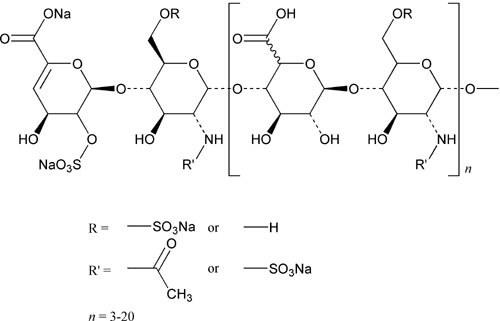 .
.
Identification—
It meets the requirements of the Assay.
pH 791—
Reconstitute with the diluent according to the manufacturer's instruction: between 6.0 and 7.5.
791—
Reconstitute with the diluent according to the manufacturer's instruction: between 6.0 and 7.5.
Osmolality 785—
Reconstitute with the diluent according to the manufacturer's instruction: not less than 240 mOsmol per kg for the solution.
785—
Reconstitute with the diluent according to the manufacturer's instruction: not less than 240 mOsmol per kg for the solution.
Heparin content—
pH 8.4 Buffer—
Dissolve tris(hydroxymethyl)aminomethane, edetic acid, and sodium chloride in water containing 0.1% polyethylene glycol 6000 to obtain a solution having concentrations of 0.050 M, 0.0075 M, and 0.175 M, respectively. Adjust with hydrochloric acid or sodium hydroxide solution to a pH of 8.4.
Chromogenic substrate solution—
Prepare a solution of chromogenic substrate for amidolytic test for factor Xa in water to obtain a solution of concentration of 2.5 mM.
Factor Xa solution—
Dissolve an accurately weighed quantity of Factor Xa in pH 8.4 Buffer to obtain a solution containing about 20 nanokatalytic units (nkats).
Stopping solution—
Prepare a 20% (v/v) solution of acetic acid in water.
Standard solution—
Dissolve an accurately weighed quantity of USP Antithrombin III Human RS in pH 8.4 Buffer to obtain a solution containing 1.0 USP Antithrombin III Unit.
Test solution—
Dissolve an accurately weighed quantity of Antithrombin III Human in pH 8.4 Buffer to obtain a solution containing 1.0 USP Antithrombin III Unit.
Procedure—
Pipet 250 µL each of pH 8.4 Buffer, the Standard solution, and the Test solution to suitable tubes placed in a water bath set at 37. Add 250 µL of Factor Xa solution prewarmed at 37 to each tube, mix, and incubate for 2 minutes. Add 250 µL of Chromogenic substrate solution prewarmed at 37 to each tube, mix, and incubate for 120 seconds. Stop the reaction by adding 250 µL Stopping solution. Record the absorbance at 405 nm, using pH 8.4 Buffer as the blank.
. Add 250 µL of Factor Xa solution prewarmed at 37 to each tube, mix, and incubate for 2 minutes. Add 250 µL of Chromogenic substrate solution prewarmed at 37 to each tube, mix, and incubate for 120 seconds. Stop the reaction by adding 250 µL Stopping solution. Record the absorbance at 405 nm, using pH 8.4 Buffer as the blank.
Calculation—
Calculate the USP Heparin Unit per USP Antithrombin III Unit using the formula:
PR (AF – AT)/(AF – AR)
in which, AF , AT , and AR are the absorbance values from pH 8.4 Buffer, the Test solution, and the Standard solution, respectively; and PR is the heparin content of USP Antithrombin III Human RS in USP Heparin Unit per USP Antithrombin III Unit: not more than 0.1 USP Heparin Unit per USP Antithrombin III Unit.
Sterility 71—
It meets the requirements when tested as directed for Direct Inoculation of the Culture Medium under Test for Sterility of the Product to be Examined.
71—
It meets the requirements when tested as directed for Direct Inoculation of the Culture Medium under Test for Sterility of the Product to be Examined.
Water, Method I 921:
not more than 3.0%.
921:
not more than 3.0%.
Pyrogen 151—
Inject per kg of the rabbit's weight 50 USP Antithrombin III Units, calculated from the activity stated on the label. It meets the requirements.
151—
Inject per kg of the rabbit's weight 50 USP Antithrombin III Units, calculated from the activity stated on the label. It meets the requirements.
General safety—
It meets the requirements for biologics as set forth for Safety Tests—Biologicals under Biological Reactivity Tests, In Vivo 88.
88.
Molecular weight distribution—
Mobile phase—
Prepare a suitable degassed and filtered solution containing 0.1 M sodium phosphate, 0.15 M sodium chloride, and 0.05% sodium azide, having a pH of 6.5.
Vo- Marker solution—
Prepare a solution of thyroglobulin in Mobile phase containing 4 to 5 mg per mL.
Test solution—
Prepare a solution of Antithrombin III Human containing 8 to 10 mg per mL.
System suitability solution—
Dilute USP Albumin Human RS, if necessary, with water to obtain a solution containing approximately 5%.
Chromatographic system (see Chromatography 621)—
The liquid chromatograph is equipped with a 7.5- × 75-mm guard column and a 7.5- × 300-mm analytical column, both containing packing L59, maintained at ambient temperature, and a 280-nm UV detector. The flow rate is 0.5 mL per minute maintained constant to ±1%; the tailing factor is between 0.5 and 2.5; and the column efficiency is greater than 1500 theoretical plates.
621)—
The liquid chromatograph is equipped with a 7.5- × 75-mm guard column and a 7.5- × 300-mm analytical column, both containing packing L59, maintained at ambient temperature, and a 280-nm UV detector. The flow rate is 0.5 mL per minute maintained constant to ±1%; the tailing factor is between 0.5 and 2.5; and the column efficiency is greater than 1500 theoretical plates.
Procedure—
Inject 10 µL of the System suitability solution, and record the chromatogram. Inject 10 µL each of Vo- Marker solution and the Test solution. Note the retention times of the major peak in the Vo- Marker solution chromatogram. The relative peak area of the high molecular weight peak eluting at about the same retention time as the major peak in the Vo- Marker solution chromatogram, or earlier, is not more than 13%.
Total protein content—
Trichloroacetic acid solution—
Prepare a solution of trichloroacetic acid in water containing 100 g of trichloroacetic acid per 100 mL of the solution.
Test solution—
Dissolve an accurately weighed quantity of Antithrombin III Human in 0.15 M sodium chloride solution to obtain a solution containing about 7.5 mg per mL.
Blank:
0.15 M solution of sodium chloride.
Procedure—
To each of 2.0 mL of the Test solution and the Blank in suitable centrifuge tubes add 1.5 mL of Trichloroacetic acid solution. Mix, allow to stand for at least 10 minutes, centrifuge for 5 minutes, and decant the supernatant. Resuspend the precipitates in 1.5 mL of Trichloroacetic acid solution, centrifuge for 5 minutes, decant the supernatant, and hold the tubes inverted on a filter paper to drain. Quantitatively transfer the residues with a minimum quantity of water to a micro-Kjeldahl flask, and determine the nitrogen content using Method II (see Nitrogen Determination 461). Multiply the result, corrected for the Blank, by 6.25 to calculate the quantity of protein.
461). Multiply the result, corrected for the Blank, by 6.25 to calculate the quantity of protein.
Assay—
pH 8.4 Buffer—
Dissolve tris(hydroxymethyl)aminomethane, edetic acid, and sodium chloride in water containing 0.1% polyethylene glycol 6000 to obtain a solution having concentrations of 0.050 M, 0.0075 M, and 0.175 M, respectively. Adjust with hydrochloric acid or sodium hydroxide solution to a pH of 8.4.
Polybrene buffer—
Prepare a 10 mg per mL solution of polybrene in Albumin–pH 8.4 buffer.
Heparin buffer—
Dissolve an accurately weighed amount of USP Heparin Sodium RS in Albumin–pH 8.4 buffer to obtain a solution containing 15 USP Heparin Units per mL.
Thrombin bovine solution—
Reconstitute thrombin bovine, and dilute with Albumin–pH 8.4 buffer to obtain a solution having a concentration of 2.0 Thrombin Units per mL.
Chromogenic substrate solution for factor IIa—
Prepare a solution of chromogenic substrate for amidolytic test (see Reagent Specifications under Reagents in the section Reagents, Indicators, and Solutions) for factor IIa in water to obtain a solution having a concentration of about 5.0 mM, and dilute the solution further with Polybrene buffer to 1.0 mM.
Stopping solution—
Prepare a 20% (v/v) solution of acetic acid in water.
Standard preparation A—
Dissolve an accurately weighed quantity of USP Antithrombin III Human RS in Heparin buffer to obtain a solution containing 1.0 USP Antithrombin III Unit.
Standard preparations B, C, D, and E—
Dilute Standard preparation A with Heparin buffer 60-, 120-, 180-, and 300-fold.
Test preparation A—
Dissolve an accurately weighed quantity of Antithrombin III Human in Heparin buffer to obtain a solution having about the same concentration as Standard preparation A.
Test preparations B, C, D, and E—
Dilute Test preparation A with Heparin buffer 60-, 120-, 180-, and 300-fold.
Procedure—
Pipet 400 µL each of Standard preparations B, C, D, and E and Test preparations B, C, D, and E into suitable tubes placed in a water bath set at 37. Add 200 µL of Thrombin bovine solution, prewarmed at 37 to each tube, mix, and incubate for 1 minute. Add 200 µL of Chromogenic substrate solution for factor IIa prewarmed at 37 to each tube, mix, and incubate for 60 seconds. Stop the reaction by adding 200 µL Stopping solution. To prepare a blank, add the reagents in reverse order, starting with 200 µL of Stopping solution, followed by the addition of 200 µL of Chromogenic substrate solution for factor IIa, then adding 200 µL of Thrombin bovine solution, and ending with 400 µL of Heparin buffer. Record the absorbance at 405 nm against the blank.
. Add 200 µL of Thrombin bovine solution, prewarmed at 37 to each tube, mix, and incubate for 1 minute. Add 200 µL of Chromogenic substrate solution for factor IIa prewarmed at 37 to each tube, mix, and incubate for 60 seconds. Stop the reaction by adding 200 µL Stopping solution. To prepare a blank, add the reagents in reverse order, starting with 200 µL of Stopping solution, followed by the addition of 200 µL of Chromogenic substrate solution for factor IIa, then adding 200 µL of Thrombin bovine solution, and ending with 400 µL of Heparin buffer. Record the absorbance at 405 nm against the blank.
Calculations—
For Standard preparations and Test preparations, calculate the regression of the absorbance against log concentrations, and calculate the activity of Antithrombin III Human in USP Antithrombin III Units, using a suitable statistical method for parallel-line assays. The four independent relative activity estimates are then combined to obtain the final mean, and the confidence limits are calculated. The estimated potency is not less than 80% and not greater than 120% of the potency stated on the label. The specific activity is not less than 6.0 USP Antithrombin III Units per mg of total protein. The confidence interval (P = 0.95) is between 90% and 110% of the estimated potency.
Auxiliary Information—
Please check for your question in the FAQs before contacting USP.
Chromatographic Column—
| Topic/Question | Contact | Expert Committee |
| Monograph | Anita Y. Szajek, Ph.D.
Senior Scientist 1-301-816-8325 |
(BBBBP05) Biologics and Biotechnology - Blood and Blood Products |
| Reference Standards | Lili Wang, Technical Services Scientist 1-301-816-8129 RSTech@usp.org |
|
| 71 |
Radhakrishna S Tirumalai, Ph.D.
Senior Scientist 1-301-816-8339 |
(MSA05) Microbiology and Sterility Assurance |
| 151 |
Radhakrishna S Tirumalai, Ph.D.
Senior Scientist 1-301-816-8339 |
(MSA05) Microbiology and Sterility Assurance |
USP32–NF27 Page 1570
Pharmacopeial Forum: Volume No. 30(1) Page 56
Chromatographic columns text is not derived from, and not part of, USP 32 or NF 27.