Labetalol Hydrochloride
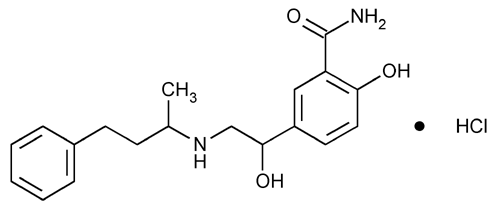
 364.87
Benzamide, 2-hydroxy-5-[1-hydroxy-2-[(1-methyl-3-phenylpropyl)amino]ethyl]-, monohydrochloride.
5-[1-Hydroxy-2-[(1-methyl-3-phenylpropyl)amino]ethyl]salicylamide monohydrochloride
[32780-64-6].» Labetalol Hydrochloride contains not less than 97.5 percent and not more than 101.0 percent of C19H24N2O3·HCl, calculated on the dried basis.
Packaging and storage—
Preserve in tight, light-resistant containers. Store at 25 , excursions permitted between 15 and 30.
, excursions permitted between 15 and 30.
pH  791
791 :
between 4.0 and 5.0, in a solution (1 in 100).
:
between 4.0 and 5.0, in a solution (1 in 100).
791:
between 4.0 and 5.0, in a solution (1 in 100).
Loss on drying 731:
Dry it in a vacuum at 105 for 4 hours: it loses not more than 1.0% of its weight.
731:
Dry it in a vacuum at 105 for 4 hours: it loses not more than 1.0% of its weight.
Residue on ignition 281:
not more than 0.1%.
281:
not more than 0.1%.
Heavy metals, Method II 231:
0.002%.
231:
0.002%.
Chromatographic purity—
Detection reagent—
Transfer 2.5 g of cadmium acetate to a 500-mL volumetric flask, add 10 mL of glacial acetic acid, dilute with alcohol to volume, and mix. Just prior to use, prepare a 0.2 in 100 solution of ninhydrin in the cadmium acetate solution for use as the Detection reagent.
Solvent mixture—
Prepare a solution of methanol and water (4:1), and mix.
Ammonium chloride reference solution—
Dissolve 60 mg of ammonium chloride in 10.0 mL of water, and mix.
Standard stock solution—
Dissolve USP Labetalol Hydrochloride RS in Solvent mixture, and mix to obtain a solution having a known concentration of 40 mg per mL.
Standard solution 1—
Quantitatively dilute a portion of the Standard stock solution with Solvent mixture to obtain a solution having a known concentration of 0.2 mg per mL.
Standard solution 2—
Quantitatively dilute a portion of the Standard solution 1 with Solvent mixture to obtain a solution having a known concentration of 0.1 mg per mL.
Test solution—
Dissolve 200 mg of Labetalol Hydrochloride in 5.0 mL of Solvent mixture, and mix.
Procedure I—Apply separately 5-µL portions of the Standard stock solution, Standard solution 1, Standard solution 2, and the Test solution to a suitable thin-layer chromatographic plate (see Chromatography 621) coated with a 0.25-mm layer of chromatographic silica gel mixture. Allow the spots to dry, and develop the chromatograms in a solvent system consisting of a mixture of dichloromethane, methanol, and ammonium hydroxide (15:5:1) until the solvent front has moved about three-fourths of the length of the plate. Remove the plate from the developing chamber, mark the solvent front, and allow the solvent to evaporate. Examine the plate under short-wavelength UV light: the RF value of the principal spot from the Test solution corresponds to that of the principal spot from the Standard stock solution.
621) coated with a 0.25-mm layer of chromatographic silica gel mixture. Allow the spots to dry, and develop the chromatograms in a solvent system consisting of a mixture of dichloromethane, methanol, and ammonium hydroxide (15:5:1) until the solvent front has moved about three-fourths of the length of the plate. Remove the plate from the developing chamber, mark the solvent front, and allow the solvent to evaporate. Examine the plate under short-wavelength UV light: the RF value of the principal spot from the Test solution corresponds to that of the principal spot from the Standard stock solution.
Spray the plate with Detection reagent, heat the plate at 105 for 15 minutes, cool to room temperature, and examine the chromatogram: no individual secondary spot observed in the chromatogram of the Test solution is greater in size or intensity than the principal spot observed in the chromatogram of Standard solution 1 (0.5% each). [note—The spots appear as dark orange spots on a light orange to yellow background. A “negative image” spot (white) near the origin may be observed in the chromatogram of the Test solution. This is due to the formation of ammonium chloride during the chromatographic procedure and may be ignored.]
for 15 minutes, cool to room temperature, and examine the chromatogram: no individual secondary spot observed in the chromatogram of the Test solution is greater in size or intensity than the principal spot observed in the chromatogram of Standard solution 1 (0.5% each). [note—The spots appear as dark orange spots on a light orange to yellow background. A “negative image” spot (white) near the origin may be observed in the chromatogram of the Test solution. This is due to the formation of ammonium chloride during the chromatographic procedure and may be ignored.]
Procedure II—Apply separately 10-µL portions of the Ammonium chloride reference solution, the Standard stock solution, Standard solution 1, Standard solution 2, and the Test solution to a suitable thin-layer chromatographic plate (see Chromatography 621), coated with a 0.25-mm layer of chromatographic silica gel mixture. Allow the spots to dry, and develop the chromatograms in a solvent system consisting of a mixture of ethyl acetate, isopropyl alcohol, water, and ammonium hydroxide (25:15:8:2) until the solvent front has moved about three-fourths of the length of the plate. Remove the plate from the developing chamber, mark the solvent front, and allow the solvent to evaporate. Examine the plate under short-wavelength UV light: no individual secondary spot (other than that due to ammonium chloride) observed in the chromatogram of the Test solution is greater in size or intensity than the principal spot observed in the chromatogram of Standard solution 1 (0.5% each).
621), coated with a 0.25-mm layer of chromatographic silica gel mixture. Allow the spots to dry, and develop the chromatograms in a solvent system consisting of a mixture of ethyl acetate, isopropyl alcohol, water, and ammonium hydroxide (25:15:8:2) until the solvent front has moved about three-fourths of the length of the plate. Remove the plate from the developing chamber, mark the solvent front, and allow the solvent to evaporate. Examine the plate under short-wavelength UV light: no individual secondary spot (other than that due to ammonium chloride) observed in the chromatogram of the Test solution is greater in size or intensity than the principal spot observed in the chromatogram of Standard solution 1 (0.5% each).
Total impurities—
The sum of the intensities of all secondary spots (other than those due to ammonium chloride) observed in the chromatograms of the Test solution from both Procedure I and Procedure II does not exceed 1.0%.
Diastereoisomer ratio—
1-Butaneboronic acid solution—
Dissolve 1-butaneboronic acid in pyridine, previously dried over a suitable molecular sieve, and mix to obtain a solution having a known concentration of 20 mg per mL.
System suitability solution—
Dissolve an accurately weighed quantity of USP Labetalol Hydrochloride RS in 1-Butaneboronic acid solution, and dilute quantitatively and stepwise with 1-Butaneboronic acid solution to obtain a solution having a known concentration of about 1.4 mg of USP Labetalol Hydrochloride RS per mL. Allow the solution to stand at room temperature for 20 minutes before using.
Test solution—
Transfer about 1 mg of Labetalol Hydrochloride to a 1-mL reaction vial, add 0.7 mL of 1-Butaneboronic acid solution, and mix until the labetalol hydrochloride is completely dissolved. Allow the solution to stand at room temperature for 20 minutes before using.
Chromatographic system (see Chromatography 621)—
The gas chromatograph is equipped with a flame-ionization detector and a 2-mm × 1.8-m glass column packed with 10% phase G3 on 100- to 120-mesh support S1AB. The column temperature is maintained at about 320, and the injection port and the detector block temperatures are maintained at about 340. Nitrogen is used as the carrier gas at the flow rate of about 30 mL per minute. Chromatograph the System suitability solution, and record the peak responses as directed for Procedure: the relative retention times are about 0.8 for the diastereoisomer B 1-butaneboronate derivative and 1.0 for the diastereoisomer A 1-butaneboronate derivative; the resolution, R, between the diastereoisomer A 1-butaneboronate derivative and diastereoisomer B 1-butaneboronate derivative peaks is not less than 1.5; and the relative standard deviation of the ratios of the peak areas of the diastereoisomers for replicate injections is not more than 2.0%.
621)—
The gas chromatograph is equipped with a flame-ionization detector and a 2-mm × 1.8-m glass column packed with 10% phase G3 on 100- to 120-mesh support S1AB. The column temperature is maintained at about 320, and the injection port and the detector block temperatures are maintained at about 340. Nitrogen is used as the carrier gas at the flow rate of about 30 mL per minute. Chromatograph the System suitability solution, and record the peak responses as directed for Procedure: the relative retention times are about 0.8 for the diastereoisomer B 1-butaneboronate derivative and 1.0 for the diastereoisomer A 1-butaneboronate derivative; the resolution, R, between the diastereoisomer A 1-butaneboronate derivative and diastereoisomer B 1-butaneboronate derivative peaks is not less than 1.5; and the relative standard deviation of the ratios of the peak areas of the diastereoisomers for replicate injections is not more than 2.0%.
Procedure—
Inject about 2 µL of the Test solution into the chromatograph, record the chromatograms, and measure the responses for the major peaks. Calculate the diastereoisomer A content, in percentage, taken by the formula:
100rA / (rA + rB)
in which rA is the peak area of the diastereoisomer A 1-butaneboronate derivative peak; and rB is the peak area of the diastereoisomer B 1-butaneboronate derivative peak. The diastereoisomer A content is not less than 45.0% and not more than 55.0%.
Assay—
Mobile phase—
Prepare a suitable filtered and degassed mixture of 0.1 M monobasic sodium phosphate and methanol (65:35). Make adjustments if necessary (see System Suitability under Chromatography 621).
621).
Standard preparation—
Dissolve an accurately weighed quantity of USP Labetalol Hydrochloride RS in Mobile phase to obtain a solution having a known concentration of about 0.4 mg per mL.
Assay preparation—
Transfer about 40 mg of Labetalol Hydrochloride, accurately weighed, to a 100-mL volumetric flask, dilute with Mobile phase to volume, and mix.
Chromatographic system (see Chromatography 621)—
The liquid chromatograph is equipped with a 230-nm detector and a 4.6-mm × 20-cm column that contains packing L1 and is maintained at 60 ± 1. The flow rate is about 1.5 mL per minute. Chromatograph the Standard preparation, and record the peak responses as directed for Procedure: the column efficiency determined from the analyte peak is not less than 700 theoretical plates; the tailing factor for the analyte peak is not more than 2.0; and the relative standard deviation for replicate injections is not more than 1.5%.
621)—
The liquid chromatograph is equipped with a 230-nm detector and a 4.6-mm × 20-cm column that contains packing L1 and is maintained at 60 ± 1. The flow rate is about 1.5 mL per minute. Chromatograph the Standard preparation, and record the peak responses as directed for Procedure: the column efficiency determined from the analyte peak is not less than 700 theoretical plates; the tailing factor for the analyte peak is not more than 2.0; and the relative standard deviation for replicate injections is not more than 1.5%.
Procedure—
Separately inject equal volumes (about 5 µL) of the Standard preparation and the Assay preparation into the chromatograph, record the chromatograms, and measure the area responses for the major peaks. Calculate the quantity, in mg, of labetalol hydrochloride (C19H24N2O3·HCl) in the portion of Labetalol Hydrochloride taken by the formula:
100C(rU / rS)
in which C is the concentration, in mg per mL, of USP Labetalol Hydrochloride RS in the Standard preparation; and rU and rS are the peak area responses obtained from the Assay preparation and the Standard preparation, respectively.
Auxiliary Information—
Please check for your question in the FAQs before contacting USP.
Chromatographic Column—
| Topic/Question | Contact | Expert Committee |
| Monograph | Sujatha Ramakrishna, Ph.D.
Scientist 1-301-816-8349 |
(MDCV05) Monograph Development-Cardiovascular |
| Reference Standards | Lili Wang, Technical Services Scientist 1-301-816-8129 RSTech@usp.org |
USP32–NF27 Page 2742
Pharmacopeial Forum: Volume No. 29(6) Page 1916
Chromatographic columns text is not derived from, and not part of, USP 32 or NF 27.