Phenylephrine Bitartrate
C9H13NO2·C4H6O6
 317.3
317.3
317.3R-2-(Methylamino)-1-(3-hydroxyphenyl)ethanol-, (2R,3R)-2,3-dihydroxybutanedioate (1:1) (salt).
(–)-1-(3-Hydroxyphenyl)-2-methylaminoethanol, hydrogen tartrate.
(–)-3 Hydroxy-
 -[(methylamino)methyl]benzenemethanol, hydrogen tartrate.
1-m-Hydroxy-
-[(methylamino)methyl]benzyl alcohol, hydrogen tartrate
[17162-39-9].» Phenylephrine Bitartrate contains not less than 99.0 percent and not more than 100.5 percent of C9H13NO2·C4H6O6, calculated on the dried basis.
Packaging and storage—
Preserve in tight, light-resistant containers. Store at controlled room temperature.
USP Reference standards  11
11 —
—
USP Norphenylephrine Hydrochloride RS .
.
USP Phenylephrine Hydrochloride RS.
11—
USP Norphenylephrine Hydrochloride RS
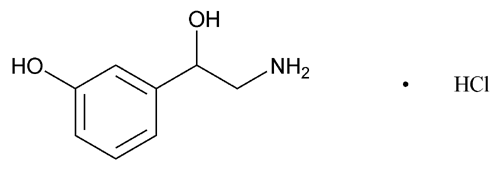 .
.
USP Phenylephrine Hydrochloride RS.
Identification—
B:
The alkaline filtrate from the test for Specific rotation responds positively to the test for Tartrate 191.
191.
Specific rotation 781S:
between –53 and –57 for the prepared sample.
781S:
between –53 and –57 for the prepared sample.
Test solution—
Prepare a sample solution of about 240 mg per mL in water. Make the solution slightly alkaline by adding concentrated ammonium hydroxide dropwise. Rub the wall of the vessel with a glass rod so that the base precipitates out. Filter the base under suction, wash with a little water and acetone, and dry at 105 for 2 hours. Prepare and measure a 50 mg per mL solution of base precipitate in 1 M hydrochloric acid.
for 2 hours. Prepare and measure a 50 mg per mL solution of base precipitate in 1 M hydrochloric acid.
pH 791:
between 3.0 and 4.0 in 10% w/v aqueous solution.
791:
between 3.0 and 4.0 in 10% w/v aqueous solution.
Loss on drying 731—
Dry at 105 to a constant weight: it loses not more than 0.5% of its weight.
731—
Dry at 105 to a constant weight: it loses not more than 0.5% of its weight.
Residue on ignition 281:
not more than 0.1%.
281:
not more than 0.1%.
Chromatographic purity—
Buffer solution—
Dissolve 3.25 g of 1-octanesulfonic acid sodium salt monohydrate in 1 L of water. Adjust slowly with 3 M phosphoric acid to a pH of 2.8.
Solution A—
Prepare a filtered and degassed mixture of Buffer solution and acetonitrile (9:1).
Solution B—
Prepare a filtered and degassed mixture of acetonitrile and Buffer solution (9:1).
Diluent—
Prepare a mixture of Solution A and Solution B (8:2).
System suitability solution—
Dissolve accurately weighed quantities of USP Phenylephrine Hydrochloride RS and USP Norphenylephrine Hydrochloride RS in Diluent, and dilute quantitatively, and stepwise if necessary, to obtain a solution having known concentrations of about 1.0 mg per mL and 0.9 µg per mL, respectively.
Blank solution—
Prepare a solution containing 0.8 mg per mL l(+)-tartaric acid in Diluent.
Test solution—
Transfer 78 mg of Phenylephrine Bitartrate, accurately weighed, to a 50-mL volumetric flask. Dissolve in and dilute with Diluent to volume, and mix.
Chromatographic system (see Chromatography 621)—
The liquid chromatograph is equipped with a 215-nm detector and a 4-mm × 5.5-cm column that contains packing L1. The column and injection port temperatures are maintained at 45 ± 2. The flow rate is about 1.5 mL per minute. The chromatograph is programmed as follows.
Chromatograph the System suitability solution, and record the peak responses as directed for Procedure: the resolution, R, between norphenylephrine and (–)-phenylephrine is not less than 1.5; the tailing factor of (–)-phenylephrine is less than 1.8; and the relative standard deviation for replicate injections is not more than 5%.
621)—
The liquid chromatograph is equipped with a 215-nm detector and a 4-mm × 5.5-cm column that contains packing L1. The column and injection port temperatures are maintained at 45 ± 2. The flow rate is about 1.5 mL per minute. The chromatograph is programmed as follows.
| Time (minutes) |
Solution A
(%) |
Solution B
(%) |
Elution |
| 0 | 93 | 7 | equilibration |
| 0–10 | 93®70 | 7®30 | linear gradient |
| 10–10.1 | 70®93 | 30®7 | linear gradient |
| 10.1–18 | 93 | 7 | equilibration |
Procedure—
Separately inject equal volumes (about 4 µL) of the Blank solution and the Test solution into the chromatograph, record the chromatograms, and measure all of the peak responses. Calculate the percentage of each impurity in the portion of Phenylephrine Bitartrate taken by the formula:
100(ri / rs)
in which ri is the peak response for each impurity, and rs is the sum of the responses of all the peaks. [note—Examine the chromatogram of the Blank solution for peaks and disregard any corresponding peaks observed in the chromatogram of the Test solution.] The limits of impurities are specified in the accompanying table.
| Compound | Approximate Relative Retention Time |
Limit (%) |
| Phenylephrine | 1.0 | — |
| Norphenylephrine | 0.9 | 0.2 |
| Phenylephrone | 1.2 | 0.1 |
| Benzylphenylephrine | 2.9 | 0.2 |
| Benzylphenylephrone | 3.1 | 0.1 |
| Individual unknown impurity | — | 0.1 |
| Total impurity | — | 0.5 |
Assay—
Transfer about 280 mg of Phenylephrine Bitartrate, accurately weighed, to a 100-mL beaker, and dissolve by stirring in 60 mL of glacial acetic acid. Titrate with 0.1 N perchloric acid, determining the endpoint potentiometrically. Perform a blank determination (see Titrimetry 541), and make the necessary correction. Each mL of 0.1 N perchloric acid is equivalent to 31.73 mg of C9H13NO2 · C4H6O6.
541), and make the necessary correction. Each mL of 0.1 N perchloric acid is equivalent to 31.73 mg of C9H13NO2 · C4H6O6.
Auxiliary Information—
Please check for your question in the FAQs before contacting USP.
Chromatographic Column—
| Topic/Question | Contact | Expert Committee |
| Monograph | Clydewyn M. Anthony, Ph.D.
Scientist 1-301-816-8139 |
(MDCCA05) Monograph Development-Cough Cold and Analgesics |
| Reference Standards | Lili Wang, Technical Services Scientist 1-301-816-8129 RSTech@usp.org |
USP32–NF27 Page 3283
Pharmacopeial Forum: Volume No. 31(3) Page 783
Chromatographic columns text is not derived from, and not part of, USP 32 or NF 27.