Histidine
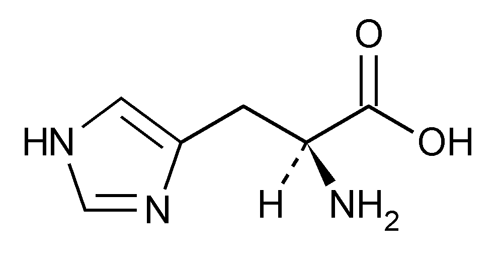
 155.15
l-Histidine.
l-Histidine
[71-00-1].» Histidine contains not less than 98.5 percent and not more than 101.5 percent of C6H9N3O2, as l-histidine, calculated on the dried basis.
Packaging and storage—
Preserve in well-closed containers.
Identification, Infrared Absorption  197K
197K —
The test specimen and USP Reference Standard are previously recrystallized from 80% alcohol.
—
The test specimen and USP Reference Standard are previously recrystallized from 80% alcohol.
197K—
The test specimen and USP Reference Standard are previously recrystallized from 80% alcohol.
Specific rotation 781S:
between +12.6 and +14.0.
781S:
between +12.6 and +14.0.
Test solution:
110 mg per mL, in 6 N hydrochloric acid.
pH 791:
between 7.0 and 8.5, in a solution (1 in 50).
791:
between 7.0 and 8.5, in a solution (1 in 50).
Loss on drying 731—
Dry it at 105 for 3 hours: it loses not more than 0.2% of its weight.
731—
Dry it at 105 for 3 hours: it loses not more than 0.2% of its weight.
Residue on ignition 281:
not more than 0.4%.
281:
not more than 0.4%.
Chloride 221—
A 0.73-g portion shows no more chloride than corresponds to 0.50 mL of 0.020 N hydrochloric acid (0.05%).
221—
A 0.73-g portion shows no more chloride than corresponds to 0.50 mL of 0.020 N hydrochloric acid (0.05%).
Sulfate 221—
A 0.33-g portion shows no more sulfate than corresponds to 0.10 mL of 0.020 N sulfuric acid (0.03%).
221—
A 0.33-g portion shows no more sulfate than corresponds to 0.10 mL of 0.020 N sulfuric acid (0.03%).
Iron 241:
0.003%.
241:
0.003%.
Heavy metals, Method I 231:
0.0015%.
231:
0.0015%.
Chromatographic purity—
Adsorbent:
0.25-mm layer of chromatographic silica gel mixture.
Test solution—
Dissolve an accurately weighed quantity of Histidine in water to obtain a solution having a concentration of 10 mg per mL. Apply 5 µL.
Standard solution—
Dissolve an accurately weighed quantity of USP l-Histidine RS in water to obtain a solution having a known concentration of about 0.05 mg per mL. Apply 5 µL. [note—This solution has a concentration equivalent to about 0.5% of that of the Test solution.]
System suitability solution—
Prepare a solution in water containing 0.4 mg each of USP l-Histidine RS and USP l-Proline RS per mL. Apply 5 µL.
Spray reagent—
Dissolve 0.2 g of ninhydrin in 100 mL of a mixture of butyl alcohol and 2 N acetic acid (95:5).
Developing solvent system—
Prepare a mixture of butyl alcohol, glacial acetic acid, and water (60:20:20).
Procedure—
Proceed as directed for Thin-Layer Chromatography under Chromatography 621. After air-drying the plate, spray with Spray reagent, and heat between 100 and 105 for about 15 minutes. Examine the plate under white light. The chromatogram obtained from the System suitability solution exhibits two clearly separated spots. Any secondary spot in the chromatogram obtained from the Test solution is not larger or more intense than the principal spot in the chromatogram obtained from the Standard solution: not more than 0.5% of any individual impurity is found; and not more than 2.0% of total impurities is found.
621. After air-drying the plate, spray with Spray reagent, and heat between 100 and 105 for about 15 minutes. Examine the plate under white light. The chromatogram obtained from the System suitability solution exhibits two clearly separated spots. Any secondary spot in the chromatogram obtained from the Test solution is not larger or more intense than the principal spot in the chromatogram obtained from the Standard solution: not more than 0.5% of any individual impurity is found; and not more than 2.0% of total impurities is found.
Assay—
Transfer about 150 mg of Histidine, accurately weighed, to a 125-mL flask, dissolve in a mixture of 3 mL of formic acid and 50 mL of glacial acetic acid, and titrate, very slowly, with 0.1 N perchloric acid VS, determining the endpoint potentiometrically. Perform a blank determination, and make any necessary correction. Each mL of 0.1 N perchloric acid is equivalent to 15.52 mg of C6H9N3O2.
Auxiliary Information—
Please check for your question in the FAQs before contacting USP.
| Topic/Question | Contact | Expert Committee |
| Monograph | Curtis Phinney
1-301-816-8540 |
(DSN05) Dietary Supplements - Non-Botanicals |
| Reference Standards | Lili Wang, Technical Services Scientist 1-301-816-8129 RSTech@usp.org |
USP32–NF27 Page 2558
Pharmacopeial Forum: Volume No. 27(1) Page 1789