Docusate Calcium
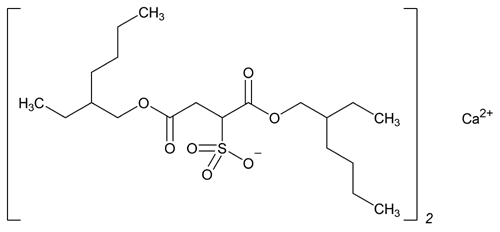
 883.22
Butanedioic acid, sulfo-, 1,4-bis(2-ethylhexyl) ester, calcium salt.
1,4-Bis(2-ethylhexyl) sulfosuccinate, calcium salt
[128-49-4].» Docusate Calcium contains not less than 91.0 percent and not more than 100.5 percent of C40H74CaO14S2, calculated on the anhydrous basis.
Packaging and storage—
Preserve in well-closed containers.
Clarity of solution—
Dissolve 25 g in 94 mL of alcohol: the solution does not develop a haze within 24 hours when maintained at a temperature of 25 ± 1 .
.
.
Identification—
A:
Place a small piece of it on a salt plate, add 1 drop of acetone, and promptly cover with another salt plate. Rub the plates together to dissolve the specimen, slide the plates apart, and allow the acetone to evaporate: the IR absorption spectrum of the film so obtained exhibits maxima only at the same wavelengths as that of a similar preparation of USP Docusate Calcium RS.
B:
Dissolve 25 mg in 2 mL of acetone. Add 2 mL of water, mix, and add 2 drops of sulfuric acid: a white precipitate is formed.
C:
Prepare a solution of it in isopropyl alcohol containing 10 mg per mL, and mix. Apply, with the aid of a stream of nitrogen, 10 µL of this solution and 10 µL of an isopropyl alcohol solution of USP Docusate Calcium RS containing 10 mg per mL to a suitable thin-layer chromatographic plate (see Chromatography  621
621 ) coated with a 0.25-mm layer of chromatographic silica gel. Allow the spots to dry, and develop the chromatogram in a solvent system consisting of a mixture of ethyl acetate, ammonium hydroxide, and alcohol (5:2:2) until the solvent front has moved three-fourths of the length of the plate. Remove the plate from the developing chamber, mark the solvent front, and allow the solvent to evaporate. Expose the plate to iodine vapors in a closed chamber for about 30 minutes, and locate the spots: the RF value of the spot obtained from the test solution corresponds to that obtained from the Standard solution.
621) coated with a 0.25-mm layer of chromatographic silica gel. Allow the spots to dry, and develop the chromatogram in a solvent system consisting of a mixture of ethyl acetate, ammonium hydroxide, and alcohol (5:2:2) until the solvent front has moved three-fourths of the length of the plate. Remove the plate from the developing chamber, mark the solvent front, and allow the solvent to evaporate. Expose the plate to iodine vapors in a closed chamber for about 30 minutes, and locate the spots: the RF value of the spot obtained from the test solution corresponds to that obtained from the Standard solution.
Water, Method I 921:
not more than 2.0%.
921:
not more than 2.0%.
Residue on ignition 281:
between 14.5% and 16.5%, calculated on the anhydrous basis.
281:
between 14.5% and 16.5%, calculated on the anhydrous basis.
Heavy metals, Method I 231—
Transfer 2.0 g to a platinum crucible, and ignite until free from carbon. Cool, moisten the residue with 1 mL of hydrochloric acid, and evaporate on a steam bath to dryness. Add 2 mL of 1 N acetic acid, digest on a steam bath for 5 minutes, filter into one of a pair of matched 50-mL, color-comparison tubes, and wash the residue with sufficient water to make 25 mL: the limit is 0.001%.
231—
Transfer 2.0 g to a platinum crucible, and ignite until free from carbon. Cool, moisten the residue with 1 mL of hydrochloric acid, and evaporate on a steam bath to dryness. Add 2 mL of 1 N acetic acid, digest on a steam bath for 5 minutes, filter into one of a pair of matched 50-mL, color-comparison tubes, and wash the residue with sufficient water to make 25 mL: the limit is 0.001%.
Limit of bis(2-ethylhexyl) maleate—
Mobile phase, Standard solution, and Chromatographic system—
Proceed as directed under Docusate Sodium.
Test solution—
Transfer about 1.0 g of Docusate Calcium, accurately weighed, to a 50-mL volumetric flask, dissolve in and dilute with alcohol to volume, and mix. If necessary, warm the mixture using the steam bath to achieve a complete dissolution.
Procedure—
Separately inject equal volumes (about 3 µL) of the Standard solution and the Test solution into the chromatograph, record the chromatograms, and measure the responses for the bis(2-ethylhexyl) maleate peaks. Calculate the percentage of bis(2-ethylhexyl) maleate in the portion of Docusate Calcium taken by the formula:
5C/W(rU / rS)
in which C is the concentration, in µg per mL, of USP Bis(2-ethylhexyl) Maleate RS in the Standard solution; W is the weight, in mg, of Docusate Calcium taken to prepare the Test solution; and rU and rS are the peak responses of bis(2-ethylhexyl) maleate obtained from the Test solution and the Standard solution, respectively: not more than 0.4% is found.
Assay—
Tetra-n-butylammonium iodide solution—
Transfer 1.250 g of tetra-n-butylammonium iodide to a 500-mL volumetric flask, dilute with water to volume, and mix.
Salt solution—
Transfer 100 g of anhydrous sodium sulfate and 10 g of sodium carbonate to a 400-mL beaker, and add sufficient water to dissolve the two salts. Transfer the solution to a 1000-mL volumetric flask, dilute with water to volume, and mix.
Procedure—
Dissolve about 50 mg of Docusate Calcium, accurately weighed, in 50 mL of chloroform in a glass-stoppered, 250-mL conical flask. Add 50 mL of Salt solution and 500 µL of bromophenol blue TS, and mix. Titrate with Tetra-n-butylammonium iodide solution until about 1 mL from the endpoint, and shake the stoppered flask vigorously for about 2 minutes. Continue the titration in 2-drop increments, shaking vigorously for about 10 seconds after each addition, and then allow the flask to stand about 10 seconds. Continue the titration until the chloroform layer just assumes a blue color. Each mL of Tetra-n-butylammonium iodide solution is equivalent to 2.989 mg of C40H74CaO14S2.
Auxiliary Information—
Please check for your question in the FAQs before contacting USP.
Chromatographic Column—
| Topic/Question | Contact | Expert Committee |
| Monograph | Elena Gonikberg, Ph.D.
Senior Scientist 1-301-816-8251 |
(MDGRE05) Monograph Development-Gastrointestinal Renal and Endocrine |
| Reference Standards | Lili Wang, Technical Services Scientist 1-301-816-8129 RSTech@usp.org |
USP32–NF27 Page 2192
Pharmacopeial Forum: Volume No. 31(3) Page 752
Chromatographic columns text is not derived from, and not part of, USP 32 or NF 27.