Propylene Glycol Dilaurate
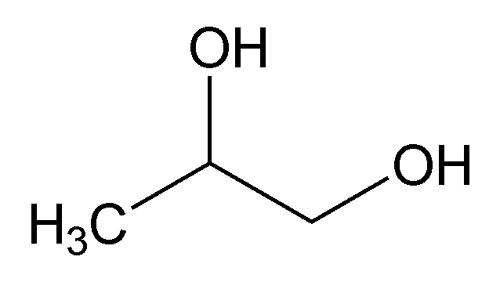
Dodecanoic acid, monoester with 1,2-propanediol.
Lauric acid, monoester with propane-1,2-diol.
Propylene dilaurate.
» Propylene Glycol Dilaurate is a mixture of the propylene glycol mono- and diesters of lauric acid. It contains not less than 70.0 percent of diesters and not more than 30.0 percent of monoesters.
Packaging and storage—
Preserve in well-closed containers, and protect from moisture. No storage requirements specified.
Identification—
A: Thin-Layer Chromatographic Identification Test  201
201 —
—
201—
Test solution:
50 mg per mL, in methylene chloride.
Developing solvent solution:
a mixture of hexane and ether (30:70).
Spray reagent—
Prepare a 0.1 mg per mL solution of rhodamine 6G in alcohol.
Procedure—
Develop the chromatogram over a path of 15 cm, and dry the plate in a current of air. Spray the plate with Spray reagent, and locate the spots on the plate by examination under UV light at a wavelength of 365 nm: the RF values of the principal spots obtained from the Test solution correspond to those obtained from the Standard solution.
B:
It complies with the requirements of the test for Fatty acid composition.
Acid value 401:
not more than 4.
401:
not more than 4.
Iodine value 401:
not more than 1.
401:
not more than 1.
Saponification value 401:
between 230 and 250.
401:
between 230 and 250.
Fatty acid composition 401—
Propylene Glycol Dilaurate exhibits the following composition profile of fatty acids, determined as directed in the chapter.
401—
Propylene Glycol Dilaurate exhibits the following composition profile of fatty acids, determined as directed in the chapter.
| Fatty Acids | Carbon-Chain Length | Percentage (%) |
| Caprylic acid | C8 | not more than 0.5 |
| Capric acid | C10 | not more than 2.0 |
| Lauric acid | C12 | not less than 95.0 |
| Myristic acid | C14 | not more than 3.0 |
| Palmitic acid | C16 | not more than 1.0 |
Water, Method Ia 921:
not more than 1.0%, using a mixture of methanol and methylene chloride (1:1) in place of methanol in the titration vessel.
921:
not more than 1.0%, using a mixture of methanol and methylene chloride (1:1) in place of methanol in the titration vessel.
Total ash 561:
not more than 0.1%.
561:
not more than 0.1%.
Limit of propylene glycol—
Mobile phase—
Proceed as directed in the Assay.
Propylene glycol standard stock solution—
Prepare a solution containing a known concentration of about 4 mg per mL of USP Propylene Glycol RS in tetrahydrofuran.
Propylene glycol standard solutions—
Into four 15-mL flasks, introduce respectively 0.25 mL, 0.5 mL, 1.0 mL, and 2.5 mL of Propylene glycol standard stock solution, and dilute with tetrahydrofuran to 5.0 mL. In a fifth 15-mL flask, introduce 5.0 mL of Propylene glycol standard stock solution.
Test solution—
Use the Assay preparation.
Chromatographic system—
Proceed as directed in the Assay.
Procedure—
Separately inject equal volumes (about 40 µL) of the Propylene glycol standard solutions and the Test solution into the chromatograph, record the chromatograms, and measure the responses for the major peaks. Prepare a standard curve of peak area versus concentration, in mg per mL, of propylene glycol in the Propylene glycol standard solutions. Obtain the concentration, C, in mg per mL, of propylene glycol in the Test solution from the standard curve. Calculate the percentage of free propylene glycol in the portion of Propylene Glycol Dilaurate taken by the formula:
100CV/W
in which V is the final volume of the Test solution; and W is the weight, in mg, of Propylene Glycol Dilaurate used to prepare the Test solution: not more than 2.0% is found.
Assay—
Mobile phase:
tetrahydrofuran.
Assay preparation—
Accurately weigh about 200 mg of Propylene Glycol Dilaurate into a 15-mL flask, add 5 mL of tetrahydrofuran, and shake to dissolve.
Chromatographic system (see Chromatography 621)—
The liquid chromatograph is equipped with a refractive index detector and a 7-mm × 60-cm column that contains 5-µm packing L21 (100 ). The flow rate is about 1 mL per minute. The column and detector temperatures are maintained at 40
 . [note—Two 7-mm × 30-cm L21 columns may be used in place of one 60-cm column, provided system suitability requirements are met.] Chromatograph the Assay preparation, and record the peak responses as directed for Procedure: the order of elution is diesters, monoesters, and propylene glycol; and the relative standard deviation for replicate injections determined from the monoester peak is not more than 1.0%.
621)—
The liquid chromatograph is equipped with a refractive index detector and a 7-mm × 60-cm column that contains 5-µm packing L21 (100). The flow rate is about 1 mL per minute. The column and detector temperatures are maintained at 40. [note—Two 7-mm × 30-cm L21 columns may be used in place of one 60-cm column, provided system suitability requirements are met.] Chromatograph the Assay preparation, and record the peak responses as directed for Procedure: the order of elution is diesters, monoesters, and propylene glycol; and the relative standard deviation for replicate injections determined from the monoester peak is not more than 1.0%.
Procedure—
Inject a volume (about 40 µL) of the Assay preparation into the chromatograph, record the chromatogram, and measure the responses for the major peaks. Calculate the percentage of monoesters or diesters in the portion of Propylene Glycol Dilaurate taken by the formula:
(100  D)(rU / rs)
in which D is the sum of the percentage content of propylene glycol and the percentage content of free fatty acids; rU is the peak response for monoesters or diesters; and rs is the sum of the responses of the monoesters and diesters peaks. Calculate the percentage content of free fatty acids using the formula:
D)(rU / rs)200(A/561.1)
in which A is the acid value.
Auxiliary Information—
Please check for your question in the FAQs before contacting USP.
| Topic/Question | Contact | Expert Committee |
| Monograph | Robert H. Lafaver, B.A.
Scientist 1-301-816-8335 |
(EM105) Excipient Monographs 1 |
| Reference Standards | Lili Wang, Technical Services Scientist 1-301-816-8129 RSTech@usp.org |
USP32–NF27 Page 1326
Pharmacopeial Forum: Volume No. 31(2) Page 500