- British Pharmacopoeia Volume I & II
- Monographs: Medicinal and Pharmaceutical Substances
Loperamide Hydrochloride |
 |


(Ph. Eur. monograph 0929)
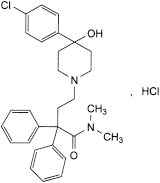
C29H33ClN2O2,HCl 513.5 34552-83-5
Opioid receptor agonist; antidiarrhoeal.
Ph Eur
4-[4-(4-Chlorophenyl)-4-hydroxypiperidin-1-yl]-N,N-dimethyl-2,2-diphenylbutanamide hydrochloride.
99.0 per cent to 101.0 per cent (dried substance).
White or almost white powder.
Slightly soluble in water, freely soluble in ethanol (96 per cent) and in methanol.
It shows polymorphism (5.9).
Infrared absorption spectrophotometry (2.2.24).
Comparison loperamide hydrochloride CRS.
If the spectra obtained show differences, dissolve the substance to be examined and the reference substance separately in the minimum volume of methylene chloride R, evaporate to dryness and record new spectra using the residues.
Liquid chromatography (2.2.29).
Test solution Dissolve 0.100 g of the substance to be examined in methanol R and dilute to 10.0 mL with the same solvent.
Reference solution (a) Dissolve 10.0 mg of loperamide hydrochloride for system suitability CRS in methanol R and dilute to 1.0 mL with the same solvent.
Reference solution (b) Dilute 1.0 mL of the test solution to 20.0 mL with methanol R. Dilute 1.0 mL of this solution to 25.0 mL with methanol R.
- — size: l = 0.10 m, Ø = 4.6 mm,
- — stationary phase: base-deactivated octadecylsilyl silica gel for chromatography R (3 µm),
- — temperature: 35 °C.
- — mobile phase A: 17.0 g/L solution of tetrabutylammonium hydrogen sulfate R1,
- — mobile phase B: acetonitrile R,
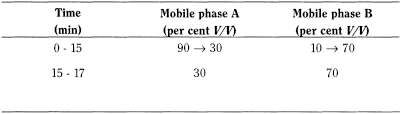
Flow rate 1.5 mL/min.
Detection Spectrophotometer at 220 nm.
Injection 10 µL.
System suitability Reference solution (a):
- — peak-to-valley ratio: minimum 1.5, where Hp = height above the baseline of the peak due to impurity G and Hv = height above the baseline of the lowest point of the curve separating this peak from the peak due to impurity H;
- — peak-to-valley ratio: minimum 1.5, where Hp = height above the baseline of the peak due to impurity E and Hv = height above the baseline of the lowest point of the curve separating this peak from the peak due to impurity A;
- — the chromatogram obtained is concordant with the chromatogram supplied with loperamide hydrochloride for system suitability CRS.
- — correction factors: for the calculation of contents, multiply the peak areas of the following impurities by the corresponding correction factor: impurity A = 1.3; impurity D = 1.7;
- — impurities A, B, C, D, E, F, G, H: for each impurity, not more than the area of the principal peak in the chromatogram obtained with reference solution (b) (0.2 per cent);
- — unspecified impurities: for each impurity, not more than 0.5 times the area of the principal peak in the chromatogram obtained with reference solution (b) (0.10 per cent);
- — total: not more than 1.5 times the area of the principal peak in the chromatogram obtained with reference solution (b) (0.3 per cent);
- — disregard limit: 0.25 times the area of the principal peak in the chromatogram obtained with reference solution (b) (0.05 per cent).
Maximum 0.5 per cent, determined on 1.000 g by drying in an oven at 105 °C for 4 h.
Maximum 0.1 per cent, determined on 1.0 g.
Dissolve 0.400 g in 50 mL of ethanol (96 per cent) R and add 5.0 mL of 0.01 M hydrochloric acid. Carry out a potentiometric titration (2.2.20), using 0.1 M sodium hydroxide. Read the volume added between the 2 points of inflexion.
1 mL of 0.1 M sodium hydroxide is equivalent to 51.35 mg of C29H34Cl2N2O2.
Protected from light.
Specified impurities A, B, C, D, E, F, G, H.
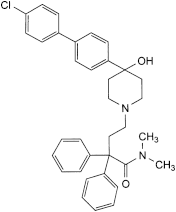
A. 4-[4-(4′-chlorobiphenyl-4-yl)-4-hydroxypiperidin-1-yl]-N,N-dimethyl-2,2-diphenylbutanamide,
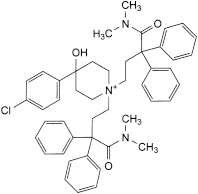
B. 4-(4-chlorophenyl)-1,1-bis[4-(dimethylamino)-4-oxo-3,3-diphenylbutyl]-4-hydroxypiperidinium,
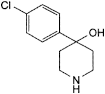
C. 4-(4-chlorophenyl)piperidin-4-ol,
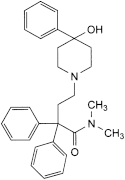
D. 4-(4-hydroxy-4-phenylpiperidin-1-yl)-N,N-dimethyl-2,2-diphenylbutanamide,
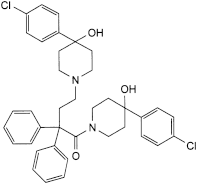
E. 4-(4-chlorophenyl)-1-[4-[4-(4-chlorophenyl)-4-hydroxypiperidin-1-yl]-2,2-diphenylbutanoyl]piperidin-4-ol,
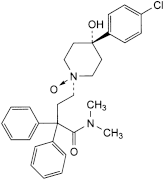
F. 4-[trans-4-(4-chlorophenyl)-4-hydroxy-1-oxidopiperidin-1-yl]-N,N-dimethyl-2,2-diphenylbutanamide (loperamide oxide),
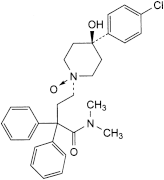
G. 4-[cis-4-(4-chlorophenyl)-4-hydroxy-1-oxidopiperidin-1-yl]-N,N-dimethyl-2,2-diphenylbutanamide,
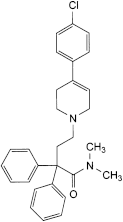
H. 4-[4-(4-chlorophenyl)-3,6-dihydropyridin-1(2H)-yl]-N,N-dimethyl-2,2-diphenylbutanamide.
Ph Eur