- British Pharmacopoeia Volume III
- Formulated Preparations: Specific Monographs
Loperamide Capsules |


Opioid receptor agonist; antidiarrhoeal.
Loperamide Capsules contain Loperamide Hydrochloride.
The capsules comply with the requirements stated under Capsules and with the following requirements.
95.0 to 105.0% of the stated amount.
A. Carry out the method for thin-layer chromatography, Appendix III A, using the following solutions.
(1) Shake a quantity of the contents of the capsules containing 10 mg of Loperamide Hydrochloride with 10 mL of methanol for 5 minutes and filter.
(2) 0.10% w/v of loperamide hydrochloride BPCRS in methanol.
(a) Use as the coating silica gel F254 (Merck silica gel 60 F254 plates are suitable).
(b) Use the mobile phase as described below.
(c) Apply 10 µL of each solution.
(d) Develop the plate to 15 cm.
(e) After removal of the plate, dry in air and examine under ultraviolet light (254 nm). Expose the plate to iodine vapour and examine again.
2.5 volumes of acetate buffer pH 4.7, 17.5 volumes of methanol, 27 volumes of ethyl acetate and 53 volumes of dichloromethane.
By each method of visualisation the principal spot in the chromatogram obtained with solution (1) corresponds in position and colour to that in the chromatogram obtained with solution (2).
B. In the Assay, the chromatogram obtained with solution (1) shows a peak with the same retention time as the principal peak in the chromatogram obtained with solution (2).
Comply with the requirements for Monographs of the British Pharmacopoeia in the dissolution test for tablets and capsules, Appendix XII B1.
(a) Use Apparatus 2, rotating the paddle at 50 revolutions per minute.
(b) Use 500 mL of a buffer solution prepared by mixing 20 mL of 1m acetic acid with 60 mL of water, adjusting the pH to 4.7 with 1m sodium hydroxide and diluting to 100 mL with water, at a temperature of 37°, as the medium.
Carry out the method for liquid chromatography, Appendix III D, using the following solutions.
(1) After 45 minutes withdraw a 10 mL sample of the medium and filter. Use the filtered medium.
(2) 0.00040% w/v of loperamide hydrochloride BPCRS in the dissolution medium.
The chromatographic conditions described under Assay may be used.
Calculate the total content of loperamide hydrochloride, C29H33ClN2O2,HCl, in the medium from the chromatograms obtained and using the declared content of C29H33ClN2O2,HCl in loperamide hydrochloride BPCRS.
Carry out the method for thin-layer chromatography, Appendix III A, using the following solutions.
(1) Shake a quantity of the contents of the capsules containing 20 mg of Loperamide Hydrochloride with 40 mL of methanol for 15 minutes, filter and evaporate the filtrate to dryness using a rotary evaporator and a water bath at 30°; to the residue add 2 mL of methanol, mix with the aid of ultrasound, centrifuge and use the supernatant liquid.
(2) 0.010% w/v of loperamide N-oxide BPCRS in methanol.
(a) Use as the coating silica gel the surface of which has been modified with chemically-bonded octadecylsilyl groups (Whatman KC 18 plates are suitable).
(b) Use the mobile phase as described below.
(c) Apply 25 µL of each solution.
(d) Develop the plate to 15 cm.
(e) After removal of the plate, dry in air and expose to iodine vapour for 16 hours.
30 volumes of water, adjusted to pH 3.0 by the addition of orthophosphoric acid, and 70 volumes of methanol.
Any spot corresponding to loperamide N-oxide in the chromatogram obtained with solution (1) is not more intense than the principal spot in the chromatogram obtained with solution (2) (1%).
Capsules containing less than 2 mg and/or less than 2% w/w of Loperamide Hydrochloride comply with the requirements stated under Capsules using the following method of analysis. Carry out the method for liquid chromatography, Appendix III D, using the following solutions.
(1) Add 150 mL of water to one whole capsule and mix with the aid of ultrasound for 30 minutes, shake mechanically for 30 minutes and dilute to 200 mL with acetonitrile, filter and use the filtrate.
(2) Dissolve 10 mg of loperamide hydrochloride BPCRS in 45 mL of water and dilute to 100 mL with acetonitrile. Dilute 1 volume of the resulting solution to 10 volumes with the same solvent mixture.
The chromatographic conditions described under Assay may be used.
Calculate the content of C29H33ClN2O2,HCl in each capsule using the declared content of C29H33ClN2O2,HCl in loperamide hydrochloride BPCRS.
Prepare 0.005m sodium octanesulfonate containing, per 1000 mL, 1 mL of 13.5m ammonia and 0.5 mL of triethylamine and adjust the pH to 3.2 with orthophosphoric acid (solvent A). Carry out the method for liquid chromatography, Appendix III D, using the following solutions.
(1) Mix a quantity of the mixed contents of 20 capsules containing 20 mg of Loperamide Hydrochloride with 90 mL of water with the aid of ultrasound for 10 minutes, shake for 30 minutes, dilute to 200 mL with acetonitrile and filter.
(2) 0.010% w/v of loperamide hydrochloride BPCRS in a mixture of 45 volumes of water and 55 volumes of acetonitrile.
(a) Use a stainless steel column (15 cm × 4 mm) packed with end-capped octadecylsilyl silica gel for chromatography (4 µm) (Novapak C18 is suitable).
(b) Use isocratic elution and the mobile phase described below.
(c) Use a flow rate of 1.5 mL per minute.
(d) Use an ambient column temperature.
(e) Use a detection wavelength of 226 nm.
(f) Inject 20 µL of each solution.
45 volumes of solvent A and 55 volumes of acetonitrile.
Calculate the content of C29H33ClN2O2,HCl in the capsules using the declared content of C29H33ClN2O2,HCl in loperamide hydrochloride BPCRS.
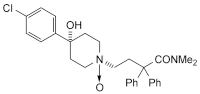
A. Loperamide N-oxide