- British Pharmacopoeia Volume I & II
- Monographs: Medicinal and Pharmaceutical Substances
Mesalazine |
 |


(Ph. Eur. monograph 1699)

C7H7NO3 153.1 89-57-6
Aminosalicylate; treatment of ulcerative colitis.
Mesalazine Foam Enema
Prolonged-release Mesalazine Granules
Gastro-resistant Mesalazine Tablets
Prolonged-release Mesalazine Tablets
Ph Eur
5-Amino-2-hydroxybenzoic acid.
98.5 per cent to 101.5 per cent (dried substance).
Almost white or light grey or light pink powder or crystals.
Very slightly soluble in water, practically insoluble in ethanol (96 per cent). It dissolves in dilute solutions of alkali hydroxides and in dilute hydrochloric acid.
First identification B.
Second identification A, C.
A. Ultraviolet and visible absorption spectrophotometry (2.2.25).
Test solution Dissolve 50.0 mg in 10 mL of a 10.3 g/L solution of hydrochloric acid R and dilute to 100.0 mL with the same acid. Dilute 5.0 mL of this solution to 200.0 mL with a 10.3 g/L solution of hydrochloric acid R.
Spectral range 210-250 nm.
Absorption maximum At about 230 nm.
Specific absorbance at the absorption maximum 430 to 450.
B. Infrared absorption spectrophotometry (2.2.24).
Comparison mesalazine CRS.
C. Thin-layer chromatography (2.2.27).
Test solution Dissolve 25 mg of the substance to be examined in 5 mL of a mixture of equal volumes of glacial acetic acid R and water R and dilute to 10.0 mL with methanol R.
Reference solution Dissolve 25 mg of mesalazine CRS in 5 mL of a mixture of equal volumes of glacial acetic acid R and water R and dilute to 10.0 mL with methanol R.
Plate A suitable silica gel as the coating substance.
Mobile phase glacial acetic acid R, methanol R, methyl isobutyl ketone R (10:40:50 V/V/V).
Application 5 µL.
Development Over 2/3 of the plate.
Drying In air.
Detection Examine in ultraviolet light at 365 nm.
Results The principal spot in the chromatogram obtained with the test solution is similar in position, colour and size to the principal spot in the chromatogram obtained with the reference solution.
Maintain the solutions at 40 °C during preparation and measurements. Dissolve 0.5 g in 1 M hydrochloric acid and dilute to 20 mL with the same acid. The solution is clear (2.2.1). Immediately measure the absorbance (2.2.25) of the solution at 440 nm and 650 nm. The absorbance is not greater than 0.15 at 440 nm and 0.10 at 650 nm.
Dissolve 0.10 g in dilute hydrochloric acid R and dilute to 25 mL with the same acid. Add 0.2 mL of starch solution R and 0.25 mL of 0.01 M iodine. Allow to stand for 2 min. The solution is blue or violet-brown.
Liquid chromatography (2.2.29). Prepare the solutions and mobile phases immediately before use.
Test solution Dissolve 50.0 mg of the substance to be examined in mobile phase A and dilute to 50.0 mL with mobile phase A.
Reference solution (a) Dissolve 5.0 mg of mesalazine impurity C CRS in mobile phase A and dilute to 100.0 mL with mobile phase A. Dilute 10.0 mL of the solution to 100.0 mL with mobile phase A.
Reference solution (b) Dissolve 5.0 mg of mesalazine impurity A CRS in mobile phase A and dilute to 250.0 mL with mobile phase A. To 1.0 mL of the solution add 1.0 mL of reference solution (a) and dilute to 100.0 mL with mobile phase A.
Reference solution (c) Dilute 1.0 mL of the test solution to 200.0 mL with mobile phase A. To 5.0 mL of this solution add 5.0 mL of reference solution (a).
- — size: l = 0.25 m, Ø = 4.6 mm;
- — stationary phase: spherical end-capped octadecylsilyl silica gel for chromatography R (3 µm).
- — mobile phase A: dissolve 1.0 g of phosphoric acid R and 2.2 g of perchloric acid R in water R and dilute to 1000.0 mL with the same solvent;
- — mobile phase B: dissolve 1.0 g of phosphoric acid R and 1.7 g of perchloric acid R in acetonitrile R1 and dilute to 1000.0 mL with the same solvent;
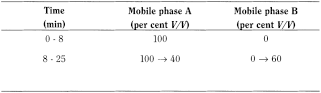
Flow rate 1.0 mL/min.
Detection Spectrophotometer at 220 nm.
Injection 20 µL.
Identification of impurities Use the chromatogram obtained with reference solution (b) to identify the peak due to impurity A; use the chromatogram obtained with reference solution (a) to identify the peak due to impurity C.
Relative retention With reference to mesalazine (retention time = about 9 min): impurity A = about 0.5; impurity C = about 0.9.
System suitability Reference solution (c):
- — resolution: minimum 3.0 between the peaks due to impurity C and mesalazine.
- — impurity A: not more than the area of the corresponding peak in the chromatogram obtained with reference solution (b) (200 ppm);
- — impurity C: not more than 4 times the area of the corresponding peak in the chromatogram obtained with reference solution (b) (200 ppm).
Liquid chromatography (2.2.29).
Test solution Dissolve 40.0 mg of the substance to be examined in the mobile phase and dilute to 20.0 mL with the mobile phase.
Reference solution Dissolve 27.8 mg of aniline hydrochloride R in the mobile phase and dilute to 100.0 mL with the mobile phase. Dilute 0.20 mL of the solution to 20.0 mL with the mobile phase. Dilute 0.20 mL of this solution to 20.0 mL with the mobile phase.
- — size: l = 0.25 m, Ø = 4 mm;
- — stationary phase: spherical octadecylsilyl silica gel for chromatography R (5 µm);
- — temperature: 40 °C.
Mobile phase Mix 15 volumes of methanol R2 with 85 volumes of a solution containing 1.41 g/L of potassium dihydrogen phosphate R and 0.47 g/L of disodium hydrogen phosphate dihydrate R previously adjusted to pH 8.0 with a 42 g/L solution of sodium hydroxide R.
Flow rate 1.0 mL/min.
Detection Spectrophotometer at 205 nm.
Injection 50 µL.
Run time 1.5 times the retention time of impurity K.
Retention time Impurity K = about 15 min.
System suitability Reference solution:
- — signal-to-noise ratio: minimum 10 for the principal peak.
- — impurity K: not more than the area of the principal peak in the chromatogram obtained with the reference solution (10 ppm).
Liquid chromatography (2.2.29). Prepare the solutions immediately before use.
Test solution Dissolve 0.100 g of the substance to be examined in 0.01 M hydrochloric acid, with the aid of ultrasound, and dilute to 100.0 mL with the same solvent.
Reference solution (a) Dilute 1.0 mL of the test solution to 100.0 mL with 0.01 M hydrochloric acid. Dilute 1.0 mL of this solution to 10.0 mL with 0.01 M hydrochloric acid.
Reference solution (b) Dissolve 5 mg of mesalazine for system suitability CRS (containing impurities F, J and P) in 0.01 M hydrochloric acid and dilute to 5.0 mL with the same solvent.
Reference solution (c) Dissolve 5 mg of 4-aminosalicylic acid R (impurity E), 5 mg of 2,5-dihydroxybenzoic acid R (impurity G), 15 mg of salicylic acid R (impurity H), 5 mg of 2-chlorobenzoic acid R (impurity L), 5 mg of 2-chloro-5-nitrobenzoic acid R (impurity M), 10 mg of sulfanilic acid R (impurity O) and 5 mg of 3-nitrosalicylic acid R (impurity R) in 0.01 M hydrochloric acid and dilute to 100.0 mL with the same acid. Dilute 1.0 mL of the solution to 50.0 mL of 0.01 M hydrochloric acid.
Reference solution (d) Dissolve 3.0 mg of 2-chlorobenzoic acid R (impurity L) in 0.01 M hydrochloric acid and dilute to 100.0 mL with the same solvent. Dilute 1.0 mL of the solution to 100.0 mL of 0.01 M hydrochloric acid.
- — size: l = 0.25 m, Ø = 4.6 mm;
- — stationary phase: end-capped octadecylsilyl amorphous organosilica polymer for mass spectrometry R (5 µm);
- — temperature: 40 °C.
- — mobile phase A: dissolve 6.9 g of sodium dihydrogen phosphate monohydrate R in 950 mL of water R, adjust to pH 6.2 with dilute sodium hydroxide solution R and dilute to 1000 mL with water R;
- — mobile phase B: acetonitrile R, mobile phase A (40:60 V/V);
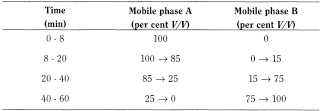
Flow rate 1.0 mL/min.
Detection Spectrophotometer at 240 nm.
Injection 20 µL.
Identification of impurities Use the chromatogram supplied with mesalazine for system suitability CRS and the chromatogram obtained with reference solution (b) to identify the peaks due to impurities F, J and P; use the chromatogram obtained with reference solution (c) to identify the peaks due to impurities E, G, H, L, M, O and R.
Relative retention With reference to mesalazine (retention time = about 6 min): impurity O = about 0.5; impurity J = about 0.6; impurity E = about 0.8; impurity F = about 1.36; impurity G = about 1.44; impurity P = about 1.5; impurity L = about 2.0; impurity M = about 3.3; impurity H = about 3.5; impurity R = about 5.1.
- — peak-to-valley ratio: minimum 3.0, where Hp = height above the baseline of the peak due to impurity F and Hv = height above the baseline of the lowest point of the curve separating this peak from the peak due to mesalazine in the chromatogram obtained with reference solution (b);
- — signal-to-noise ratio: minimum 45 for the peak due to impurity L in the chromatogram obtained with reference solution (d).
- — correction factors: for the calculation of content, multiply the peak areas of the following impurities by the corresponding correction factor: impurity E = 1.3; impurity G = 1.4; impurity H = 1.4; impurity J = 2.0; impurity L = 4.5; impurity M = 1.7; impurity O = 0.6; impurity P = 0.6; impurity R = 1.3;
- — impurity H: not more than 3 times the area of the principal peak in the chromatogram obtained with reference solution (a) (0.3 per cent);
- — impurities F, J, O, P: for each impurity, not more than the area of the principal peak in the chromatogram obtained with reference solution (a) (0.1 per cent);
- — impurities E, G, L, M, R: for each impurity, not more than 0.5 times the area of the principal peak in the chromatogram obtained with reference solution (a) (0.05 per cent);
- — unspecified impurities: for each impurity, not more than 0.5 times the area of the principal peak in the chromatogram obtained with reference solution (a) (0.05 per cent);
- — total: not more than 5 times the area of the principal peak in the chromatogram obtained with reference solution (a) (0.5 per cent);
- — disregard limit: 0.3 times the area of the principal peak in the chromatogram obtained with reference solution (a) (0.03 per cent).
Maximum 0.1 per cent.
Dissolve 1.50 g in 50 mL of anhydrous formic acid R. Add 100 mL of water R and 5 mL of 2 M nitric acid. Titrate with 0.005 M silver nitrate, determining the end-point potentiometrically (2.2.20).
1 mL of 0.005 M silver nitrate is equivalent to 0.1773 mg of Cl.
Maximum 200 ppm.
Shake 1.0 g with 20 mL of distilled water R for 1 min and filter. 15 mL of the filtrate complies with the test.
Maximum 10 ppm.
1.0 g complies with test F. Prepare the reference solution using 1 mL of lead standard solution (10 ppm Pb) R.
Maximum 0.5 per cent, determined on 1.000 g by drying in an oven at 105 °C.
Maximum 0.2 per cent, determined on 1.0 g.
Dissolve 50.0 mg in 100 mL of boiling water R. Cool rapidly to room temperature and titrate with 0.1 M sodium hydroxide, determining the end-point potentiometrically (2.2.20).
1 mL of 0.1 M sodium hydroxide is equivalent to 15.31 mg of C7H7NO3.
In an airtight container, protected from light.
Specified impurities: A, C, E, F, G, H, J, K, L, M, O, P, R.
Other detectable impurities (the following substances would, if present at a sufficient level, be detected by one or other of the tests in the monograph. They are limited by the general acceptance criterion for other/unspecified impurities and/or by the general monograph Substances for pharmaceutical use (2034). It is therefore not necessary to identify these impurities for demonstration of compliance. See also 5.10. Control of impurities in substances for pharmaceutical use): B, D, I, N, Q, S.

A. 4-aminophenol,

B. 3-aminophenol,

C. 2-aminophenol,

D. 3-aminobenzoic acid,

E. 4-amino-2-hydroxybenzoic acid (4-aminosalicylic acid),

F. 3-amino-2-hydroxybenzoic acid (3-aminosalicylic acid),

G. 2,5-dihydroxybenzoic acid,

H. 2-hydroxybenzoic acid (salicylic acid),
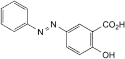
I. 2-hydroxy-5-(phenyldiazenyl)benzoic acid (phenylazosalicylic acid),

J. 3,5-diamino-2-hydroxybenzoic acid (3,5-diaminosalicylic acid),

K. aniline,

L. 2-chlorobenzoic acid,

M. 2-chloro-5-nitrobenzoic acid,

N. 2-hydroxy-5-nitrobenzoic acid (5-nitrosalicylic acid),

O. 4-aminobenzenesulfonic acid (sulfanilic acid),
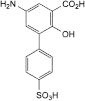
P. 5-amino-2-hydroxy-3-(4-sulfophenyl)benzoic acid (3-(4-sulfophenyl)-5-aminosalicylic acid),

Q. 2-chloro-3-nitrobenzoic acid,

R. 2-hydroxy-3-nitrobenzoic acid (3-nitrosalicylic acid),
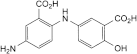
S. 2-hydroxy-5-[(2-carboxy-4-aminophenyl)amino]benzoic acid.
Ph Eur