- British Pharmacopoeia Volume I & II
- Monographs: Medicinal and Pharmaceutical Substances
Voriconazole |
 |
(Ph. Eur. monograph 2576)
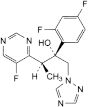
C16H14F3N5O 349.3 137234-62-9
Antifungal.
Ph Eur
(2R,3S)-2-(2,4-Difluorophenyl)-3-(5-fluoropyrimidin-4-yl)-1-(1H-1,2,4-triazol-1-yl)butan-2-ol.
97.5 per cent to 102.0 per cent (anhydrous substance).
White or almost white powder.
Very slightly soluble in water, freely soluble in acetone and in methylene chloride.
A. Infrared absorption spectrophotometry (2.2.24).
Comparison voriconazole CRS.
B. Enantiomeric purity (see Tests).
The solution is clear (2.2.1) and colourless (2.2.2, Method II).
Dissolve 0.5 g in a 103 g/L solution of hydrochloric acid R and dilute to 20 mL with the same solution.
Liquid chromatography (2.2.29).
Test solution Dissolve 25.0 mg of the substance to be examined in 2 mL of acetonitrile R and dilute to 50.0 mL with the mobile phase.
Reference solution (a) Dissolve 5.0 mg of voriconazole impurity D CRS in 2 mL of acetonitrile R and dilute to 50.0 mL with the mobile phase.
Reference solution (b) Dissolve 25 mg of the substance to be examined in 2 mL of acetonitrile R, add 1 mL of reference solution (a) and dilute to 50.0 mL with the mobile phase.
Reference solution (c) Dilute 1.0 mL of reference solution (a) to 100.0 mL with the mobile phase.
- — size: l = 0.25 m, Ø = 4.6 mm;
- — stationary phase: silica gel BC for chiral chromatography R (5 µm);
- — temperature: 30 °C.
Mobile phase Mix 18 volumes of acetonitrile R and 82 volumes of a 0.77 g/L solution of ammonium acetate R previously adjusted to pH 5.0 with glacial acetic acid R.
Flow rate 1.0 mL/min.
Detection Spectrophotometer at 256 nm.
Injection 20 µL of the test solution and reference solutions (b) and (c).
Run time 2.5 times the retention time of voriconazole.
Relative retention With reference to voriconazole (retention time = about 7 min): impurity D = about 1.5.
System suitability Reference solution (b):
- — resolution: minimum 4.0 between the peaks due to voriconazole and impurity D.
- — impurity D: not more than the area of the principal peak in the chromatogram obtained with reference solution (c) (0.2 per cent).
Liquid chromatography (2.2.29).
Test solution Dissolve 50.0 mg of the substance to be examined in 5.0 mL of methanol R and dilute to 10.0 mL with the mobile phase.
Reference solution (a) Dissolve 25.0 mg of voriconazole impurity E CRS in 50 mL of methanol R and dilute to 100.0 mL with the mobile phase.
Reference solution (b) Dissolve 17 mg of sodium chloride R in water R and dilute to 200.0 mL with the same solvent. Mix 1 mL of the solution, 1 mL of reference solution (a) and 25 mL of methanol R and dilute to 50.0 mL with the mobile phase.
Reference solution (c) To 1.0 mL of reference solution (a) add 25 mL of methanol R and dilute to 50.0 mL with the mobile phase.
- — size: l = 0.25 m, Ø = 4.0 mm;
- — stationary phase: strongly basic anion exchange resin for chromatography R (8.5 µm);
- — temperature: 40 °C.
Mobile phase To 1500 mL of water R add 500 mL of methanol R, mix and degas; add about 175 µL of a 470 g/L solution of sodium hydroxide R and mix.
Flow rate 1.0 mL/min.
Detection Conductivity detector; use a self-regenerating anion suppressor.
Injection 20 µL of the test solution and reference solutions (b) and (c).
Run time Twice the retention time of impurity E.
Relative retention With reference to impurity E (retention time = about 4 min): chloride = about 1.5.
- — resolution: minimum 3.5 between the peaks due to impurity E and chloride in the chromatogram obtained with reference solution (b);
- — symmetry factor: maximum 1.7 for the peak due to impurity E in the chromatogram obtained with reference solution (c).
- — impurity E: not more than the area of the principal peak in the chromatogram obtained with reference solution (c) (0.10 per cent).
Liquid chromatography (2.2.29).
Test solution (a) Dissolve 50.0 mg of the substance to be examined in the mobile phase, sonicating if necessary, and dilute to 100.0 mL with the mobile phase. Mix well to ensure complete dissolution.
Test solution (b) Dilute 5.0 mL of test solution (a) to 100.0 mL with the mobile phase.
Reference solution (a) Dissolve 50.0 mg of voriconazole CRS in the mobile phase, sonicating if necessary, and dilute to 100.0 mL with the mobile phase. Mix well to ensure complete dissolution. Dilute 5.0 mL of the solution to 100.0 mL with the mobile phase.
Reference solution (b) Suspend 0.100 g of the substance to be examined in 10 mL of a 40 g/L solution of sodium hydroxide R and dilute to 20 mL with the mobile phase; sonicate if necessary. Allow to stand for 30 min. Dilute 1.0 mL of the solution to 100.0 mL with the mobile phase (in situ degradation to obtain impurities A and C).
Reference solution (c) Dilute 1.0 mL of test solution (a) to 100.0 mL with the mobile phase and mix. Dilute 1.0 mL of this solution to 10.0 mL with the mobile phase and mix well.
Reference solution (d) Dissolve 2 mg of voriconazole impurity B CRS in the mobile phase and dilute to 200 mL with the mobile phase. Dilute 1.0 mL of the solution to 10.0 mL with the mobile phase.
- — size: l = 0.15 m, Ø = 3.9 mm;
- — stationary phase: end-capped octadecylsilyl silica gel for chromatography R (4 µm);
- — temperature: 35 °C.
Mobile phase Mix 15 volumes of acetonitrile R, 30 volumes of methanol R and 55 volumes of a 1.90 g/L solution of ammonium formate R previously adjusted to pH 4.0 with anhydrous formic acid R while stirring continuously.
Flow rate 1.0 mL/min.
Detection Spectrophotometer at 256 nm.
Injection 20 µL of test solution (a) and reference solutions (b), (c) and (d).
Run time 3 times the retention time of voriconazole.
Identification of impurities Use the chromatogram obtained with reference solution (b) to identify the peaks due to impurities A and C; use the chromatogram obtained with reference solution (d) to identify the peak due to impurity B.
Relative retention With reference to voriconazole (retention time = about 8 min): impurity A = 0.25; impurity C = about 0.3; impurity B = about 0.6.
System suitability Reference solution (b):
- — resolution: minimum 1.8 between the peaks due to impurities A and C.
- — correction factors: for the calculation of content, multiply the peak areas of the following impurities by the corresponding correction factor: impurity A = 0.7; impurity B = 2.1; impurity C = 0.7;
- — impurities A, B, C: for each impurity, not more than 1.5 times the area of the principal peak in the chromatogram obtained with reference solution (c) (0.15 per cent);
- — unspecified impurities: for each impurity, not more than the area of the principal peak in the chromatogram obtained with reference solution (c) (0.10 per cent);
- — sum of impurities A, B, C, D, E and unspecified impurities: maximum 0.5 per cent;
- — disregard limit: 0.5 times the area of the principal peak in the chromatogram obtained with reference solution (c) (0.05 per cent).
Maximum 10 ppm.
Solvent mixture water R, acetone R (30:70 V/V).
0.250 g complies with test H. Prepare the reference solution using 0.25 mL of lead standard solution (10 ppm Pb) R.
Maximum 0.4 per cent, determined on 1.00 g.
Maximum 0.1 per cent, determined on 1.0 g in a platinum crucible.
Less than 0.2 IU/mg, if intended for use in the manufacture of parenteral preparations without a further appropriate procedure for the removal of bacterial endotoxins.
Liquid chromatography (2.2.29) as described in the test for related substances with the following modification.
Injection Test solution (b) and reference solution (a).
Calculate the percentage content of C16H14F3N5O from the declared content of voriconazole CRS.
If the substance is sterile, store in a sterile, airtight, tamper-proof container.
Specified impurities A, B, C, D, E.
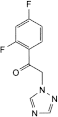
A. 1-(2,4-difluorophenyl)-2-(1H-1,2,4-triazol-1-yl)ethanone,
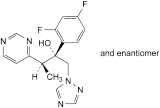
B. (2RS,3SR)-2-(2,4-difluorophenyl)-3-pyrimidin-4-yl-1-(1H-1,2,4-triazol-1-yl)butan-2-ol,

C. 4-ethyl-5-fluoropyrimidine,
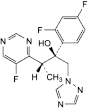
D. (2S,3R)-2-(2,4-difluorophenyl)-3-(5-fluoropyrimidin-4-yl)-1-(1H-1,2,4-triazol-1-yl)butan-2-ol (voriconazole enantiomer),
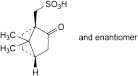
E. [(1R,4S)-7,7-dimethyl-2-oxobicyclo[2.2.1]hept-1-yl]methanesulfonic acid ((±)-10-camphorsulfonic acid).
Ph Eur