Cephalothin Sodium
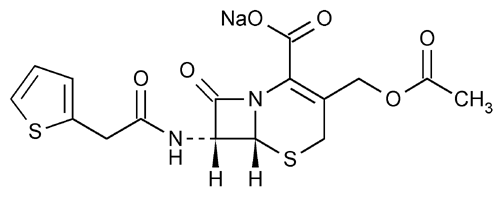
 418.42
5-Thia-1-azabicyclo[4.2.0]oct-2-ene-2-carboxylic acid, 3-[(acetyloxy)methyl]-8-oxo-7-[(2-thienylacetyl)amino]-, monosodium salt, (6R-trans)-.
Monosodium (6R,7R)-3-(hydroxymethyl)-8-oxo-7-[2-(2-thienyl)-acetamido]-5-thia-1-azabicyclo[4.2.0]oct-2-ene-2-carboxylate acetate (ester)
[58-71-9].» Cephalothin Sodium contains the equivalent of not less than 850 µg of cephalothin (C16H16N2O6S2) per mg, calculated on the dried basis.
Packaging and storage—
Preserve in tight containers.
Labeling—
Where it is intended for use in preparing injectable dosage forms, the label states that it is sterile or must be subjected to further processing during the preparation of injectable dosage forms.
Specific rotation  781S
781S :
between +124
:
between +124 and +134.
781S:
between +124 and +134.
Test solution:
a known amount of specimen, equivalent to about 50 mg of cephalothin, per mL, in water.
Crystallinity 695:
meets the requirements.
695:
meets the requirements.
pH 791:
between 4.5 and 7.0, in a solution containing 250 mg per mL.
791:
between 4.5 and 7.0, in a solution containing 250 mg per mL.
Loss on drying 731—
Dry about 100 mg, accurately weighed, in a capillary-stoppered bottle in vacuum at a pressure not exceeding 5 mm of mercury at 60 for 3 hours: it loses not more than 1.5% of its weight.
731—
Dry about 100 mg, accurately weighed, in a capillary-stoppered bottle in vacuum at a pressure not exceeding 5 mm of mercury at 60 for 3 hours: it loses not more than 1.5% of its weight.
Chromatographic purity—
Standard solution—
Use the Standard preparation, prepared as directed in the Assay, transfer 1.0 mL to a 100-mL volumetric flask, dilute with Mobile phase to volume, and mix.
Procedure—
Proceed as directed for the Procedure in the Assay, except to inject equal volumes (about 20 µL) of the Standard solution and the Test solution and to continue the chromatography of the Test solution for at least 4 times the retention time of the main cephalothin peak. The area of any peak in the chromatogram obtained from the Test solution, except the main peak, is not greater than the area of the main peak in the chromatogram obtained from the Standard solution (1.0%), and the sum of the areas of any such peaks is not greater than 3 times the area of the main peak in the chromatogram obtained from the Standard solution (3.0%). [note—Any peak in the chromatogram obtained from the Test solution with an area less than one-tenth that of the main peak in the chromatogram obtained from the Standard solution is disregarded.]
Other requirements—
Where the label states that Cephalothin Sodium is sterile, it meets the requirements for Sterility and Bacterial endotoxins under Cephalothin for Injection. Where the label states that Cephalothin Sodium must be subjected to further processing during the preparation of injectable dosage forms, it meets the requirements for Bacterial endotoxins under Cephalothin for Injection.
Assay—
Mobile phase—
Dissolve 17 g of sodium acetate in 790 mL of water, add 0.6 mL of glacial acetic acid, and if necessary adjust with 0.1 N sodium hydroxide or glacial acetic acid to a pH of 5.9 ± 0.1. Add 150 mL of acetonitrile and 70 mL of alcohol, and mix. Make adjustments if necessary (see System Suitability under Chromatography 621).
621).
Standard preparation—
Dissolve an accurately weighed quantity of USP Cephalothin Sodium RS quantitatively in Mobile phase to obtain a solution having a known concentration of about 1 mg per mL.
Resolution solution—
Heat a 5-mL portion of the Standard preparation in a water bath at 90 for 10 minutes. Cool the solution, and immediately inject a portion of it into the chromatograph as directed under Chromatographic system.
for 10 minutes. Cool the solution, and immediately inject a portion of it into the chromatograph as directed under Chromatographic system.
Assay preparation—
Transfer about 25 mg of Cephalothin Sodium, accurately weighed, to a 25-mL volumetric flask, add about 15 mL of Mobile phase, swirl to dissolve, dilute with Mobile phase to volume, and mix.
Chromatographic system
(see Chromatography 621)—The liquid chromatograph is equipped with a 254-nm detector and a 4.6-mm × 25-cm column that contains 5 µm packing L1 and is maintained at a constant temperature of about 40. The flow rate is about 1 mL per minute. Chromatograph the Resolution solution, and record the peak responses as directed under Procedure: the resolution between the two principal peaks is not less than 9.0. Chromatograph the Standard preparation, and record the peak responses as directed under Procedure: the tailing factor is not more than 1.8, and the relative standard deviation for replicate injections is not more than 1.0%.
621)—The liquid chromatograph is equipped with a 254-nm detector and a 4.6-mm × 25-cm column that contains 5 µm packing L1 and is maintained at a constant temperature of about 40. The flow rate is about 1 mL per minute. Chromatograph the Resolution solution, and record the peak responses as directed under Procedure: the resolution between the two principal peaks is not less than 9.0. Chromatograph the Standard preparation, and record the peak responses as directed under Procedure: the tailing factor is not more than 1.8, and the relative standard deviation for replicate injections is not more than 1.0%.
Procedure—
[note—Use peak areas where peak responses are indicated.] Separately inject equal volumes (about 20 µL) of the Standard preparation and the Assay preparation into the chromatograph, record the chromatograms, and measure the responses for the major peaks. Calculate the quantity, in µg, of cephalothin (C16H16N2O6S2) in each mg of Cephalothin Sodium taken by the formula:
25(CP / W)(rU / rS)
in which C is the concentration, in mg per mL, of USP Cephalothin Sodium RS in the Standard preparation; P is the assigned potency, in µg of cephalothin per mg, of USP Cephalothin Sodium RS; W is the quantity, in mg, of Cephalothin Sodium taken to prepare the Assay preparation; and rU and rS are the cephalothin peak responses obtained from the Assay preparation and the Standard preparation, respectively.
Auxiliary Information—
Please check for your question in the FAQs before contacting USP.
Chromatographic Column—
| Topic/Question | Contact | Expert Committee |
| Monograph | Ahalya Wise, M.S.
Scientist 1-301-816-8161 |
(MDANT05) Monograph Development-Antibiotics |
| Reference Standards | Lili Wang, Technical Services Scientist 1-301-816-8129 RSTech@usp.org |
USP32–NF27 Page 1873
Chromatographic columns text is not derived from, and not part of, USP 32 or NF 27.