Trehalose
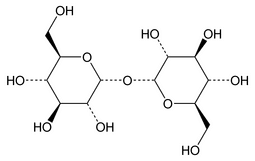
C12H22O11 342.30
C12H22O11·2H2O 378.33
 -d-Glucopyranosyl -d-glucopyranoside.
Anhydrous [99-20-7].
Dihydrate[6138-23-4].
+'&img=../../images/v35300/cas-99-20-7.gif&casNumber=99-20-7&usp=35&nf=30&chemicalStructureImage=true&ID='+parent.myID,600,500);)
C12H22O11 342.30
C12H22O11·2H2O 378.33
-d-Glucopyranosyl -d-glucopyranoside.
Anhydrous
[99-20-7].Dihydrate
[6138-23-4].DEFINITION
Trehalose is a stable, nonreducing disaccharide with two glucose molecules linked in an ,-1,1 configuration. It is obtained through enzymatic conversion of food-grade starch. It contains NLT 97.0% and NMT 102.0% of C12H22O11, calculated on the anhydrous basis.
,-1,1 configuration. It is obtained through enzymatic conversion of food-grade starch. It contains NLT 97.0% and NMT 102.0% of C12H22O11, calculated on the anhydrous basis.IDENTIFICATION
• B.
Sample solution:
400 mg/mL of Trehalose
Analysis:
Add 0.4 mL of a solution containing 1-naphthol in 95% alcohol (1 in 20) to 1 mL of the Sample solution. Gently add 2 mL of sulfuric acid to the solution.
Acceptance criteria:
A violet color develops at the interface between the two solutions.
• C.
Glycine solution:
40 mg/mL of Glycine
Sample solution:
40 mg/mL of Trehalose
Analysis:
Add 1 mL of diluted hydrochloric acid to 2 mL of the Sample solution. Allow to stand for 20 min at room temperature. Add 4 mL of sodium hydroxide TS and 2 mL of the Glycine solution to the Sample solution. Heat the solution for 10 min in boiling water.
Acceptance criteria:
A brown color does not develop.
ASSAY
• Procedure
Mobile phase:
Water
Standard solution:
10 mg/mL of USP Trehalose RS, calculated on the anhydrous basis
Sample solution:
10 mg/mL of Trehalose, calculated on the anhydrous basis
Chromatographic system
Mode:
LC
Detector:
Refractive index
Column:
8-mm × 30-cm; packing L58
Temperature
Detector:
40
Column:
80
Flow rate:
Adjust so that the retention time of trehalose is about 15 min.
Injection size:
20 µL
System suitability
Sample:
Standard solution
Suitability requirements
Relative standard deviation:
NMT 2.0%
Analysis
Samples:
Standard solution and Sample solution
Calculate the percentage of trehalose (C12H22O11) in the portion of Trehalose taken:
Result = (rU/rS) × (CS/CU) × 100
| rU | = | = peak response of the Sample solution |
| rS | = | = peak response of the Standard solution |
| CS | = | = concentration of USP Trehalose RS in the Standard solution (mg/mL) |
| CU | = | = concentration of Trehalose in the Sample solution (mg/mL) |
Acceptance criteria:
97.0%–102.0% on the anhydrous basis
IMPURITIES
• Residue on Ignition  281
281 :
NMT 0.1%, determined on 2.0 g of Trehalose
:
NMT 0.1%, determined on 2.0 g of Trehalose
281:
NMT 0.1%, determined on 2.0 g of Trehalose
• Heavy Metals, Method I 231
231
Sample:
4.0 g
Monitor preparation:
Prepare with 2.5 mL of Standard Lead Solution.
Acceptance criteria:
NMT 5 ppm
• Related Substances
Mobile phase and Chromatographic system:
Prepare as directed in the Assay.
Sample solution:
10 mg/mL of Trehalose
Standard solution:
0.1 mg/mL of Sample solution
System suitability solution:
Dissolve 2.5 mL of Sample solution, 25 mg of maltotriose, and 25 mg of glucose, and dilute with water to 10.0 mL.
System suitability
Sample:
System suitability solution
[Note—The relative retention times for maltotriose, trehalose, and glucose are about 0.9, 1.0, and 1.2, respectively. ]
Suitability requirements
Resolution:
NLT 1.5 between trehalose and maltotriose
Relative standard deviation:
NMT 2.0% for the trehalose peak
Analysis
Samples:
Sample solution and Standard solution
Determine the peak areas for all peaks.
Acceptance criteria:
For the Sample solution, the areas of any peaks corresponding to maltotriose and other polysaccharrides and eluting before trehalose are NMT half of the area of the peak corresponding to trehalose in the chromatogram of the Standard solution (0.5%). The areas of any peaks corresponding to glucose and eluting after trehalose are NMT half of the area of the peak corresponding to trehalose in the chromatogram of the Standard solution (0.5%).
SPECIFIC TESTS
• Color and Clarity of Solution
851), measure the absorbances of the Sample solution at 420 and 720 nm in a 10-cm cuvette. The absorbance of the Sample solution at 720 nm is NMT 0.050.
Sample solution:
33 g of Trehalose in 67 g of recently boiled water
Analysis
Using a suitable spectrophotometer (see Spectrophotometry and Light-Scattering 851), measure the absorbances of the Sample solution at 420 and 720 nm in a 10-cm cuvette. The absorbance of the Sample solution at 720 nm is NMT 0.050.
Determine the absorbance difference:
Result = A420  A720
A720
A720
| A420 | = | = absorbance of the Sample solution at 420 nm |
| A720 | = | = absorbance of the Sample solution at 720 nm |
Acceptance criteria:
The absorbance difference is NMT 0.100.
• Microbial Enumeration Tests 61 and Tests for Specified Microorganisms 62:
The total aerobic microbial count is NMT 100 cfu/g, and the total combined molds and yeasts count is NMT 100 cfu/g. It meets the requirements of the tests for absence of Salmonella species and Escherichia coli.
61 and Tests for Specified Microorganisms 62:
The total aerobic microbial count is NMT 100 cfu/g, and the total combined molds and yeasts count is NMT 100 cfu/g. It meets the requirements of the tests for absence of Salmonella species and Escherichia coli.
• Water Determination, Method I 921:
For the anhydrous form, NMT 1.0%; for the dihydrate form, 9.0%–11.0%
921:
For the anhydrous form, NMT 1.0%; for the dihydrate form, 9.0%–11.0%
Sample:
0.1g
• Bacterial Endotoxins Test 85:
If labeled for use in preparing parenteral dosage forms, it also meets the following requirements. The level of bacterial endotoxins is such that the requirement in the relevant dosage form monograph(s) in which Trehalose is used can be met. Where the label states that Trehalose must be subjected to further processing during the preparation of injectable dosage forms, the level of bacterial endotoxins is such that the requirement in the relevant dosage form monograph(s) in which Trehalose is used can be met.
85:
If labeled for use in preparing parenteral dosage forms, it also meets the following requirements. The level of bacterial endotoxins is such that the requirement in the relevant dosage form monograph(s) in which Trehalose is used can be met. Where the label states that Trehalose must be subjected to further processing during the preparation of injectable dosage forms, the level of bacterial endotoxins is such that the requirement in the relevant dosage form monograph(s) in which Trehalose is used can be met.
• Chloride and Sulfate, Chloride 221:
A 2.0-g sample shows no more chloride than corresponds to 0.70 mL of 0.01 M hydrochloric acid (NMT 0.0125%).
221:
A 2.0-g sample shows no more chloride than corresponds to 0.70 mL of 0.01 M hydrochloric acid (NMT 0.0125%).
• Chloride and Sulfate, Sulfate 221:
A 2.0-g sample shows no more sulfate than corresponds to 0.83 mL of 0.005 M sulfuric acid (NMT 0.0200%).
221:
A 2.0-g sample shows no more sulfate than corresponds to 0.83 mL of 0.005 M sulfuric acid (NMT 0.0200%).
• Nitrogen Content, Method I 461
461
Sample:
5.0 g
Analysis:
Proceed as directed for Method I, increasing the sulfuric acid used for digestion to 30 mL and reducing the sodium hydroxide solution (2 in 5) to 45 mL.
Acceptance criteria:
NMT 0.005%
• Soluble Starch
Sample solution:
10% Trehalose (w/v)
Analysis:
Add several drops of iodine TS to the Sample solution.
Acceptance criteria:
No blue color develops.
ADDITIONAL REQUIREMENTS
• Packaging and Storage:
Preserve in tight containers. No storage requirements specified.
• Labeling:
Where Trehalose is intended for use in the manufacture of injectable dosage forms, it is so labeled. Where Trehalose must be subjected to further processing during the preparation of injectable dosage forms to ensure acceptable levels of bacterial endotoxins, it is so labeled.
') + '&img=../../images/v35300/cas-56-81-5.gif',600,500);)
Auxiliary Information—
Please check for your question in the FAQs before contacting USP.
| Topic/Question | Contact | Expert Committee |
|---|---|---|
| Monograph | Robert H. Lafaver, M.S.
Scientific Liaison 1-301-816-8335 |
(EXC2010) Monographs - Excipients |
| 61 |
Radhakrishna S Tirumalai, Ph.D.
Principal Scientific Liaison 1-301-816-8339 |
(GCM2010) General Chapters - Microbiology |
| 62 |
Radhakrishna S Tirumalai, Ph.D.
Principal Scientific Liaison 1-301-816-8339 |
(GCM2010) General Chapters - Microbiology |
| 85 |
Radhakrishna S Tirumalai, Ph.D.
Principal Scientific Liaison 1-301-816-8339 |
(GCM2010) General Chapters - Microbiology |
| Reference Standards | RS Technical Services 1-301-816-8129 rstech@usp.org |
USP35–NF30 Page 2007
Pharmacopeial Forum: Volume No. 34(3) Page 677