Warfarin Sodium
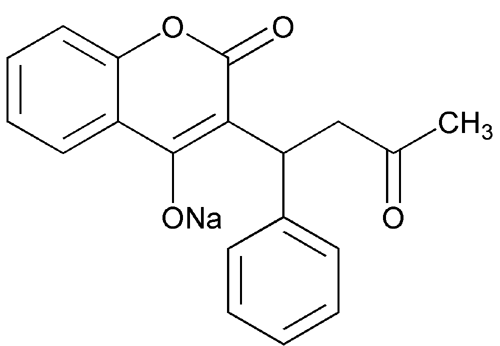
 330.31
2H-1-Benzopyran-2-one, 4-hydroxy-3-(3-oxo-1-phenylbutyl)-, sodium salt.
3-(
 -Acetonylbenzyl)-4-hydroxycoumarin sodium salt
[129-06-6].
-Acetonylbenzyl)-4-hydroxycoumarin sodium salt
[129-06-6].» Warfarin Sodium is an amorphous solid or a crystalline clathrate. The clathrate form consists principally of warfarin sodium and isopropyl alcohol, in a 2:1 molecular ratio; it contains not less than 8.0 percent and not more than 8.5 percent of isopropyl alcohol. Warfarin Sodium contains not less than 97.0 percent and not more than 102.0 percent of C19H15NaO4, calculated on the anhydrous basis for the amorphous form or on the anhydrous and isopropyl alcohol-free basis for the crystalline form.
Packaging and storage—
Preserve in well-closed, light-resistant containers.
Labeling—
Label it to indicate whether it is the amorphous or the crystalline form.
Identification—
A:
Infrared Absorption  197K
197K —
—
197K—
Standard specimen—
Use USP Warfarin RS.
Test specimen—
Dissolve about 100 mg in 25 mL of water, and adjust with hydrochloric acid to a pH of less than 3, using short-range pH indicator paper. Stir the mixture, and allow the precipitate to coagulate. Filter the mixture, and retain the filtrate for Identification test C. Wash the precipitate with four 5-mL portions of water, and dry in vacuum over phosphorus pentoxide for 4 hours. Use the warfarin obtained to prepare the Test specimen.
B:
The retention time of the major peak in the chromatogram of the Assay preparation corresponds to that of the Standard preparation, as obtained in the Assay.
C:
The filtrate obtained in Identification test A meets the requirements of the flame test for Sodium 191.
191.
pH 791:
between 7.2 and 8.3, in a solution (1 in 100).
791:
between 7.2 and 8.3, in a solution (1 in 100).
Water, Method I 921:
not more than 4.5% for the amorphous form; not more than 0.3% for the crystalline clathrate form.
921:
not more than 4.5% for the amorphous form; not more than 0.3% for the crystalline clathrate form.
Heavy metals 231—
Dissolve 4.0 g in 45 mL of water, add 5 mL of glacial acetic acid, stir until the precipitate agglomerates, filter, and use 25 mL of the filtrate, employing glacial acetic acid, if necessary, to make the pH adjustment: the limit is 0.001%.
231—
Dissolve 4.0 g in 45 mL of water, add 5 mL of glacial acetic acid, stir until the precipitate agglomerates, filter, and use 25 mL of the filtrate, employing glacial acetic acid, if necessary, to make the pH adjustment: the limit is 0.001%.
Absorbance in alkaline solution—
Dissolve 1.25 g, accurately weighed, in 10 mL of sodium hydroxide solution (1 in 20), filter through a membrane filter, and within 15 minutes determine the absorbance of the solution in a 1-cm cell at 385 nm, with a suitable spectrophotometer, using sodium hydroxide solution (1 in 20) as the blank: the absorbance does not exceed 0.1.
Chromatographic purity—
Solvent mixture—
Prepare a mixture of water and methanol (75:25).
Mobile phase—
Prepare a filtered and degassed mixture of water, acetonitrile, and glacial acetic acid (68:32:1). Make adjustments if necessary (see System Suitability under Chromatography 621).
621).
Standard solution—
Transfer an accurately weighed quantity of about 24 mg of USP Warfarin RS and 24 mg of USP Warfarin Related Compound A RS to a 200-mL volumetric flask, add 4.0 mL of 0.1 N sodium hydroxide, 50 mL of methanol, and dissolve. Dilute with water to volume, and mix. Transfer 10.0 mL of this solution to a 200-mL volumetric flask, dilute with Solvent mixture to volume, and mix. Transfer 20.0 mL of this solution to a 50-mL volumetric flask, dilute with Solvent mixture to volume, and mix.
Test solution—
Transfer an accurately weighed quantity of about 80 mg of Warfarin Sodium to a 100-mL volumetric flask, dissolve in and dilute with Solvent mixture to volume, and mix.
Chromatographic system (see Chromatography 621)—
The liquid chromatograph is equipped with a 260-nm detector and a 4.6-mm × 25-cm column that contains packing L10. The flow rate is about 1.5 mL per minute. Chromatograph the Standard solution, and record the chromatogram as directed for Procedure: the resolution, R, between warfarin and warfarin related compound A is not less than 3; and the relative standard deviation for replicate injections is not more than 5.0%.
621)—
The liquid chromatograph is equipped with a 260-nm detector and a 4.6-mm × 25-cm column that contains packing L10. The flow rate is about 1.5 mL per minute. Chromatograph the Standard solution, and record the chromatogram as directed for Procedure: the resolution, R, between warfarin and warfarin related compound A is not less than 3; and the relative standard deviation for replicate injections is not more than 5.0%.
Procedure—
Separately inject equal volumes (about 50 µL) of the Standard solution and the Test solution into the chromatograph, record the chromatograms, and measure the responses for all of the peaks. The relative retention times of warfarin and warfarin related compound A are 1.0 and about 1.2, respectively. Calculate the percentage of each impurity in the portion of Warfarin Sodium taken by the formula:
10,000(C / M)(ri / rS)
in which C is the concentration, in mg per mL, of warfarin sodium in the Standard solution; M is the quantity, in mg, of warfarin sodium taken to prepare the Test solution; ri is the peak response of the individual impurity; and rS is the peak response due to warfarin in the Standard solution: not more than 0.3% of any individual impurity and not more than 1.0% of total impurities is found.
Isopropyl alcohol content (crystalline clathrate form)—
Internal standard solution—
Dilute 2 mL of n-propyl alcohol with water to 100.0 mL in a volumetric flask.
Standard preparation—
Transfer an accurately weighed quantity of about 1.6 g of isopropyl alcohol to a 100-mL volumetric flask, dilute with water to volume, and mix. Transfer 10.0 mL of this solution to a 100-mL volumetric flask, add 10.0 mL of the Internal standard solution, dilute with water to volume, and mix to obtain a Standard preparation having a known concentration of about 1.6 mg of isopropyl alcohol per mL.
Test preparation—
Dissolve an accurately weighed quantity of about 1.85 g of Warfarin Sodium in about 50 mL of water in a 100-mL volumetric flask. Add 10.0 mL of the Internal standard solution, dilute with water to volume, and mix.
Chromatographic system (see Chromatography 621)—
The gas chromatograph is equipped with a flame-ionization detector and a 4-mm × 1.8-m column packed with 80- to 100-mesh support S2. The temperatures of the column, injector, and the detector are maintained at about 140 , 200, and 250, respectively. The carrier gas is nitrogen, flowing at the rate of about 40 mL per minute. The column temperature may be varied so that the following system suitability criteria are met: the resolution, R, between n-propyl alcohol and isopropyl alcohol is not less than 2.0; the tailing factor, T, for the isopropyl alcohol peak is not more than 1.5; and the relative standard deviation of the ratio of isopropyl alcohol area to n-propyl alcohol area for five replicate injections of the Standard preparation is not more than 2.0%.
621)—
The gas chromatograph is equipped with a flame-ionization detector and a 4-mm × 1.8-m column packed with 80- to 100-mesh support S2. The temperatures of the column, injector, and the detector are maintained at about 140, 200, and 250, respectively. The carrier gas is nitrogen, flowing at the rate of about 40 mL per minute. The column temperature may be varied so that the following system suitability criteria are met: the resolution, R, between n-propyl alcohol and isopropyl alcohol is not less than 2.0; the tailing factor, T, for the isopropyl alcohol peak is not more than 1.5; and the relative standard deviation of the ratio of isopropyl alcohol area to n-propyl alcohol area for five replicate injections of the Standard preparation is not more than 2.0%.
Procedure—
Separately inject equal volumes (about 5 µL) of the Standard preparation and the Test preparation into the chromatograph, record the chromatograms, and measure the areas of the major peaks. Calculate the weight, in mg, of the major peaks. Calculate the weight, in mg, of isopropyl alcohol in the portion of Warfarin Sodium taken by the formula:
100C(RU / RS)
in which C is the concentration, in mg per mL, of isopropyl alcohol in the Standard preparation; and RU and RS are the peak area ratios of isopropyl alcohol to n-propyl alcohol obtained from the Test preparation and the Standard preparation, respectively.
Assay—
pH 7.4 Buffer—
Transfer 1.36 g of monobasic potassium phosphate to a 200-mL volumetric flask, and dissolve in 50 mL of water. Add 39.1 mL of 0.2 N sodium hydroxide, and dilute with water to volume. Adjust with sodium hydroxide or phosphoric acid to a pH of 7.4 ± 0.1.
Mobile phase—
Prepare a degassed solution containing a mixture of methanol, water, and glacial acetic acid (64:36:1). Adjust the ratio as necessary.
Standard preparation—
Transfer about 94 mg of USP Warfarin RS, accurately weighed, to a 250-mL volumetric flask, and dissolve in 97.8 mL of 0.1 N sodium hydroxide. Add 62.5 mL of 0.2 M monobasic potassium phosphate, dilute with water to volume, and mix. Pipet 5 mL of this solution and 15 mL of pH 7.4 Buffer into a conical flask, and mix.
Assay preparation—
Using about 100 mg of Warfarin Sodium, accurately weighed, prepare as directed for Standard preparation.
Chromatographic system (see Chromatography 621)—
The liquid chromatograph is equipped with a 280-nm detector and a 4.6-mm × 25-cm column that contains packing L7. The flow rate is about 1.4 mL per minute. Chromatograph five replicate injections of the Standard preparation, and record the peak responses as directed for Procedure: the relative standard deviation of the warfarin responses is not more than 2.0%.
621)—
The liquid chromatograph is equipped with a 280-nm detector and a 4.6-mm × 25-cm column that contains packing L7. The flow rate is about 1.4 mL per minute. Chromatograph five replicate injections of the Standard preparation, and record the peak responses as directed for Procedure: the relative standard deviation of the warfarin responses is not more than 2.0%.
Procedure—
Separately inject equal volumes (about 20 µL) of the Standard preparation and the Assay preparation into the chromatograph, record the chromatograms, and measure the responses for the major peaks. Calculate the quantity, in mg, of C19H15NaO4 in the portion of Warfarin Sodium taken by the formula:
(330.31 / 308.34)C(rU / rS)
in which 330.31 and 308.34 are the molecular weights of warfarin sodium and warfarin, respectively; C is the concentration, in µg per mL, of USP Warfarin RS in the Standard preparation; and rU and rS are the peak responses of warfarin obtained from the Assay preparation and the Standard preparation, respectively.
Auxiliary Information—
Please check for your question in the FAQs before contacting USP.
Chromatographic Column—
| Topic/Question | Contact | Expert Committee |
| Monograph | Feiwen Mao, M.S.
Scientist 1-301-816-8320 |
(MDOOD05) Monograph Development-Ophthalmics Oncologics and Dermatologicals |
| Reference Standards | Lili Wang, Technical Services Scientist 1-301-816-8129 RSTech@usp.org |
USP32–NF27 Page 3868
Pharmacopeial Forum: Volume No. 33(3) Page 468
Chromatographic columns text is not derived from, and not part of, USP 32 or NF 27.