Sucralose
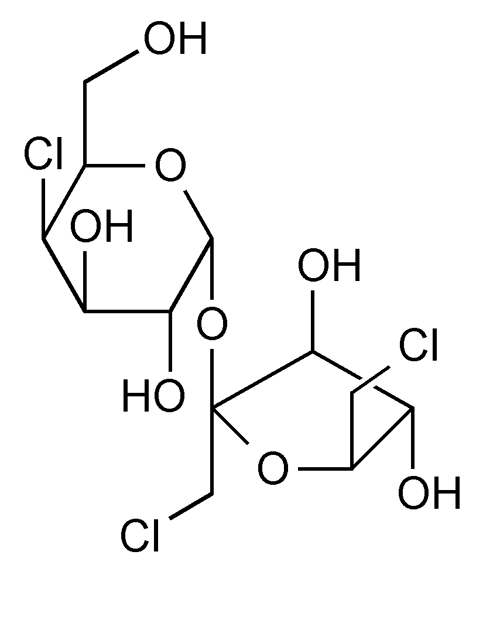
 397.64
1,6-Dichloro-1,6-dideoxy-
 -d-fructofuranosyl-4-chloro-4-deoxy-
 -d-galactopyranoside.
1¢,4,6¢-Trichlorogalactosucrose
[56038-13-2].» Sucralose contains not less than 98.0 percent and not more than 102.0 percent of C12H19Cl3O8, calculated on the anhydrous basis.
Packaging and storage—
Preserve in well-closed containers, in a cool, dry place, at a temperature not exceeding 21 .
.
.
Identification—
B:
The retention time of the principal peak in the chromatogram of the Assay preparation corresponds to that in the chromatogram of the Standard preparation, as obtained in the Assay.
C:
The RF value of the principal spot in the chromatogram of the Test solution corresponds to that of Standard solution 1, as obtained in the test for Related compounds.
Specific rotation  781S
781S :
between +84.0 and +87.5, determined at 20.
:
between +84.0 and +87.5, determined at 20.
781S:
between +84.0 and +87.5, determined at 20.
Test solution:
10 mg per mL, in water.
Water, Method I 921:
not more than 2.0%.
921:
not more than 2.0%.
Residue on ignition 281:
not more than 0.7%.
281:
not more than 0.7%.
Heavy metals, Method II 231:
0.001%.
231:
0.001%.
Limit of hydrolysis products—
[note—This test does not require a developing solvent.]
Adsorbent:
0.25-mm layer of chromatographic silica gel.
Spray reagent—
Dissolve about 1.23 g of p-anisidine and 1.66 g of phthalic acid in 100 mL of methanol. Store the solution in the dark and refrigerate to prevent discoloration. Discard if the solution becomes discolored. [Caution—p-Anisidine is toxic if inhaled or if absorbed through the skin.
]
Standard solution 1—
Transfer about 10.0 g of mannitol to a 100-mL volumetric flask, dissolve in and dilute with water to volume, and mix.
Standard solution 2—
Transfer about 40.0 mg of fructose and 10.0 g of mannitol to a 100-mL volumetric flask, dissolve in 25 mL of water, dilute with water to volume, and mix.
Test solution—
Transfer about 2.5 g of Sucralose, accurately weighed, to a 10-mL volumetric flask, dissolve in about 5 mL of methanol, dilute with methanol to volume, and mix.
Application volume:
5-µL portions separately applied in 1-µL increments, allowing the plate to dry between applications.
Procedure—
Proceed as directed for Thin-Layer Chromatography under Chromatography 621. Spray the plate with Spray reagent, and heat the plate at 100 ± 2 for 15 minutes. If the spot from Standard solution 1 has darkened, repeat the test, heating for a shorter period of time. Immediately after heating, view the plate against a dark background: the color of the spot obtained from the Test solution is not more intense than that obtained from Standard solution 2 (0.1%).
621. Spray the plate with Spray reagent, and heat the plate at 100 ± 2 for 15 minutes. If the spot from Standard solution 1 has darkened, repeat the test, heating for a shorter period of time. Immediately after heating, view the plate against a dark background: the color of the spot obtained from the Test solution is not more intense than that obtained from Standard solution 2 (0.1%).
Limit of methanol—
Internal standard solution—
Mix a suitable quantity of n-propyl alcohol with pyridine, and dilute quantitatively with pyridine to obtain a solution containing about 0.1 µL of n-propyl alcohol per mL.
Standard solution—
Transfer 2.0 mL of methanol to a 100-mL volumetric flask, dilute with Internal standard solution to volume, and mix. Transfer 1.0 mL of this solution to a 100-mL volumetric flask, dilute with Internal standard solution to volume, and mix.
Test solution—
Transfer about 2 g of Sucralose, accurately weighed, to a 10-mL volumetric flask, dilute with Internal standard solution to volume, and mix.
Chromatographic system
(see Chromatography 621)—The gas chromatograph is equipped with a flame-ionization detector and a 4-mm × 2-m glass column packed with 80- to 100-mesh silanized support S6. The injection port is maintained at about 200, the detector is maintained at about 250, and the column is maintained at 150. Helium is used as the carrier gas, flowing at a rate of about 20 mL per minute. Chromatograph the Standard solution, and record the peak responses as directed for Procedure: the relative standard deviation for replicate injections is not more than 2.0%.
621)—The gas chromatograph is equipped with a flame-ionization detector and a 4-mm × 2-m glass column packed with 80- to 100-mesh silanized support S6. The injection port is maintained at about 200, the detector is maintained at about 250, and the column is maintained at 150. Helium is used as the carrier gas, flowing at a rate of about 20 mL per minute. Chromatograph the Standard solution, and record the peak responses as directed for Procedure: the relative standard deviation for replicate injections is not more than 2.0%.
Procedure—
Separately inject equal volumes (about 1 µL) of the Standard solution and the Test solution into the chromatograph, record the chromatograms, and measure the areas for the major peaks. Calculate the percentage of methanol in the portion of Sucralose taken by the formula:
0.79(C / W)(RU / RS)
in which 0.79 is the specific gravity of methanol; C is the concentration, in µL per mL, of methanol in the Standard solution; W is the weight, in g, of Sucralose taken to prepare the Test solution; and RU and RS are the peak response ratios of the methanol peak relative to the n-propyl alcohol peak obtained from the Test solution and the Standard solution, respectively: not more than 0.1% of methanol is found.
Related compounds—
Adsorbent:
0.20-mm layer of octadecylsilanized chromatographic silica gel. The thin-layer chromatographic plate also has a preadsorbent zone.
Detection reagent—
Prepare a solution of sulfuric acid in methanol (3 in 20).
Standard solution 1—
Quantitatively dissolve an accurately weighed quantity of USP Sucralose RS in methanol to obtain a solution having a known concentration of about 10.0 mg per mL.
Standard solution 2—
Transfer 0.5 mL of Standard solution 1 to a 10-mL volumetric flask, and dilute with methanol to volume.
Test solution—
Prepare a solution in methanol containing about 100.0 mg of Sucralose per mL.
Developing solvent system:
a mixture of sodium chloride solution (1 in 20) and acetonitrile (7:3).
Application volume:
5 µL.
Procedure—
Proceed as directed for Thin-Layer Chromatography under Chromatography 621. Spray the plate with Detection reagent. Heat the plate for 10 minutes at 125: the RF value of the principal spot obtained from the Test solution corresponds to that obtained from Standard solution 1, and the color of any other single spot obtained from the Test solution is not more intense than that of the principal spot obtained from the Standard solution 2 (0.5%).
621. Spray the plate with Detection reagent. Heat the plate for 10 minutes at 125: the RF value of the principal spot obtained from the Test solution corresponds to that obtained from Standard solution 1, and the color of any other single spot obtained from the Test solution is not more intense than that of the principal spot obtained from the Standard solution 2 (0.5%).
Assay—
Mobile phase—
Prepare a filtered and degassed mixture of water and acetonitrile (17:3). Make adjustments if necessary (see System Suitability under Chromatography 621).
621).
Standard preparation—
Dissolve an accurately weighed quantity of USP Sucralose RS in Mobile phase, and dilute quantitatively, and stepwise if necessary, with Mobile phase to obtain a solution having a known concentration of about 1 mg per mL.
Assay preparation—
Transfer about 25 mg of Sucralose, accurately weighed, to a 25-mL volumetric flask, dissolve in and dilute with Mobile phase to volume, and mix.
Chromatographic system
(see Chromatography 621)—The liquid chromatograph is equipped with a refractive index detector and a 8-mm × 10-cm column that contains packing L1. Maintain the flow rate at about 1.5 mL per minute, so that the retention time for the sucralose peak is about 9 minutes. Chromatograph the Standard preparation, and record the peak responses as directed for Procedure: the relative standard deviation for replicate injections is not more than 2.0%.
621)—The liquid chromatograph is equipped with a refractive index detector and a 8-mm × 10-cm column that contains packing L1. Maintain the flow rate at about 1.5 mL per minute, so that the retention time for the sucralose peak is about 9 minutes. Chromatograph the Standard preparation, and record the peak responses as directed for Procedure: the relative standard deviation for replicate injections is not more than 2.0%.
Procedure—
Separately inject equal volumes (about 20 µL) of the Standard preparation and the Assay preparation into the chromatograph, record the chromatograms, and measure the areas for the major peaks. Calculate the quantity, in mg, of C12H19Cl3O8 in the portion of Sucralose taken by the formula:
25C(rU / rS)
in which C is the concentration, in mg per mL, of USP Sucralose RS in the Standard preparation; and rU and rS are the peak responses obtained from the Assay preparation and the Standard preparation, respectively.
Auxiliary Information—
Please check for your question in the FAQs before contacting USP.
Chromatographic Column—
| Topic/Question | Contact | Expert Committee |
| Monograph | Robert H. Lafaver, B.A.
Scientist 1-301-816-8335 |
(EM105) Excipient Monographs 1 |
| Reference Standards | Lili Wang, Technical Services Scientist 1-301-816-8129 RSTech@usp.org |
USP32–NF27 Page 1362
Pharmacopeial Forum: Volume No. 33(6) Page 1255
Chromatographic columns text is not derived from, and not part of, USP 32 or NF 27.