Sorbitol
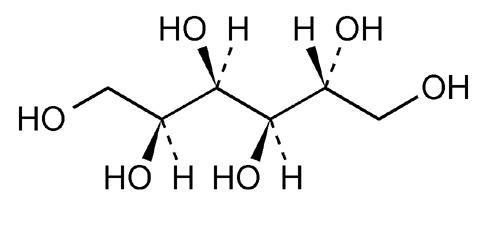
 182.17
d-Glucitol.
d-Glucitol
[50-70-4].» Sorbitol contains not less than 91.0 percent and not more than 100.5 percent of d-sorbitol, calculated on the anhydrous basis. The amounts of total sugars, other polyhydric alcohols, and any hexitol anhydrides, if detected, are not included in the requirements, nor in the calculated amount under Other Impurities.
Packaging and storage—
Preserve in well-closed containers. No storage requirements specified.
Labeling—
Sorbitol intended for use in preparing parenteral dosage forms is so labeled.
Identification—
A:
Dissolve 1 g of Sorbitol in 75 mL of water. Transfer 3 mL of this solution to a 15-cm test tube, add 3 mL of freshly prepared catechol solution (1 in 10), and mix. Add 6 mL of sulfuric acid, mix again, then gently heat the tube in a flame for about 30 seconds: a deep pink or wine-red color appears.
B:
The retention time of the major peak in the chromatogram of the Assay preparation corresponds to that in the chromatogram of the Standard preparation, as obtained in the Assay.
Microbial enumeration tests  61
61 and Tests for specified microorganisms 62—
The total aerobic count using the Plate Method is not more than 1000 cfu per g and the total combined molds and yeasts count is not more than 100 cfu per g.
and Tests for specified microorganisms 62—
The total aerobic count using the Plate Method is not more than 1000 cfu per g and the total combined molds and yeasts count is not more than 100 cfu per g.
61 and Tests for specified microorganisms 62—
The total aerobic count using the Plate Method is not more than 1000 cfu per g and the total combined molds and yeasts count is not more than 100 cfu per g.
pH 791:
between 3.5 and 7.0, in a 10% (w/w) solution in carbon dioxide-free water.
791:
between 3.5 and 7.0, in a 10% (w/w) solution in carbon dioxide-free water.
Water, Method I 921:
not more than 1.5%.
921:
not more than 1.5%.
Residue on ignition 281:
not more than 0.1%, determined on a 1.5-g portion, accurately weighed.
281:
not more than 0.1%, determined on a 1.5-g portion, accurately weighed.
Reducing sugars—
Dissolve 3.3 g of Sorbitol in 3 mL of water with the aid of gentle heat. Cool, and add 20.0 mL of cupric citrate TS and a few glass beads. Heat so that boiling begins after 4 minutes, and maintain boiling for 3 minutes. Cool rapidly, and add 40 mL of diluted acetic acid, 60 mL of water, and 20.0 mL of 0.05 N iodine VS. With continuous shaking, add 25 mL of a mixture of 6 mL of hydrochloric acid and 94 mL of water. When the precipitate has dissolved, titrate the excess of iodine with 0.05 N sodium thiosulfate VS using 2 mL of starch TS, added towards the end of the titration, as an indicator. Not less than 12.8 mL of 0.05 N sodium thiosulfate VS is required, corresponding to not more than 0.3% of reducing sugars, as glucose. The amount determined in this test is not included in the calculated amount under Other Impurities.
Limit of nickel—
Test solution—
Dissolve 20.0 g of Sorbitol in diluted acetic acid, and dilute with diluted acetic acid to 150 mL. Add 2.0 mL of a saturated ammonium pyrrolidinedithiocarbamate solution (containing about 10 g of ammonium pyrrolidinedithiocarbamate per L) and 10.0 mL of methyl isobutyl ketone, and shake for 30 seconds. Protect from bright light. Allow the two layers to separate, and use the methyl isobutyl ketone layer.
Blank solution—
Prepare as directed for Test solution, except to omit the use of Sorbitol.
Standard solutions—
Prepare as directed for Test solution, except to prepare three solutions by adding 0.5 mL, 1.0 mL, and 1.5 mL of nickel standard solution TS.
Procedure—
Set the instrument to zero using the Blank solution. Concomitantly determine the absorbances of the Standard solutions and the Test solution at least three times each, at the wavelength of maximum absorbance at 232.0 nm, with a suitable atomic absorption spectrophotometer (see Spectrophotometry and Light-Scattering 851) equipped with a nickel hollow-cathode lamp and an air–acetylene flame. Record the average of the steady readings for each of the Standard solutions and the Test solution. Between each measurement, aspirate the Blank solution, and ascertain that the reading returns to zero. Plot the absorbances of the Standard solutions and the Test solution versus the added quantity of nickel. Extrapolate the line joining the points on the graph until it meets the concentration axis. The distance between this point and the intersection of the axes represents the concentration of nickel in the Test solution: not more than 1 µg per g is found.
851) equipped with a nickel hollow-cathode lamp and an air–acetylene flame. Record the average of the steady readings for each of the Standard solutions and the Test solution. Between each measurement, aspirate the Blank solution, and ascertain that the reading returns to zero. Plot the absorbances of the Standard solutions and the Test solution versus the added quantity of nickel. Extrapolate the line joining the points on the graph until it meets the concentration axis. The distance between this point and the intersection of the axes represents the concentration of nickel in the Test solution: not more than 1 µg per g is found.
Other requirements—
If labeled for use in preparing parenteral dosage forms, it also meets the following requirements.
Clarity and color of solution—
Dissolve a 10.0-g portion in carbon dioxide-free water, and dilute with carbon dioxide-free water to 100.0 mL: the solution is clear and colorless.
Bacterial endotoxins 85:
not more than 4 USP Endotoxin Units per g for parenteral dosage forms having a concentration of less than 100 g of sorbitol per L and not more than 2.5 USP Endotoxin Units per g for parenteral dosage forms having a concentration of 100 g or more of sorbitol per L.
85:
not more than 4 USP Endotoxin Units per g for parenteral dosage forms having a concentration of less than 100 g of sorbitol per L and not more than 2.5 USP Endotoxin Units per g for parenteral dosage forms having a concentration of 100 g or more of sorbitol per L.
Chloride 221—
A 1.5-g portion shows no more chloride than corresponds to 0.10 mL of 0.020 N hydrochloric acid. Not more than 0.0050% is found.
221—
A 1.5-g portion shows no more chloride than corresponds to 0.10 mL of 0.020 N hydrochloric acid. Not more than 0.0050% is found.
Sulfate 221—
A 1.0-g portion shows no more sulfate than corresponds to 0.10 mL of 0.020 N sulfuric acid. Not more than 0.01% is found.
221—
A 1.0-g portion shows no more sulfate than corresponds to 0.10 mL of 0.020 N sulfuric acid. Not more than 0.01% is found.
Assay—
Mobile phase—
Use degassed water.
Resolution solution—
Dissolve mannitol and USP Sorbitol RS in water to obtain a solution having concentrations of about 4.8 mg per g of each.
Standard preparation—
Dissolve an accurately weighed quantity of USP Sorbitol RS in water to obtain a solution having a known concentration of about 4.8 mg per g.
Assay preparation—
Dissolve about 0.10 g of Sorbitol, accurately weighed, in water, and dilute with water to about 20 g. Accurately record the final solution weight, and mix thoroughly.
Chromatographic system (see Chromatography 621)—
The liquid chromatograph is equipped with a refractive index detector that is maintained at a constant temperature of about 35 and a 7.8-mm × 10-cm column that contains packing L34. The column temperature is maintained at a constant temperature of about 50, controlled within ±2, and the flow rate is about 0.7 mL per minute. Chromatograph the Standard preparation, and record the peak responses as directed for Procedure: the relative standard deviation for replicate injections is not more than 2.0%. Chromatograph the Resolution solution, and record the peak responses as directed for Procedure: the relative retention times are about 0.6 for mannitol and 1.0 for sorbitol; and the resolution, R, between sorbitol and mannitol is not less than 2.0.
621)—
The liquid chromatograph is equipped with a refractive index detector that is maintained at a constant temperature of about 35 and a 7.8-mm × 10-cm column that contains packing L34. The column temperature is maintained at a constant temperature of about 50, controlled within ±2, and the flow rate is about 0.7 mL per minute. Chromatograph the Standard preparation, and record the peak responses as directed for Procedure: the relative standard deviation for replicate injections is not more than 2.0%. Chromatograph the Resolution solution, and record the peak responses as directed for Procedure: the relative retention times are about 0.6 for mannitol and 1.0 for sorbitol; and the resolution, R, between sorbitol and mannitol is not less than 2.0.
Procedure—
Separately inject equal volumes (about 10 µL) of the Assay preparation and the Standard preparation into the chromatograph, record the chromatograms, and measure the responses for the major peaks. Calculate the percentage, on the anhydrous basis, of d-sorbitol in the portion of Sorbitol taken by the formula:
[10,000(CS / CU)(rU / rS)] / (100 – W)
in which CS is the concentration, in mg per g, of USP Sorbitol RS in the Standard preparation; CU is the concentration, in mg per g, of Sorbitol in the Assay preparation; rU and rS are the peak responses obtained from the Assay preparation and the Standard preparation, respectively; and W is the percentage obtained in the test for Water.
Auxiliary Information—
Please check for your question in the FAQs before contacting USP.
Chromatographic Column—
| Topic/Question | Contact | Expert Committee |
| Monograph | Robert H. Lafaver, B.A.
Scientist 1-301-816-8335 |
(EM105) Excipient Monographs 1 |
| Reference Standards | Lili Wang, Technical Services Scientist 1-301-816-8129 RSTech@usp.org |
|
| 61 |
Radhakrishna S Tirumalai, Ph.D.
Senior Scientist 1-301-816-8339 |
(MSA05) Microbiology and Sterility Assurance |
| 62 |
Radhakrishna S Tirumalai, Ph.D.
Senior Scientist 1-301-816-8339 |
(MSA05) Microbiology and Sterility Assurance |
| 85 |
Radhakrishna S Tirumalai, Ph.D.
Senior Scientist 1-301-816-8339 |
(MSA05) Microbiology and Sterility Assurance |
USP32–NF27 Page 1351
Pharmacopeial Forum: Volume No. 30(3) Page 992
Chromatographic columns text is not derived from, and not part of, USP 32 or NF 27.