Quinapril Hydrochloride
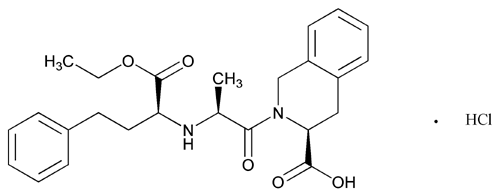
 474.98
3-Isoquinolinecarboxylic acid, 2-[2-[[1-(ethoxycarbonyl)-3-phenylpropyl]amino]-1-oxopropyl]-1,2,3,4-tetrahydro-, monohydrochloride, [3S-[2[R*(R*)],3R*]].
(S)-2-[(S)-N-[(S)-1-Carboxy-3-phenylpropyl]alanyl]-1,2,3,4-tetrahydro-3-isoquinolinecarboxylic acid, 1-ethyl ester, monohydrochloride
[82586-55-8].» Quinapril Hydrochloride contains not less than 98.5 percent and not more than 101.5 percent of C25H30N2O5·HCl, calculated on the anhydrous basis.
Packaging and storage—
Preserve in well-closed containers, and store at controlled room temperature.
USP Reference standards  11
11 —
—
USP Quinapril Hydrochloride RS.
USP Quinapril Related Compound A RS .
.
USP Quinapril Related Compound B RS .
11—
USP Quinapril Hydrochloride RS.
USP Quinapril Related Compound A RS
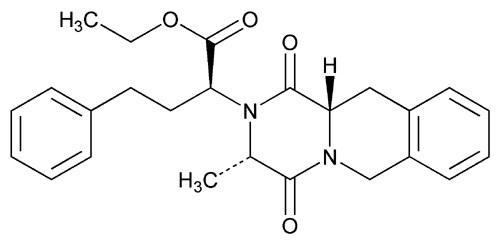 .
. USP Quinapril Related Compound B RS
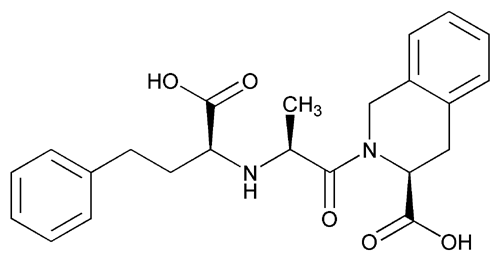 .
.
Identification—
B:
The retention time of the major peak in the chromatogram of the Assay preparation corresponds to that in the chromatogram of the Standard preparation, as obtained in the Assay.
Water, Method I 921:
not more than 1.0%.
921:
not more than 1.0%.
Residue on ignition 281:
not more than 0.1%.
281:
not more than 0.1%.
Heavy metals, Method II 231:
0.002%.
231:
0.002%.
Limit of residual solvents—
Standard stock solution—
Transfer about 50 mL of dimethylformamide to a 200-mL volumetric flask. Add about 75 mg each of acetone and acetonitrile and 30 mg each of methylene chloride and toluene, each accurately weighed by difference, and mix. Dilute with dimethylformamide to volume, and mix.
System suitability solution 1—
Transfer about 25 mL of dimethylformamide to a 50-mL volumetric flask. Add 35 µL of dehydrated alcohol and 25 µL of methylene chloride. Dilute with dimethylformamide to volume, and mix. Transfer 1.0 mL of this solution to a 50-mL volumetric flask, dilute with dimethylformamide to volume, and mix.
System suitability solution 2—
Transfer 2.0 mL of the Standard stock solution to a 50-mL volumetric flask, dilute with dimethylformamide to volume, and mix.
Standard solution—
Transfer 4.0 mL of the Standard stock solution to a 50-mL volumetric flask, dilute with dimethylformamide to volume, and mix.
Test solution—
Transfer about 60 mg of Quinapril Hydrochloride, accurately weighed, to a suitable headspace vial, add 5.0 mL of dimethylformamide, seal, and shake to dissolve.
Chromatographic system (see Chromatography 621)—
The gas chromatograph is equipped with a flame-ionization detector, a headspace sampler, a 0.53-mm × 30-m fused-silica column coated with a 1.0-µm film of phase G16, and a split injection system. The carrier gas is helium, flowing at a rate of 6 mL per minute. The split flow rate is about 100 mL per minute, with a back pressure of 3.5 psi. The oven temperature of the headspace sampler is maintained at 60 , and the vial pressure is maintained at 6.1 psi. The temperature of the headspace loop and transfer lines is maintained at 65. The vials are equilibrated for 10 minutes prior to injection, and injection occurs every 36 minutes. The chromatograph is programmed as follows. Initially the column temperature is maintained at 35 for 10 minutes, then the temperature is increased at a rate of 7 per minute to 150, and maintained at 150 for 4 minutes. The injection port temperature is maintained at 180, and the detector is maintained at 240. Chromatograph System suitability solution 1, and record the peak responses as directed for Procedure: the relative retention times are about 0.94 for methylene chloride and 1.0 for alcohol; the resolution, R, between methylene chloride and alcohol is not less than 1.2; the column efficiency, determined from the methylene chloride peak, is not less than 4900 theoretical plates; and the tailing factor for the methylene chloride peak is not more than 1.7. Chromatograph System suitability solution 2, and record the peak responses as directed for Procedure: the relative standard deviation for replicate injections is not more than 15.0%.
621)—
The gas chromatograph is equipped with a flame-ionization detector, a headspace sampler, a 0.53-mm × 30-m fused-silica column coated with a 1.0-µm film of phase G16, and a split injection system. The carrier gas is helium, flowing at a rate of 6 mL per minute. The split flow rate is about 100 mL per minute, with a back pressure of 3.5 psi. The oven temperature of the headspace sampler is maintained at 60, and the vial pressure is maintained at 6.1 psi. The temperature of the headspace loop and transfer lines is maintained at 65. The vials are equilibrated for 10 minutes prior to injection, and injection occurs every 36 minutes. The chromatograph is programmed as follows. Initially the column temperature is maintained at 35 for 10 minutes, then the temperature is increased at a rate of 7 per minute to 150, and maintained at 150 for 4 minutes. The injection port temperature is maintained at 180, and the detector is maintained at 240. Chromatograph System suitability solution 1, and record the peak responses as directed for Procedure: the relative retention times are about 0.94 for methylene chloride and 1.0 for alcohol; the resolution, R, between methylene chloride and alcohol is not less than 1.2; the column efficiency, determined from the methylene chloride peak, is not less than 4900 theoretical plates; and the tailing factor for the methylene chloride peak is not more than 1.7. Chromatograph System suitability solution 2, and record the peak responses as directed for Procedure: the relative standard deviation for replicate injections is not more than 15.0%.
Procedure—
Separately inject equal volumes (about 1 mL) of the gaseous headspace of the Standard solution and the Test solution into the chromatograph, record the chromatograms, and measure the areas for the major peaks. Separately calculate the percentages, by weight, of acetone, acetonitrile, methylene chloride, and toluene in the portion of Quinapril Hydrochloride taken by the formula:
0.2(WS / WQ)(rU / rS)
in which WS is the weight, in mg, of the appropriate solvent taken to prepare the Standard solution; WQ is the weight, in mg, of Quinapril Hydrochloride taken to prepare the Test solution; and rU and rS are the peak responses of the relevant solvent obtained from the Test solution and the Standard solution, respectively: not more than 0.25% each of acetone and acetonitrile is found; and not more than 0.1% each of methylene chloride and toluene is found.
Related compounds—
Diluent, Mobile phase, and Chromatographic system—
Prepare as directed in the Assay.
System suitability solution—
Prepare as directed for the System suitability preparation in the Assay.
Standard solution—
Dissolve accurately weighed quantities of USP Quinapril Related Compound A RS and USP Quinapril Related Compound B RS in Diluent to obtain a solution having known concentrations of about 0.5 mg of each per mL. Transfer 1.0 mL of this solution to a 100-mL volumetric flask, dilute with Diluent to volume, and mix.
Test solution—
Use the Assay preparation.
Procedure—
Separately inject equal volumes (about 10 µL) of the Standard solution and the Test solution into the chromatograph, record the chromatograms, and measure the areas for the major peaks. Calculate the percentage of each quinapril related compound in the portion of Quinapril Hydrochloride taken by the formula:
100(VU / WU)CS (rU / rS)
in which VU is the volume, in mL, of the Test solution; WU is the weight, in mg, of Quinapril Hydrochloride taken to prepare the Test solution; CS is the concentration, in mg per mL, of the relevant USP Reference Standard in the Standard solution; and rU and rS are the peak areas of the corresponding quinapril related compound obtained from the Test solution and the Standard solution, respectively: not more than 0.5% each of quinapril related compound A and quinapril related compound B is found. Calculate the percentage of each impurity in the portion of Quinapril Hydrochloride taken by the formula:
100(ri / rs)
in which ri is the peak response for each impurity obtained from the Test solution; and rs is the sum of the responses of all the peaks obtained from the Test solution: not more than 0.2% of any individual impurity, other than quinapril related compound A and quinapril related compound B, is found; and not more than 2.0% of total impurities is found.
Content of chloride—
Transfer about 100 mg of Quinapril Hydrochloride, accurately weighed, to a 100-mL beaker. Dissolve in 50 mL of water and 10 mL of alcohol. Acidify with nitric acid. Titrate with 0.01 N silver nitrate VS, and determine the endpoint potentiometrically, using suitable electrodes (see Titrimetry 541). Perform a blank determination, and make any necessary correction. Each mL of 0.01 N silver nitrate is equivalent to 0.3545 mg of chloride: not less than 7.2% and not more than 7.6% of chloride is found.
541). Perform a blank determination, and make any necessary correction. Each mL of 0.01 N silver nitrate is equivalent to 0.3545 mg of chloride: not less than 7.2% and not more than 7.6% of chloride is found.
Assay—
Diluent—
Prepare a mixture of pH 6.5, 0.025 M monobasic ammonium phosphate solution and acetonitrile (3:2).
Mobile phase—
Prepare a filtered and degassed mixture of water, acetonitrile, and methanesulfonic acid (72:28:0.1). Make adjustments if necessary (see System Suitability under Chromatography 621).
621).
System suitability preparation—
Dissolve accurately weighed quantities of USP Quinapril Hydrochloride RS, USP Quinapril Related Compound A RS, and USP Quinapril Related Compound B RS in Diluent to obtain a solution having known concentrations of about 2 mg of USP Quinapril Hydrochloride RS per mL and 0.005 mg each of USP Quinapril Related Compound A RS and USP Quinapril Related Compound B RS per mL.
Standard preparation—
Dissolve an accurately weighed quantity of USP Quinapril Hydrochloride RS in Diluent to obtain a solution having a known concentration of about 2 mg per mL.
Assay preparation—
Transfer about 100 mg of Quinapril Hydrochloride, accurately weighed, to a 50-mL volumetric flask, dissolve in and dilute with Diluent to volume, and mix.
Chromatographic system (see Chromatography 621)—
The liquid chromatograph is equipped with a 214-nm detector, a 4.6-mm × 3-cm guard column that contains 5-µm packing L10, and a 4.6-mm × 25-cm column that contains 5-µm packing L10. The flow rate is about 1.5 mL per minute. Chromatograph the System suitability preparation, and record the peak responses as directed for Procedure: the resolution between quinapril and quinapril related compound A is not less than 1.75; the resolution between quinapril and quinapril related compound B is not less than 3.5; the column efficiency is not less than 550 theoretical plates; and the relative standard deviation for replicate injections is not more than 2.0%.
621)—
The liquid chromatograph is equipped with a 214-nm detector, a 4.6-mm × 3-cm guard column that contains 5-µm packing L10, and a 4.6-mm × 25-cm column that contains 5-µm packing L10. The flow rate is about 1.5 mL per minute. Chromatograph the System suitability preparation, and record the peak responses as directed for Procedure: the resolution between quinapril and quinapril related compound A is not less than 1.75; the resolution between quinapril and quinapril related compound B is not less than 3.5; the column efficiency is not less than 550 theoretical plates; and the relative standard deviation for replicate injections is not more than 2.0%.
Procedure—
Separately inject equal volumes (about 10 µL) of the Standard preparation and the Assay preparation into the chromatograph, record the chromatograms, and measure the areas for the quinapril hydrochloride peaks. Calculate the quantity, in mg, of C25H30N2O5·HCl in the portion of Quinapril Hydrochloride taken by the formula:
50C(rU / rS)
in which C is the concentration, in mg per mL, of USP Quinapril Hydrochloride RS in the Standard preparation; and rU and rS are the peak responses obtained from the Assay preparation and the Standard preparation, respectively.
Auxiliary Information—
Please check for your question in the FAQs before contacting USP.
Chromatographic Column—
| Topic/Question | Contact | Expert Committee |
| Monograph | Sujatha Ramakrishna, Ph.D.
Scientist 1-301-816-8349 |
(MDCV05) Monograph Development-Cardiovascular |
| Reference Standards | Lili Wang, Technical Services Scientist 1-301-816-8129 RSTech@usp.org |
USP32–NF27 Page 3458
Pharmacopeial Forum: Volume No. 29(4) Page 1068
Chromatographic columns text is not derived from, and not part of, USP 32 or NF 27.