Propafenone Hydrochloride
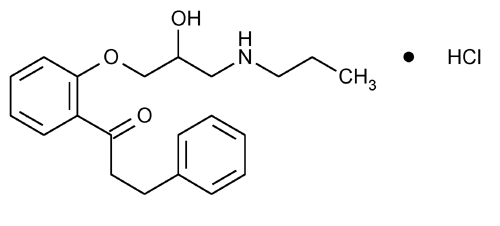
 377.90
1-Propanone, 1-[2-[2-hydroxy-3-(propylamino)propoxy]phenyl]-3-phenyl-, hydrochloride.
2¢-[2-Hydroxy-3-(propylamino)propoxy]-3-phenylpropiophenone hydrochloride
[34183-22-7].» Propafenone Hydrochloride contains not less than 98.0 percent and not more than 102.0 percent of C21H27NO3·HCl, calculated on the dried basis.
Packaging and storage—
Preserve in tight, light-resistant containers, and store at a temperature between 15 and 30.
and 30.
Clarity of solution—
Dissolve 1.0 g in 30 mL of hot water, and observe without delay: the solution initially is clear.
Identification—
B:
Dissolve 0.5 g of propafenone hydrochloride in 50 mL of water with heating. Adjust with 0.1 N sodium hydroxide to a pH of 9.5 to 10.0: a precipitate is formed. Cool the mixture, and filter. Add 1 mL of 6 N nitric acid and 2 to 3 drops of 0.1 N silver nitrate to the filtrate: a precipitate is formed, which dissolves upon the addition of a few drops of ammonium hydroxide.
pH  791
791 :
between 5.0 and 6.2 in a solution (1 in 200).
:
between 5.0 and 6.2 in a solution (1 in 200).
791:
between 5.0 and 6.2 in a solution (1 in 200).
Loss on drying 731—
Dry it at 105 to constant weight; it loses not more than 0.5% of its weight.
731—
Dry it at 105 to constant weight; it loses not more than 0.5% of its weight.
Residue on ignition 281:
not more than 0.1%.
281:
not more than 0.1%.
Heavy metals, Method II 231:
20 ppm.
231:
20 ppm.
Limit of methanol and acetone—
Standard solution—
Prepare a solution, in dimethyl sulfoxide, containing 2.0 µg of methanol and 20.0 µg of acetone.
Test solution—
Dissolve an accurately weighed portion of the material to be tested in dimethyl sulfoxide to obtain a final solution having a known concentration of about 20 mg of the test material per mL.
Chromatographic system (see Chromatography 621)—
The gas chromatograph is equipped with a flame-ionization detector, a 0.53-mm × 30-m fused silica analytical column coated with a 3.0-µm G43 stationary phase, and a 0.53-mm × 5-m silica guard column deactivated with phenylmethyl siloxane. The carrier gas is helium with a linear velocity of about 35 cm per second. The injection port and detector temperatures are maintained at 140 and 260, respectively. The column temperature is programmed according to the following steps. It is maintained at 40 for 20 minutes, then increased rapidly to 240, and maintained at 240 for 20 minutes. Inject the Standard solution, and record the peak responses as directed for Procedure: the relative standard deviation of the individual peak responses from replicate injections is not more than 15%.
621)—
The gas chromatograph is equipped with a flame-ionization detector, a 0.53-mm × 30-m fused silica analytical column coated with a 3.0-µm G43 stationary phase, and a 0.53-mm × 5-m silica guard column deactivated with phenylmethyl siloxane. The carrier gas is helium with a linear velocity of about 35 cm per second. The injection port and detector temperatures are maintained at 140 and 260, respectively. The column temperature is programmed according to the following steps. It is maintained at 40 for 20 minutes, then increased rapidly to 240, and maintained at 240 for 20 minutes. Inject the Standard solution, and record the peak responses as directed for Procedure: the relative standard deviation of the individual peak responses from replicate injections is not more than 15%.
Procedure—
Separately inject equal volumes (about 1 µL) of the Standard solution and the Test solution into the chromatograph, record the chromatograms, and measure the peak responses. Identify, based on retention time, any peaks present in the chromatogram of the Test solution, and calculate the amounts of methanol and acetone present. Not more than 100 ppm of methanol and 1000 ppm of acetone are found.
Chromatographic purity—
Mobile phase—
Prepare a filtered and degassed mixture of 2.5 mM tetrabutylammonium hydrogen sulfate and acetonitrile (16:9). Make adjustments if necessary (see System Suitability under Chromatography 621).
621).
Diluent—
Prepare a mixture of acetonitrile and water (9:1).
Standard solution—
Dissolve an accurately weighed quantity of USP Propafenone Hydrochloride RS in Diluent, and dilute quantitatively, and stepwise if necessary, with Diluent to obtain a solution having a known concentration of about 5 µg per mL.
Test solution—
Transfer about 50 mg of Propafenone Hydrochloride, accurately weighed, to a 50-mL volumetric flask, dissolve in 5 mL of Diluent, dilute with Mobile phase to volume, and mix.
Chromatographic system (see Chromatography 621)—
The liquid chromatograph is equipped with a 222-nm detector and a 3.9-mm × 15-cm column that contains packing L10. The flow rate is about 1.0 mL per minute. Chromatograph the Standard solution, and record the peak responses as directed for Procedure: the column efficiency is not less than 2000 theoretical plates; and the relative standard deviation for replicate injections is not more than 15%.
621)—
The liquid chromatograph is equipped with a 222-nm detector and a 3.9-mm × 15-cm column that contains packing L10. The flow rate is about 1.0 mL per minute. Chromatograph the Standard solution, and record the peak responses as directed for Procedure: the column efficiency is not less than 2000 theoretical plates; and the relative standard deviation for replicate injections is not more than 15%.
Procedure—
Separately inject a volume (about 10 µL) of the Standard solution and the Test solution into the chromatograph, and allow the Test solution to elute for not less than eight times the retention time of propafenone. Record the chromatogram, and measure the peak responses for all the peaks: the sum of the peak responses, other than that of propafenone, in the chromatogram of the Test solution is not more than two times the propafenone response obtained from the Standard solution (1.0%); and no other peak response, other than that of propafenone, in the chromatogram of the Test solution is greater than the propafenone response obtained from the Standard solution (0.5%).
Assay—
Transfer about 250 mg of Propafenone Hydrochloride, accurately weighed, to a 125-mL flask. Dissolve in 30 mL of methanol, add 15 mL of mercuric acetate TS, and titrate with 0.1 N perchloric acid VS, determining the endpoint potentiometrically. Perform a blank determination, and make any necessary correction. Each mL of 0.1 N perchloric acid is equivalent to 37.79 mg of C21H27NO3·HCl.
Auxiliary Information—
Please check for your question in the FAQs before contacting USP.
Chromatographic Column—
| Topic/Question | Contact | Expert Committee |
| Monograph | Sujatha Ramakrishna, Ph.D.
Scientist 1-301-816-8349 |
(MDCV05) Monograph Development-Cardiovascular |
| Reference Standards | Lili Wang, Technical Services Scientist 1-301-816-8129 RSTech@usp.org |
USP32–NF27 Page 3408
Pharmacopeial Forum: Volume No. 29(3) Page 659
Chromatographic columns text is not derived from, and not part of, USP 32 or NF 27.