Polyvinyl Alcohol
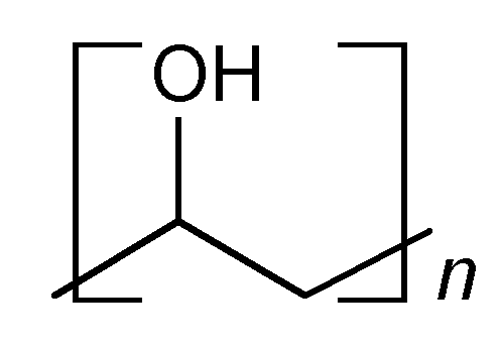
Ethenol, homopolymer.
Vinyl alcohol polymer
 [9002-89-5].
Change to read:
» Polyvinyl Alcohol is a water-soluble synthetic resin, represented by the formula:
(C2H4O)n
in which the average value of n lies between 500 and 5000. It is prepared by 85 percent to 89 percent hydrolysis of polyvinyl acetate. The apparent viscosity,  in mPa·s, at 20
 , of a 4% (w/w) aqueous solutionUSP32 is not less than 85.0 percent and not more than 115.0 percent of that stated on the label.
in mPa·s, at 20, of a 4% (w/w) aqueous solutionUSP32 is not less than 85.0 percent and not more than 115.0 percent of that stated on the label.
Change to read:
Packaging and storage—
Preserve in well-closed containers, and store at room temperature in a dry place.USP32
Add the following:
Labeling—
Label it to indicate the viscosity, giving the viscosity measurement parameters, the concentration of the solution, and the type of equipment used.USP32
Add the following:
USP Reference standards  11
11 —
—
USP Acetone RS.
USP Methyl Acetate RS.
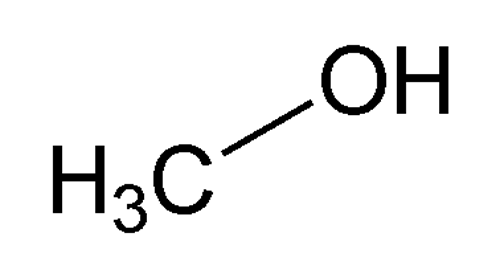
USP Methyl Alcohol RS
 .
. USP Polyvinyl Alcohol RS.
USP32
Add the following:
Identification—
A:
Infrared Absorption 197K.
197K.
B:
It meets the requirements of the test for Viscosity.
C:
Dissolve 0.5 g of Polyvinyl Alcohol in 10 mL of water, with the aid of heat if necessary, and let the solution cool to room temperature. Transfer 5 mL of the solution so obtained to a test tube, add 1 drop of iodine TS, mix, and allow to stand. A dark red to blue color is produced. Add 10 mL of alcohol to the remaining 5 mL of the polyvinyl alcohol solution, and mix. A white, turbid, or flocculent precipitate is formed.USP32
USP32
Change to read:
Viscosity 911—USP32
After determining the Loss on drying, weigh a quantity of undried Polyvinyl Alcohol, equivalent to 6.00 g on the dried basis. Over a period of seconds, transfer the test specimen with continuous slow stirring to about 140 mL of water contained in a suitable tared flask. When the specimen is well-wetted, increase the rate of stirring, avoiding mixing in excess air. Heat the mixture to 90, and maintain the temperature at 90 for about 5 minutes. Discontinue heating, and continue stirring for 1 hour. Add water to make the mixture weigh 150 g. Resume stirring to obtain a homogenous solution. Filter the solution through a tared 100-mesh screen into a 250-mL conical flask, cool the filtrateUSP32 to about 15, and mix. Determine its viscosity at 20 ± 0.1, using an appropriate viscometer: the apparent viscosity is between 85.0% and 115.0% of the value stated on the label.USP32
pH 791:
between 5.0 and 8.0, in a solution (1 in 25).
791:
between 5.0 and 8.0, in a solution (1 in 25).
Loss on drying 731—
Dry it at 110 to constant weight: it loses not more than 5.0% of its weight.
731—
Dry it at 110 to constant weight: it loses not more than 5.0% of its weight.
Add the following:
Acid value—
Add 200 mL of water to a borosilicate round-bottomed flask attached to a reflux condenser. Heat the water on a water bath with constant stirring. Add 10.0 g of Polyvinyl Alcohol to the water, and continue heating for 30 minutes with continuous stirring. Remove the flask from the water bath, and continue stirring until room temperature is reached. Quantitatively transfer this solution to a 250-mL volumetric flask, dilute with water to volume, and mix. Titrate 50 mL of this solution with 0.05 N potassium hydroxide VS by adding 0.5 mL of phenolphthalein TS as an indicator, until the pink color persists for 15 seconds. Calculate the acid value by the formula:
5(56.11)NV/W
in which 5 is the dilution factor; N is the normality of potassium hydroxide; V is the volume, in mL, of 0.05 N potassium hydroxide used; W is the weight, in g, of Polyvinyl Alcohol taken to prepare the polyvinyl alcohol solution. The acid value is not more than 3.0.USP32
Change to read:
Water-insoluble substances—
Wash the tared 100-mesh screen used in the test for Viscosity immediately afterwardUSP32 with two 25-mL portions of water, and dry at 110 for 1 hour: not more than 6.4 mg of water-insoluble substances is found corresponding to not more than 0.1% of water-insoluble substances.USP32
Add the following:
Limit of methanol (methyl alcohol) and methyl acetate—
Standard solution—
In a 100-mL screw-cap bottle, dissolve quantities of USP Methyl Alcohol RS and USP Methyl Acetate RS in water to prepare a 100-mL solution having known concentrations of about 0.24 µL per mL each of USP Methyl Alcohol RS and USP Methyl Acetate RS. Add 30 µL of USP Acetone RS to the screw-cap bottle. Close the bottle tightly with the screw cap, and heat it in a water bath, stirring continuously. Remove the bottle from the water bath, and allow it to cool to room temperature.
Test solution—
Transfer a quantity of Polyvinyl Alcohol, equivalent to 2.0 g on the dried basis, to a 100-mL screw-cap bottle, and add a magnetic stirrer. Add 98 mL of water and 30 µL of USP Acetone RS. Close the bottle tightly with the screw cap, and heat it in a water bath, stirring continuously. Once the solution becomes clear, remove the bottle from the water bath, and allow it to cool to room temperature.
Chromatographic system (see Chromatography 621)—
The gas chromatograph is equipped with a flame-ionization detector and a 3.2-mm × 2-m glass column packed with phase S3. The injection port is maintained at about 160, the detector is maintained at about 160, and the column is maintained at 160. Nitrogen is used as the carrier gas, flowing at a rate of about 30 mL per minute. Chromatograph the Standard solution, and record the peak responses as directed for Procedure: the relative standard deviation for replicate injections is not more than 2.0%.
621)—
The gas chromatograph is equipped with a flame-ionization detector and a 3.2-mm × 2-m glass column packed with phase S3. The injection port is maintained at about 160, the detector is maintained at about 160, and the column is maintained at 160. Nitrogen is used as the carrier gas, flowing at a rate of about 30 mL per minute. Chromatograph the Standard solution, and record the peak responses as directed for Procedure: the relative standard deviation for replicate injections is not more than 2.0%.
Procedure—
Separately inject equal volumes (about 0.4 µL) of the Standard solution and the Test solution into the chromatograph, record the chromatograms, and measure the areas for the major peaks. Calculate the percentages of methanol and methyl acetate in the portion of Polyvinyl Alcohol taken by the formula:
USP32
10G(C/W)(RU / RS)
in which G is the specific gravity of methanol (methyl alcohol) or methyl acetate (0.79 is the specific gravity of methanol, and 0.93 is the specific gravity of methyl acetate); C is the concentration, in µL per mL, of methanol (methyl alcohol) or methyl acetate in the Standard solution; W is the weight, in g, of Polyvinyl Alcohol on the dried basis taken to prepare the Test solution; and RU and RS are the peak response ratios of the methanol or methyl acetate peak relative to the acetone peak obtained from the Test solution and the Standard solution, respectively: not more than 1.0% of methanol (methyl alcohol) is found, and not more than 1.0% of methyl acetate is found.USP32
Degree of hydrolysis—
Procedure—
Transfer about 1 g of Polyvinyl Alcohol, previously dried at 110 to constant weight and accurately weighed, to a wide-mouth, 250-mL conical flask fitted by means of a suitable glass joint to a reflux condenser. Add 35 mL of dilute methanol (3 in 5), and mix gently to assure complete wetting of the solid. Add 3 drops of phenolphthalein TS, and add 0.2 N hydrochloric acid or 0.2 N sodium hydroxide, if necessary, to neutralize. Add 25.0 mL of 0.2 N sodium hydroxide VS, and reflux gently on a hot plate for 1 hour. Wash the condenser with 10 mL of water, collecting the washings in the flask, cool, and titrate with 0.2 N hydrochloric acid VS. Concomitantly perform a blank determination in the same manner, using the same quantity of 0.2 N sodium hydroxide VS.
to constant weight and accurately weighed, to a wide-mouth, 250-mL conical flask fitted by means of a suitable glass joint to a reflux condenser. Add 35 mL of dilute methanol (3 in 5), and mix gently to assure complete wetting of the solid. Add 3 drops of phenolphthalein TS, and add 0.2 N hydrochloric acid or 0.2 N sodium hydroxide, if necessary, to neutralize. Add 25.0 mL of 0.2 N sodium hydroxide VS, and reflux gently on a hot plate for 1 hour. Wash the condenser with 10 mL of water, collecting the washings in the flask, cool, and titrate with 0.2 N hydrochloric acid VS. Concomitantly perform a blank determination in the same manner, using the same quantity of 0.2 N sodium hydroxide VS.
Calculation of saponification value—
Calculate the saponification value by the formula:
[(B  A)N56.11]/W
in which B and A are the volumes, in mL, of 0.2 N hydrochloric acid VS consumed in the titration of the blank and the test preparation, respectively; N is the exact normality of the hydrochloric acid solution; W is the weight, in g, of the portion of Polyvinyl Alcohol taken; and 56.11 is the molecular weight of potassium hydroxide.
A)N56.11]/W
Calculation of degree of hydrolysis—
Calculate the degree of hydrolysis, expressed as percentage of hydrolysis of polyvinyl acetate, by the formula:
100 [7.84S/(100 0.075S)]
in which S is the saponification value of the Polyvinyl Alcohol taken: between 85% and 89% is found.
[7.84S/(100 0.075S)]
Auxiliary Information—
Please check for your question in the FAQs before contacting USP.
Chromatographic Column—
| Topic/Question | Contact | Expert Committee |
| Monograph | Hong Wang, Ph.D.
Scientist 1-301-816-8351 |
(EM205) Excipient Monographs 2 |
| Reference Standards | Lili Wang, Technical Services Scientist 1-301-816-8129 RSTech@usp.org |
USP32–NF27 Page 3329
Pharmacopeial Forum: Volume No. 33(6) Page 1206
Chromatographic columns text is not derived from, and not part of, USP 32 or NF 27.