Phenylpropanolamine Hydrochloride
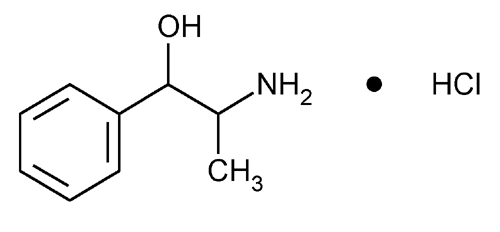
 187.67
Benzenemethanol,
 -(1-aminoethyl)-, hydrochloride, (R*,S*)-, (±).
(±)-Norephedrine hydrochloride
[154-41-6].» Phenylpropanolamine Hydrochloride contains not less than 98.0 percent and not more than 101.0 percent of C9H13NO·HCl, calculated on the dried basis.
Packaging and storage—
Preserve in tight, light-resistant containers.
USP Reference standards  11
11 —
—
USP Cathinone Hydrochloride RS.
USP Dextroamphetamine Sulfate RS.
USP Phenylpropanolamine Hydrochloride RS.
11—
USP Cathinone Hydrochloride RS.
USP Dextroamphetamine Sulfate RS.
USP Phenylpropanolamine Hydrochloride RS.
Identification—
B:
Ultraviolet Absorption 197U—
197U—
Solution:
500 µg per mL.
Medium:
water.
Absorptivities at 256 nm, calculated on the dried basis, do not differ by more than 3.0%.
C:
Dissolve 1 g in 10 mL of water, add 10 mL of saturated sodium carbonate solution, and mix. Separate the precipitate by vacuum filtration, using a medium-porosity, sintered-glass filter, and wash with three 5-mL portions of ice-cold water. Dry the crystals at 80 for 1 hour: the phenylpropanolamine so obtained melts between 101 and 104 (see Melting Range or Temperature 741).
for 1 hour: the phenylpropanolamine so obtained melts between 101 and 104 (see Melting Range or Temperature 741).
pH 791:
between 4.2 and 5.5, in a solution (3 in 100).
791:
between 4.2 and 5.5, in a solution (3 in 100).
Loss on drying 731—
Dry it at 105 for 2 hours: it loses not more than 0.5% of its weight.
731—
Dry it at 105 for 2 hours: it loses not more than 0.5% of its weight.
Residue on ignition 281:
not more than 0.1%.
281:
not more than 0.1%.
Heavy metals, Method I 231—
Dissolve 1 g in 5 mL of water, add 1 mL of 1 N acetic acid, and dilute with water to 25 mL: the limit is 0.002%.
231—
Dissolve 1 g in 5 mL of water, add 1 mL of 1 N acetic acid, and dilute with water to 25 mL: the limit is 0.002%.
Limit of cathinone hydrochloride—
Transfer 2.5 g to a 25-mL volumetric flask, add dilute hydrochloric acid (1 in 120) to volume, and mix. Concomitantly determine the absorbances of this solution and a Standard solution of USP Cathinone Hydrochloride RS in the same medium having a known concentration of 100 µg per mL in 1-cm cells at the wavelength of maximum absorbance at about 285 nm, using dilute hydrochloric acid (1 in 120) as the blank: the absorbance of the test solution is not greater than that of the Standard solution. Not more than 0.10% is found.
Limit of amphetamine hydrochloride—
Mobile phase—
Prepare a filtered and degassed mixture of water, acetonitrile, phosphoric acid, and triethylamine (950:50:8:5). Make adjustments if necessary (see System suitability under Chromatography 621).
621).
System suitability solution—
Dissolve suitable quantities of USP Phenylpropanolamine Hydrochloride RS and USP Dextroamphetamine Sulfate RS in water to obtain a solution containing about 5 µg of each per mL.
Amphetamine stock solution—
Dissolve an accurately weighed quantity of USP Dextroamphetamine Sulfate RS in water, and dilute quantitatively, and stepwise if necessary, with water to obtain a solution having a known concentration of about 2.5 µg per mL.
Phenylpropanolamine stock solution—
Transfer about 2.5 g of Phenylpropanolamine Hydrochloride, accurately weighed, to a 10-mL volumetric flask, dilute with water to volume, and dissolve, using sonication if necessary.
Standard solution—
Transfer 4.0 mL of Phenylpropanolamine stock solution, accurately measured, to a 10-mL volumetric flask, add 4.0 mL of Amphetamine stock solution, dilute with water to volume, and mix to obtain a solution having known concentrations of about 100 mg per mL and 1 µg per mL, respectively.
Test solution—
Transfer about 4.0 mL of Phenylpropanolamine stock solution, accurately measured, to a 10-mL volumetric flask, dilute with water to volume, and mix.
Chromatographic system (see Chromatography 621)—
The liquid chromatograph is equipped with a 206-nm detector and a 4.6-mm × 25-cm column that contains 5-µm, base-deactivated packing L1. The flow rate is about 1 mL per minute. Chromatograph the System suitability solution, and record the peak responses as directed for Procedure: the relative retention times are 1.0 for phenylpropanolamine and 2.1 for amphetamine; the resolution, R, between phenylpropanolamine and amphetamine is not less than 15; and the column efficiency is not less than 10,000 theoretical plates. Chromatograph the Standard solution, and record the peak responses as directed for Procedure: the relative standard deviation of the amphetamine peak for replicate injections is not more than 3.0%.
621)—
The liquid chromatograph is equipped with a 206-nm detector and a 4.6-mm × 25-cm column that contains 5-µm, base-deactivated packing L1. The flow rate is about 1 mL per minute. Chromatograph the System suitability solution, and record the peak responses as directed for Procedure: the relative retention times are 1.0 for phenylpropanolamine and 2.1 for amphetamine; the resolution, R, between phenylpropanolamine and amphetamine is not less than 15; and the column efficiency is not less than 10,000 theoretical plates. Chromatograph the Standard solution, and record the peak responses as directed for Procedure: the relative standard deviation of the amphetamine peak for replicate injections is not more than 3.0%.
Procedure—
Separately inject equal volumes (about 5 µL) of the Standard solution and the Test solution into the chromatograph, record the chromatograms, and measure the responses at the locus of the amphetamine peak. Calculate the percentage of amphetamine hydrochloride in the portion of Phenylpropanolamine Hydrochloride taken by the formula:
0.2(171.67/368.49)(CS / CU)[rU /(rS  rU)]
rU)]
in which 171.67 and 368.49 are the molecular weights of amphetamine hydrochloride and amphetamine sulfate, respectively; CS is the concentration, in µg per mL, of USP Dextroamphetamine Sulfate RS in the Standard solution; CU is the concentration, in mg per mL, of Phenylpropanolamine Hydrochloride in the Test solution; and rU and rS are the peak responses of amphetamine obtained from the Test solution and the Standard solution, respectively: not more than 0.001% is found.
rU)]
Assay—
Dissolve about 500 mg of Phenylpropanolamine Hydrochloride, accurately weighed, in 50 mL of glacial acetic acid. Add 10 mL of mercuric acetate TS and 2 drops of crystal violet TS, and titrate with 0.1 N perchloric acid VS to a green endpoint. Perform a blank determination, and make any necessary correction. Each mL of 0.1 N perchloric acid is equivalent to 18.77 mg of C9H13NO·HCl.
Auxiliary Information—
Please check for your question in the FAQs before contacting USP.
Chromatographic Column—
| Topic/Question | Contact | Expert Committee |
| Monograph | Clydewyn M. Anthony, Ph.D.
Scientist 1-301-816-8139 |
(MDCCA05) Monograph Development-Cough Cold and Analgesics |
| Reference Standards | Lili Wang, Technical Services Scientist 1-301-816-8129 RSTech@usp.org |
USP32–NF27 Page 3287
Pharmacopeial Forum: Volume No. 26(6) Page 1562
Chromatographic columns text is not derived from, and not part of, USP 32 or NF 27.