Penicillamine
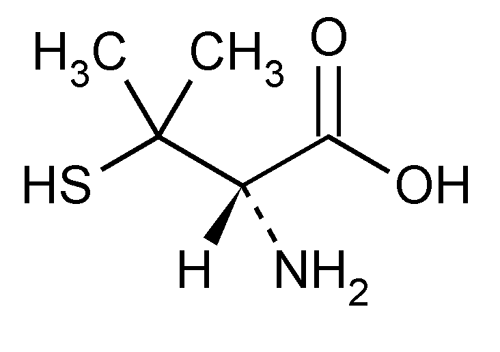
 149.21
d-Valine, 3-mercapto-.
d-3-Mercaptovaline
[52-67-5].» Penicillamine contains not less than 97.0 percent and not more than 102.0 percent of C5H11NO2S, calculated on the dried basis.
Packaging and storage—
Preserve in tight containers.
USP Reference standards  11
11 —
—
USP Penicillamine RS.
USP Penicillin G Potassium RS.
USP Penicillamine Disulfide RS.
11—
USP Penicillamine RS.
USP Penicillin G Potassium RS.
USP Penicillamine Disulfide RS.
Identification—
A:
Infrared Absorption 197M (50 mg in 300 mg).
197M (50 mg in 300 mg).
B:
Dissolve 10 mg in 5 mL of water, and add 1 drop of 5 N sodium hydroxide and 20 mg of ninhydrin: a blue or violet-blue color is produced immediately.
C:
Dissolve 20 mg in 4 mL of water, add 2 mL of phosphotungstic acid solution (1 in 10), and heat nearly to boiling: a deep blue color is produced immediately.
Specific rotation 781S:
between  60.5
60.5 and 64.5.
781S:
between 60.5 and 64.5.
Test solution:
50 mg per mL, in 1.0 N sodium hydroxide.
pH 791:
between 4.5 and 5.5, in a solution (1 in 100).
791:
between 4.5 and 5.5, in a solution (1 in 100).
Loss on drying 731—
Dry about 100 mg, accurately weighed, in a capillary-stoppered bottle in vacuum at a pressure not exceeding 5 mm of mercury at 60 for 3 hours: it loses not more than 0.5% of its weight.
731—
Dry about 100 mg, accurately weighed, in a capillary-stoppered bottle in vacuum at a pressure not exceeding 5 mm of mercury at 60 for 3 hours: it loses not more than 0.5% of its weight.
Residue on ignition 281:
not more than 0.1%, the charred residue being moistened with 2 mL of nitric acid and 5 drops of sulfuric acid.
281:
not more than 0.1%, the charred residue being moistened with 2 mL of nitric acid and 5 drops of sulfuric acid.
Heavy metals, Method II 231:
not more than 0.002%.
231:
not more than 0.002%.
Limit of penicillin activity—
pH 2.5 Buffer—
Dissolve 100 g of monobasic potassium phosphate in water, add 0.2 mL of hydrochloric acid, dilute with water to 1000 mL, and mix. Adjust, if necessary, with phosphoric acid or with 10 N potassium hydroxide to a pH of 2.5.
Standard preparation—
Prepare as directed for Penicillin G in Table 2 under Antibiotics—Microbial Assays 81, except to prepare a final stock solution containing 100 Penicillin G Units per mL and six test dilutions ranging from 0.005 Penicillin G Unit per mL to 0.2 Penicillin G Unit per mL, and to use a median dose of the Standard of 0.050 Penicillin G Unit per mL.
81, except to prepare a final stock solution containing 100 Penicillin G Units per mL and six test dilutions ranging from 0.005 Penicillin G Unit per mL to 0.2 Penicillin G Unit per mL, and to use a median dose of the Standard of 0.050 Penicillin G Unit per mL.
Test preparation—
Dissolve 1.0 g in water to make 18.0 mL, transfer 9.0 mL of this solution to a separator, add 20 mL of amyl acetate and 1 mL of pH 2.5 Buffer, and shake. Allow the layers to separate, and draw off the aqueous layer into a second separator, retaining the amyl acetate extract in the first separator. Check the pH of the aqueous layer, and if it is greater than 3.0 adjust it with hydrochloric acid to a pH of 2.5, and extract with 20 mL of amyl acetate. Discard the aqueous layer, and add the amyl acetate extract to the first separator. Wash the combined amyl acetate extracts with 10 mL of diluted pH 2.5 Buffer (1 in 10), and discard the aqueous layer. Extract the amyl acetate with 10.0 mL of Buffer No. 1 (see Phosphate Buffers and Other Solutions in the section Media and Diluents under Antibiotics—Microbial Assays 81). Use a portion of the buffer extract as Test solution A. To a 5-mL portion of the extract add 0.1 mL of penicillinase solution, and incubate at 36 to 37.5 for 60 minutes (Test solution B).
81). Use a portion of the buffer extract as Test solution A. To a 5-mL portion of the extract add 0.1 mL of penicillinase solution, and incubate at 36 to 37.5 for 60 minutes (Test solution B).
Preparation of inoculum—
Prepare as directed under Antibiotics—Microbial Assays 81, using Micrococcus luteus (ATCC 9341) as the test organism, and an inoculum that gives clear sharp zones of inhibition 17 mm to 21 mm in diameter with the median dose level of the Standard.
81, using Micrococcus luteus (ATCC 9341) as the test organism, and an inoculum that gives clear sharp zones of inhibition 17 mm to 21 mm in diameter with the median dose level of the Standard.
Procedure—
Proceed as directed for the Cylinder-Plate Method under Antibiotics—Microbial Assays 81, using 10 mL of Medium 1 for the base layer and 4 mL of inoculated Medium 4 for the seed layer, and incubating the plates at 29 to 31, except on each test plate to fill 2 cylinders with Test solution A, 2 cylinders with Test solution B, and 2 cylinders with the median dose of the Standard. If Test solution A yields no zone of inhibition, the test is negative for penicillin. If Test solution A yields a zone of inhibition and Test solution B does not, penicillin is present. Determine its level from the standard curve: not more than 0.01 Penicillin G Unit is found in each mL of Test solution A (0.2 Penicillin G Unit per g).
81, using 10 mL of Medium 1 for the base layer and 4 mL of inoculated Medium 4 for the seed layer, and incubating the plates at 29 to 31, except on each test plate to fill 2 cylinders with Test solution A, 2 cylinders with Test solution B, and 2 cylinders with the median dose of the Standard. If Test solution A yields no zone of inhibition, the test is negative for penicillin. If Test solution A yields a zone of inhibition and Test solution B does not, penicillin is present. Determine its level from the standard curve: not more than 0.01 Penicillin G Unit is found in each mL of Test solution A (0.2 Penicillin G Unit per g).
Mercury—
note—Mercuric dithizonate is light-sensitive. Perform this test in subdued light.
Dithizone stock solution—
Dissolve 40 mg of dithizone in 1000 mL of chloroform.
Dithizone titrant—
Dilute 30.0 mL of Dithizone stock solution with chloroform to 100.0 mL. This solution contains approximately 12 mg of dithizone per L.
Standard solution—
Transfer 135.4 mg of mercuric chloride to a 100-mL volumetric flask, add 0.25 N sulfuric acid to volume, and mix. This solution contains the equivalent of 100 mg of Hg in 100 mL.
Diluted standard solution—
Pipet 2 mL of Standard solution into a 100-mL volumetric flask, add 0.25 N sulfuric acid to volume, and mix. Each mL of this solution contains the equivalent of 20 µg of Hg.
Standardization—
Pipet 1 mL of Diluted standard solution into a 250-mL separator, and add 100 mL of 0.25 N sulfuric acid, 90 mL of water, and 10 mL of hydroxylamine hydrochloride solution (1 in 5). Then add 1 mL of edetate disodium solution (1 in 50), 1 mL of glacial acetic acid, and 5 mL of chloroform, shake for 1 minute, allow to separate, and discard the chloroform layer. To the solution add Dithizone titrant, in portions of 0.3 mL to 0.5 mL, from a 10-mL buret. After each addition, shake the mixture 20 times, and allow the chloroform layer to separate and discard it. Continue until an addition of Dithizone titrant remains green after the shaking. Calculate the quantity, in µg, of mercury equivalent to 1 mL of Dithizone titrant by dividing 20 by the number of mL of Dithizone titrant added.
Procedure—
Transfer 500 mg of Penicillamine to a 650-mL Kjeldahl flask containing a few glass beads, incline the flask at an angle of about 45, and add 2.5 mL of nitric acid through a small funnel placed in the mouth of the flask. Allow the mixture to stand at room temperature until nitrous oxide fumes are evolved and vigorous reaction subsides (5 to 30 minutes). Add 2.5 mL of sulfuric acid through the funnel, and heat, gently at first and then to the production of fumes of sulfur trioxide, then cool. Cautiously add 2.5 mL of nitric acid, again heat to the production of sulfur trioxide fumes, and cool. Repeat the treatment with nitric acid and heat, then cool, and cautiously add 50 mL of water, rinsing the funnel and collecting the rinsings in the flask. Remove the funnel, boil the solution down to approximately half its volume (about 25 mL), and cool to room temperature. Transfer to a 250-mL separator with the aid of water, and add water to make about 50 mL. Add 1 mL of edetate disodium solution (1 in 50) and 1 mL of glacial acetic acid, and extract with small portions of chloroform until the last chloroform extract remains colorless. Discard the chloroform extract, and add 50 mL of 0.25 N sulfuric acid, 90 mL of water, and 10 mL of hydroxylamine hydrochloride solution (1 in 5). Add Dithizone titrant, in portions of 0.3 mL to 0.5 mL, from a 10-mL buret. After each addition, shake the mixture 20 times, and allow the chloroform layer to separate and discard it. Continue until an addition of Dithizone titrant remains green after the shaking. Calculate the amount of mercury present: the limit is 10 µg (0.002%).
, and add 2.5 mL of nitric acid through a small funnel placed in the mouth of the flask. Allow the mixture to stand at room temperature until nitrous oxide fumes are evolved and vigorous reaction subsides (5 to 30 minutes). Add 2.5 mL of sulfuric acid through the funnel, and heat, gently at first and then to the production of fumes of sulfur trioxide, then cool. Cautiously add 2.5 mL of nitric acid, again heat to the production of sulfur trioxide fumes, and cool. Repeat the treatment with nitric acid and heat, then cool, and cautiously add 50 mL of water, rinsing the funnel and collecting the rinsings in the flask. Remove the funnel, boil the solution down to approximately half its volume (about 25 mL), and cool to room temperature. Transfer to a 250-mL separator with the aid of water, and add water to make about 50 mL. Add 1 mL of edetate disodium solution (1 in 50) and 1 mL of glacial acetic acid, and extract with small portions of chloroform until the last chloroform extract remains colorless. Discard the chloroform extract, and add 50 mL of 0.25 N sulfuric acid, 90 mL of water, and 10 mL of hydroxylamine hydrochloride solution (1 in 5). Add Dithizone titrant, in portions of 0.3 mL to 0.5 mL, from a 10-mL buret. After each addition, shake the mixture 20 times, and allow the chloroform layer to separate and discard it. Continue until an addition of Dithizone titrant remains green after the shaking. Calculate the amount of mercury present: the limit is 10 µg (0.002%).
Limit of penicillamine disulfide—
Diluent
, Mobile phase, and Resolution solution—Prepare as directed in the Assay.
Standard preparation—
Dissolve an accurately weighed quantity of USP Penicillamine Disulfide RS in Diluent to obtain a solution having a known concentration of about 0.025 mg per mL.
Test preparation—
Use the Assay preparation.
Chromatographic system—
Proceed as directed in the Assay. Chromatograph the Standard preparation, and record the penicillamine disulfide peak responses as directed for Procedure: the relative standard deviation for replicate injections is not more than 2.0%.
Procedure—
[note—Use peak areas where peak responses are indicated.] Separately inject equal volumes (about 20 µL) of the Standard preparation and the Test preparation into the chromatograph, record the chromatograms, and measure the responses for the penicillamine disulfide peaks. Calculate the percentage of penicillamine disulfide (C10H20N2O4S2) in the Penicillamine taken by the formula:
100C(rU / rS)
in which C is the concentration, in mg per mL, of USP Penicillamine Disulfide RS in the Standard preparation, and rU and rS are the penicillamine disulfide peak responses obtained from the Test preparation and the Standard preparation, respectively: not more than 1.0% of penicillamine disulfide is found.
Assay—
Diluent—
Dissolve 1.0 g of edetate disodium in water to make 1000 mL of solution.
Mobile phase—
Dissolve 6.9 g of monobasic sodium phosphate and 0.20 g of sodium 1-hexanesulfonate in water to make 1000 mL of solution. Adjust with phosphoric acid to a pH of 3.0 ± 0.1, and filter through a suitable filter of 1 µm or finer porosity. Make adjustments if necessary (see System Suitability under Chromatography 621).
621).
Resolution solution—
Prepare a solution in Diluent containing about 1 mg of USP Penicillamine RS and 0.1 mg of USP Penicillamine Disulfide RS per mL.
Standard preparation—
Dissolve an accurately weighed quantity of USP Penicillamine RS in Diluent to obtain a solution having a concentration of about 1.25 mg per mL.
Assay preparation—
Transfer about 125 mg of Penicillamine, accurately weighed, to a 100-mL volumetric flask, dissolve in and dilute with Diluent to volume, and mix.
Chromatographic system
(see Chromatography 621)—The liquid chromatograph is equipped with a 210-nm detector and a 3.9-mm × 30-cm column containing packing L1. The flow rate is about 1.6 mL per minute. Chromatograph the Resolution solution, and record the responses as directed for Procedure: the relative retention times are about 0.7 for penicillamine and 1.0 for penicillamine disulfide, and the resolution, R, between the penicillamine peak and the penicillamine disulfide peak is not less than 3.0. Chromatograph the Standard preparation, and record the responses as directed for Procedure: the relative standard deviation for replicate injections is not more than 1.0%.
621)—The liquid chromatograph is equipped with a 210-nm detector and a 3.9-mm × 30-cm column containing packing L1. The flow rate is about 1.6 mL per minute. Chromatograph the Resolution solution, and record the responses as directed for Procedure: the relative retention times are about 0.7 for penicillamine and 1.0 for penicillamine disulfide, and the resolution, R, between the penicillamine peak and the penicillamine disulfide peak is not less than 3.0. Chromatograph the Standard preparation, and record the responses as directed for Procedure: the relative standard deviation for replicate injections is not more than 1.0%.
Procedure—
[note—Use peak areas where peak responses are indicated.] Separately inject equal volumes (about 20 µL) of the Standard preparation and the Assay preparation into the chromatograph, record the chromatograms, and measure the responses for the major peaks. Calculate the quantity, in mg, of penicillamine (C5H11NO2S) in the portion of Penicillamine taken by the formula:
100C(rU / rS)
in which C is the concentration, in mg per mL, of USP Penicillamine RS in the Standard preparation, and rU and rS are the penicillamine peak responses obtained from the Assay preparation and the Standard preparation, respectively.
Auxiliary Information—
Please check for your question in the FAQs before contacting USP.
Chromatographic Column—
| Topic/Question | Contact | Expert Committee |
| Monograph | Ahalya Wise, M.S.
Scientist 1-301-816-8161 |
(MDANT05) Monograph Development-Antibiotics |
| Reference Standards | Lili Wang, Technical Services Scientist 1-301-816-8129 RSTech@usp.org |
USP32–NF27 Page 3220
Chromatographic columns text is not derived from, and not part of, USP 32 or NF 27.