Parachlorophenol
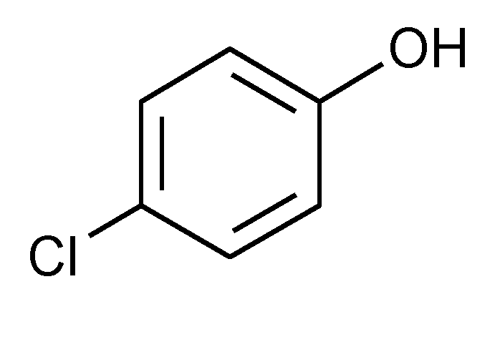
 128.56
Phenol, 4-chloro-.
p-Chlorophenol
[106-48-9].» Parachlorophenol contains not less than 99.0 percent and not more than 100.5 percent of C6H5ClO.
Packaging and storage—
Preserve in tight, light-resistant containers.
Clarity and reaction of solution—
A 1 in 100 solution is clear and is acid to litmus.
Identification—
A:
To a 1 in 100 solution of it add bromine TS dropwise: a white precipitate is formed, and at first it redissolves, but then it becomes permanent as an excess of the reagent is added.
B:
Add 1 drop of ferric chloride TS to 10 mL of a 1 in 100 solution of it: the solution acquires a violet-blue color.
C:
Heat a few crystals, held on a copper wire, in the edge of a nonluminous flame: a green color is imparted to the flame.
D:
To a mixture of 1 g of it and 5 mL of sodium hydroxide solution (1 in 3) add 1.5 g of monochloroacetic acid. Shake, and heat on a steam bath for 1 hour. Cool, dilute with 15 mL of water, and acidify with hydrochloric acid. Extract with 50 mL of ether, wash the ether solution with 10 mL of cold water, then extract the ether solution with 25 mL of sodium carbonate solution (1 in 20). Acidify the solution with hydrochloric acid, collect the resulting precipitate on a filter, and recrystallize it from hot water: the resulting parachlorophenoxyacetic acid melts between 154 and 158.
and 158.
Limit of nonvolatile residue—
Heat about 1 g, accurately weighed, in a tared container on a steam bath until it is volatilized, and dry at 105 for 1 hour: not more than 0.1% of residue remains.
for 1 hour: not more than 0.1% of residue remains.
Chloride—
Acidify 10 mL of a 1 in 100 solution with 2 N nitric acid, and add a few drops of silver nitrate TS: no turbidity or opalescence is produced.
Assay—
Transfer about 1 g of Parachlorophenol, accurately weighed, to a 500-mL volumetric flask, dissolve in and dilute with water to volume, and mix. Transfer a 25.0-mL portion of the solution to an iodine flask, cool in an ice bath to about 4, and add 20.0 mL of 0.1 N bromine VS. Add 5 mL of hydrochloric acid, and immediately insert the stopper. Maintain the flask at a temperature of 4 for 30 minutes, shaking at frequent intervals. Allow it to stand for 15 minutes, remove the stopper just sufficiently to introduce quickly 5 mL of potassium iodide solution (1 in 5), taking care that no bromine vapor escapes, and at once insert the stopper in the flask. Shake thoroughly, remove the stopper, and rinse it and the neck of the flask with a small portion of water, allowing the washings to flow into the flask. Shake the mixture, and titrate the liberated iodine with 0.1 N sodium thiosulfate VS, using 3 mL of starch TS as the indicator. Perform a blank determination (see Residual Titrations under Titrimetry  541
541 ). Each mL of 0.1 N bromine is equivalent to 3.214 mg of C6H5ClO.
, and add 20.0 mL of 0.1 N bromine VS. Add 5 mL of hydrochloric acid, and immediately insert the stopper. Maintain the flask at a temperature of 4 for 30 minutes, shaking at frequent intervals. Allow it to stand for 15 minutes, remove the stopper just sufficiently to introduce quickly 5 mL of potassium iodide solution (1 in 5), taking care that no bromine vapor escapes, and at once insert the stopper in the flask. Shake thoroughly, remove the stopper, and rinse it and the neck of the flask with a small portion of water, allowing the washings to flow into the flask. Shake the mixture, and titrate the liberated iodine with 0.1 N sodium thiosulfate VS, using 3 mL of starch TS as the indicator. Perform a blank determination (see Residual Titrations under Titrimetry 541). Each mL of 0.1 N bromine is equivalent to 3.214 mg of C6H5ClO.
Auxiliary Information—
Please check for your question in the FAQs before contacting USP.
| Topic/Question | Contact | Expert Committee |
| Monograph | Behnam Davani, Ph.D., M.B.A.
Senior Scientist 1-301-816-8394 |
(MDAA05) Monograph Development-Antivirals and Antimicrobials |
USP32–NF27 Page 3207