Lidocaine
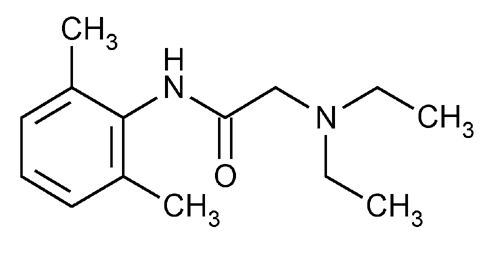
 234.34
Acetamide, 2-(diethylamino)-N-(2,6-dimethylphenyl)-.
2-(Diethylamino)-2¢,6¢-acetoxylidide
[137-58-6].» Lidocaine contains not less than 97.5 percent and not more than 102.5 percent of C14H22N2O.
Packaging and storage—
Preserve in well-closed containers.
Identification—
A:
Infrared Absorption  197K
197K : previously dried in vacuum over silica gel for 24 hours.
197K: previously dried in vacuum over silica gel for 24 hours.
B:
To about 100 mg dissolved in 1 mL of alcohol add 10 drops of cobaltous chloride TS, and shake the solution for about 2 minutes: a bright green color develops, and a fine precipitate is formed.
 and 69
Residue on ignition 281:
not more than 0.1%.
281:
not more than 0.1%.
Chloride 221—
Dissolve 1.0 g in a mixture of 3 mL of 2 N nitric acid and 12 mL of water, and add 1 mL of silver nitrate TS: the turbidity does not exceed that produced by 50 µL of 0.020 N hydrochloric acid (0.0035%).
221—
Dissolve 1.0 g in a mixture of 3 mL of 2 N nitric acid and 12 mL of water, and add 1 mL of silver nitrate TS: the turbidity does not exceed that produced by 50 µL of 0.020 N hydrochloric acid (0.0035%).
Sulfate—
Dissolve about 200 mg in a mixture of 2 mL of 2 N nitric acid and 20 mL of water, and filter if necessary. To one-half of the filtrate add 1 mL of barium chloride TS: no more turbidity is produced than is present in the remaining portion of the filtrate to which nothing has been added.
Heavy metals, Method I 231—
Dissolve 1.0 g in a mixture of 2 mL of 3 N hydrochloric acid and 10 mL of water, evaporate on a steam bath to dryness, and dissolve the residue in 25 mL of water: the limit is 0.002%.
231—
Dissolve 1.0 g in a mixture of 2 mL of 3 N hydrochloric acid and 10 mL of water, evaporate on a steam bath to dryness, and dissolve the residue in 25 mL of water: the limit is 0.002%.
Assay—
Mobile phase, Standard preparation, Resolution preparation, and Chromatographic system—
Prepare as directed in the Assay under Lidocaine Hydrochloride.
Assay preparation—
Dissolve about 85 mg of Lidocaine, accurately weighed, with warming if necessary, in 0.5 mL of 1 N hydrochloric acid in a 50-mL volumetric flask, dilute with Mobile phase to volume, and mix.
Procedure—
Proceed as directed for Procedure in the Assay under Lidocaine Hydrochloride. Calculate the quantity, in mg, of C14H22N2O in the portion of Lidocaine taken by the formula:
50C(rU / rS)
in which C is the concentration, in mg per mL, of USP Lidocaine RS in the Standard preparation; and rU and rS are the lidocaine peak responses obtained from the Assay preparation and the Standard preparation, respectively.
Auxiliary Information—
Please check for your question in the FAQs before contacting USP.
Chromatographic Column—
| Topic/Question | Contact | Expert Committee |
| Monograph | Daniel K. Bempong, Ph.D.
Senior Scientist 1-301-816-8143 |
(MDPS05) Monograph Development-Pulmonary and Steroids |
| Reference Standards | Lili Wang, Technical Services Scientist 1-301-816-8129 RSTech@usp.org |
USP32–NF27 Page 2780
Chromatographic columns text is not derived from, and not part of, USP 32 or NF 27.